👩🏻❤️👩🏿
The Emoji
Couple With Heart: Woman, Woman, Light Skin Tone, Dark Skin Tone
U+1F469 U+1F3FB U+200D U+2764 U+FE0F U+200D U+1F469 U+1F3FF · :couple_with_heart_woman_woman_light_skin_tone_dark_skin_tone:
Trend 68
Meaning layers
- interpretation
- Used to celebrate WLW (women-loving-women) relationships, queer love, and interracial lesbian couples; also used broadly to express sisterhood, female solidarity, or admiration between friends.
- tiktok usage
- Appears in WLW coming-out videos, pride content, interracial couple appreciation posts, and 'soft girl' relationship aesthetics.
- irony level
- 2 / 10
Platform meanings
- meaning
- Symbol of WLW love, queer pride, and interracial female relationships; used in coming-out videos and couple content.
- trend usage
- Paired with trending sounds about love, queerness, and pride; frequently in 'day in our life' couple content and pride month challenges.
- hashtags
- #WLW#LesbianCouple#PrideMonth#InterracialCouple#QueerLove
- virality score
- 72 / 100
Cultural meanings
🇺🇸
Western / Gen-Z
Widely embraced as a pride symbol representing WLW love and interracial queer relationships; used openly and frequently without stigma in progressive spaces.
🇵🇰
Pakistan & India
Rarely used publicly due to social and legal stigma around same-sex relationships; may appear in private queer circles or among progressive urban youth online.
🌍
Middle East
Extremely rare in public use due to legal and cultural prohibitions on same-sex relationships; may exist in anonymous or private queer digital spaces.
🌐
Global Neutral
Universally readable as depicting two women with a romantic connection, though cultural reception varies widely from celebration to rejection.
🇧🇩
Bangladesh
Largely taboo in public digital discourse; same-sex relationships face significant social stigma and legal risk, limiting this emoji's visible use.
🇱🇰
Sri Lanka
Uncommon in mainstream use; queer communities may use it privately, but public expression remains socially restricted.
🇨🇳
China
Used cautiously within LGBTQ+ communities on platforms like Weibo; increased censorship of queer content limits its visibility in mainstream Chinese social media.
🇯🇵
Japan
Present in queer communities and in fandom/shipping culture; Japan's ambiguous legal stance on same-sex relationships means usage is accepted in subcultures but not mainstream.
🇰🇷
South Korea
Used within LGBTQ+ communities and K-pop shipping culture; broader social conservatism means it remains more niche than in Western contexts.
🇹🇼
Taiwan
Used openly and with pride, especially since Taiwan became the first Asian country to legalize same-sex marriage; widely accepted in mainstream digital culture.
🇭🇰
Hong Kong
Present in LGBTQ+ activist and community spaces; growing visibility amid ongoing social and political pressures.
🇵🇭
Philippines
Used within LGBTQ+ communities; the Philippines has relatively visible queer culture but no legal same-sex marriage, so usage is community-focused rather than mainstream.
🇮🇩
Indonesia
Very limited public use due to strong social and religious conservatism; queer communities use it discreetly in private or anonymous digital spaces.
🇹🇭
Thailand
Used in queer-friendly and cosmopolitan digital spaces; Thailand's relatively tolerant social culture allows for more open usage compared to some regional neighbors.
🇻🇳
Vietnam
Emerging use within younger LGBTQ+ communities online; social acceptance is growing but legal recognition of same-sex relationships remains absent.
🇲🇾
Malaysia
Extremely rare in public use due to legal prohibitions on same-sex activity; confined to underground or anonymous queer digital spaces.
🇸🇦
Saudi Arabia
Not used publicly; same-sex relationships are criminalized, making this emoji essentially absent from mainstream Saudi digital culture.
🇦🇪
UAE
Rarely used publicly due to legal restrictions; may appear in expat and international digital communities but is avoided by local users in mainstream contexts.
🇪🇬
Egypt
Very limited use; social and legal conservatism around LGBTQ+ identities means this emoji is effectively invisible in mainstream Egyptian digital spaces.
🇹🇷
Turkey
Used within LGBTQ+ communities, particularly in Istanbul-connected digital spaces; increasing political hostility toward queer visibility has pushed usage toward private channels.
🇮🇷
Iran
Not publicly used; same-sex relationships are criminalized, making this emoji effectively absent from mainstream Iranian digital culture outside anonymous/VPN-enabled spaces.
🇳🇬
Nigeria
Extremely rare due to strong legal and social prohibitions; queer Nigerians may use it in private or diaspora-connected online spaces.
🇿🇦
South Africa
Used openly in queer communities; South Africa's constitution protects LGBTQ+ rights, making this one of the more accepting contexts on the African continent.
🇬🇧
UK & Ireland
Used openly and positively to celebrate WLW relationships, interracial queer couples, and pride; mainstream acceptance is high.
🇫🇷
France
Embraced in queer communities and among progressive youth; French culture's general openness around relationships allows relatively mainstream usage.
🇩🇪
Germany
Used openly in LGBTQ+ communities and among progressive demographics; Germany's legal protections for same-sex couples make this emoji socially normalized.
🇪🇸
Spain & Italy
Widely used in Spain where same-sex marriage is legal and culturally normalized; somewhat more varied in Italy where acceptance is growing but slower.
🇧🇷
Brazil
Actively used in Brazil's vibrant LGBTQ+ community; Brazil has strong queer cultural visibility despite ongoing political tensions around LGBTQ+ rights.
🇲🇽
Mexico
Used in LGBTQ+ communities and urban progressive spaces; growing acceptance especially in major cities, though regional variation in reception remains significant.
🌎
Latin America
Usage varies widely across Latin America; accepted in urban progressive communities and LGBTQ+ spaces but faces cultural conservatism in many regions.
🇦🇺
Australia & NZ
Widely accepted and used openly; both countries have strong legal protections for same-sex relationships and positive mainstream cultural attitudes toward this emoji.
How its meaning shifted
- 2010
This specific emoji did not exist in 2010; same-sex couple emojis were not yet part of Unicode, and skin tone modifiers were still years away.
- 2015
Basic same-sex couple emojis began appearing after Unicode 6.0 era updates; skin tone combinations were not yet available, and queer representation in emoji was limited and groundbreaking.
- 2020
Skin tone combination variants became more widely supported across platforms; heavily used during Pride Month and amid global conversations about diversity and LGBTQ+ representation.
- 2026
Normalized as a standard representation of WLW love across most major platforms; the interracial skin tone combination is actively celebrated as meaningful representation in digital communication.
See it on every platform
Adjacent emojis
- Often confused with
- women holding handspeople huggingtwo women holding hands light dark
- Can replace
- rainbow flagred hearttwo hearts
Share & embed
Frequently asked
01What does the 👩🏻❤️👩🏿 Couple With Heart: Woman, Woman, Light Skin Tone, Dark Skin Tone emoji mean?
A couple composed of two women with a heart between them, where one woman has a light skin tone and the other has a dark skin tone, representing a same-sex romantic relationship with skin tone diversity.
02What does 👩🏻❤️👩🏿 mean on TikTok?
Symbol of WLW love, queer pride, and interracial female relationships; used in coming-out videos and couple content.
03What does 👩🏻❤️👩🏿 mean on WhatsApp?
Sent between female partners or close queer friends to express love and connection; also used by allies to show support.
04What does 👩🏻❤️👩🏿 mean in Gen-Z slang?
Used to celebrate WLW (women-loving-women) relationships, queer love, and interracial lesbian couples; also used broadly to express sisterhood, female solidarity, or admiration between friends.
05Is the 👩🏻❤️👩🏿 emoji safe to use?
A positive representation of a same-sex female couple with diverse skin tones; used for love, pride, and representation.
06What does 👩🏻❤️👩🏿 mean in texting?
Carries deep affirmational weight for LGBTQ+ individuals, functioning as both a visibility signal and an emotional declaration; for interracial couples it also signals pride in diversity.
07What is the shortcode for 👩🏻❤️👩🏿?
The shortcode for Couple With Heart: Woman, Woman, Light Skin Tone, Dark Skin Tone is :couple_with_heart_woman_woman_light_skin_tone_dark_skin_tone:
08What does 👩🏻❤️👩🏿 mean in dating?
Used by women to signal romantic interest in other women, or to express affection toward a female partner; signals queer availability or relationship status.
Safety & usage
- Safe meaning
- A positive representation of a same-sex female couple with diverse skin tones; used for love, pride, and representation.
- Caution
- Rarely weaponized toxically; may be used mockingly by homophobic or racist actors in harassment contexts targeting WLW or interracial couples.
In culturally conservative or legally restrictive environments, using this emoji publicly may expose individuals to social backlash or even legal risk; context-awareness is important.
How it looks across platforms
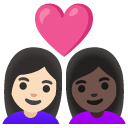
Appearance varies by platform and device. Google Noto, Twemoji, and OpenMoji are open-source.