👂🏼
The Emoji
Ear: Medium-light Skin Tone
U+1F442 U+1F3FC · :ear_mediumlight_skin_tone:
Trend 58
Meaning layers
- interpretation
- Used to signal 'I'm listening,' 'spill the tea,' or 'say that louder.' Often deployed ironically to indicate you heard something you weren't supposed to or to beg for gossip.
- tiktok usage
- Placed in comments like 'ears are open 👂🏼' when someone hints at drama or a secret. Also used in 'storytime' videos to prompt creators to keep talking.
- irony level
- 5 / 10
Platform meanings
- meaning
- Signal of eager listening, especially for drama, gossip, or storytime content.
- trend usage
- Flooded in comment sections of 'part 2?' or 'should I post more?' videos. Creators use it in overlays to set up auditory storytelling hooks.
- hashtags
- #storytime#teaTime#spill#listeningmode#ears
- virality score
- 62 / 100
Cultural meanings
🇺🇸
Western / Gen-Z
Primarily signals 'spill the tea' or 'I'm listening for drama' — heavily ironic and gossipy in tone. Widely recognized and used fluidly across platforms.
🇵🇰
Pakistan & India
Used casually in group chats to indicate attentiveness or curiosity; may appear in Bollywood fan groups when discussing rumors or entertainment gossip.
🌍
Middle East
Used to express active listening in family or community group chats; also used to signal 'I heard something' in casual peer conversations.
🌐
Global Neutral
Universally understood as the listening or hearing symbol — safe to use cross-culturally without misinterpretation.
🇧🇩
Bangladesh
Used in messaging apps to say 'I'm all ears' in both casual friendships and online community discussions about local gossip or news.
🇱🇰
Sri Lanka
Appears in text conversations to signal paying attention, especially in group chats about local drama or school/university life.
🇨🇳
China
Used on WeChat or Weibo to indicate listening or as a humorous 'I overheard something' marker; skin tone may be adjusted to match user preference.
🇯🇵
Japan
Used modestly in digital communication to signal attentive listening; aligns with cultural value of careful listening (傾聴, keicho) without drawing excessive attention.
🇰🇷
South Korea
Popular on KakaoTalk in fan communities to signal 'I'm all ears' for idol gossip or comeback rumors; paired with excited emojis.
🇹🇼
Taiwan
Used in LINE chats to signal curiosity or listening; appears in youth culture conversations about celebrity news and school drama.
🇭🇰
Hong Kong
Used across WhatsApp and Instagram in bilingual contexts — both English and Cantonese slang contexts for 'heard something interesting.'
🇵🇭
Philippines
Frequently used in group chats to say 'anong balita?' (what's the news?) energy — nosy in the best, most affectionate way.
🇮🇩
Indonesia
Common in LINE and WhatsApp chats among youth to show they are following a conversation or waiting eagerly for a story to continue.
🇹🇭
Thailand
Used on LINE and Twitter to react to gossip or dramatic news; often paired with wide-eye emojis in entertainment fan communities.
🇻🇳
Vietnam
Appears in Zalo and Facebook chats to signal active listening or curiosity, especially among youth discussing trending news or drama.
🇲🇾
Malaysia
Used across apps to indicate 'I'm paying attention' — often in a mix of Bahasa Malaysia and English code-switched chats.
🇸🇦
Saudi Arabia
Used in WhatsApp to signal listening in family or friend conversations; may be used when discussing religious lectures or important news.
🇦🇪
UAE
Popular in multicultural digital conversations to indicate attentiveness; used casually across Arabic and English-language chats.
🇪🇬
Egypt
Used in WhatsApp and Facebook groups to say 'I'm listening closely' — often in the context of awaiting news or reacting to drama.
🇹🇷
Turkey
Used on Twitter and WhatsApp to signal 'I'm paying attention' to someone's story; appears in reaction tweets to surprising news.
🇮🇷
Iran
Used on Telegram and Instagram to express curiosity or readiness to listen, especially in youth-driven entertainment or political discussion groups.
🇳🇬
Nigeria
Used in WhatsApp and Twitter conversations to eagerly signal 'drop the gist' (gossip) — very much part of online Naija banter culture.
🇿🇦
South Africa
Used across WhatsApp and Twitter to say 'I'm listening' in both serious and humorous contexts; common in youth pop culture chats.
🇬🇧
UK & Ireland
Deployed with dry humor — 'ears perked 👂🏼' — often sarcastic or nosy in tone; popular in Twitter replies and group chats.
🇫🇷
France
Used in casual digital conversations to signal interest or curiosity; French users may pair it with 'j'écoute' (I'm listening) captions.
🇩🇪
Germany
Used pragmatically to indicate listening or hearing-related content; less ironic than in Anglo cultures, more literal in professional or casual use.
🇪🇸
Spain & Italy
Used expressively in group chats to signal 'tell me everything' energy — Southern European expressiveness translates well with this emoji.
🇧🇷
Brazil
Very popular in WhatsApp and Twitter for gossip-ready culture — 'pode falar' (you can talk) energy; used with warmth and enthusiasm.
🇲🇽
Mexico
Used in casual messaging to say 'aquí estoy' (I'm here, I'm listening) — affectionate and curious usage common among youth.
🌎
Latin America
Broadly used across Latin American countries to signal openness, curiosity, and readiness to hear news or gossip in group chats.
🇦🇺
Australia & NZ
Used with relaxed humor in chats — 'ears open mate 👂🏼' — casual and friendly, often in reaction to surprising or funny news.
How its meaning shifted
- 2010
Rarely used; emoji were primarily accessed via basic keyboard sets and this was an uncommon, literal symbol for ear or hearing-related topics.
- 2015
Started gaining traction as emoji culture expanded; used mostly literally for hearing, audio, or medical topics like ear infections.
- 2020
Became more culturally layered — adopted by Gen Z as a gossip and 'I'm listening' shorthand, with skin tone variants becoming more prominent and celebrated.
- 2026
Fully embedded in internet culture as a gossip/attentiveness signal; skin tone versions embraced for representation; heavily used in ASMR, podcast, and audio creator communities.
See it on every platform
Adjacent emojis
- Often confused with
- call me handear with hearing aidindex pointing up
- Can replace
- eyesface with hand over mouthdetective
Share & embed
Frequently asked
01What does the 👂🏼 Ear: Medium-light Skin Tone emoji mean?
A human ear depicted with a medium-light skin tone modifier, representing the organ of hearing and listening.
02What does 👂🏼 mean on TikTok?
Signal of eager listening, especially for drama, gossip, or storytime content.
03What does 👂🏼 mean on WhatsApp?
Casual shorthand for 'I'm listening' or 'go on, tell me more' in group chats or personal conversations.
04What does 👂🏼 mean in Gen-Z slang?
Used to signal 'I'm listening,' 'spill the tea,' or 'say that louder.' Often deployed ironically to indicate you heard something you weren't supposed to or to beg for gossip.
05Is the 👂🏼 emoji safe to use?
Active listening, curiosity, attentiveness, audio and hearing contexts, gossip readiness in a playful sense.
06What does 👂🏼 mean in texting?
The ear symbol psychologically signals active listening and validation — a core human need. Using it can communicate emotional availability or voyeuristic curiosity, depending on context.
07What is the shortcode for 👂🏼?
The shortcode for Ear: Medium-light Skin Tone is :ear_mediumlight_skin_tone:
08What does 👂🏼 mean in dating?
Sent to say 'I'm hanging on your every word' or 'you have my full attention,' which can come across as flattering and attentive in early-stage flirting.
Safety & usage
- Safe meaning
- Active listening, curiosity, attentiveness, audio and hearing contexts, gossip readiness in a playful sense.
- Caution
- Can be used to imply surveillance or eavesdropping in harassment contexts — 'we're watching and listening to you' as an implied threat.
Generally very safe. Rare misuse in stalking or threatening contexts where combined with other intimidating emojis it implies surveillance. Medium-light skin tone does not carry additional cultural baggage beyond standard representation discourse.
How it looks across platforms
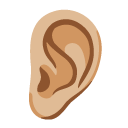


Appearance varies by platform and device. Google Noto, Twemoji, and OpenMoji are open-source.