👂🏽
The Emoji
Ear: Medium Skin Tone
U+1F442 U+1F3FD · :ear_medium_skin_tone:
Trend 45
Meaning layers
- interpretation
- Used to signal 'I'm listening,' call out tea/gossip, or prompt someone to spill information. Also used ironically to mock someone being nosy or to indicate eavesdropping.
- tiktok usage
- Placed in comment sections when someone shares drama or a hot take, meaning 'say more' or 'I need to hear this.' Also used in 'did you hear that?' reaction videos.
- irony level
- 4 / 10
Platform meanings
- meaning
- Signals active listening, inviting someone to share more gossip, tea, or a story. Also used in duets/reactions to indicate shock at what was said.
- trend usage
- Appears in comment sections under drama or controversial videos. Used in 'storytime' videos to prompt viewers to keep watching.
- hashtags
- #ImAllEars#SpillTheTea#Listening#EarEmoji#TellMeMore
- virality score
- 52 / 100
Cultural meanings
🇺🇸
Western / Gen-Z
Primarily used to signal 'spill the tea' or 'I'm listening to drama.' Also used authentically to show empathy in online conversations.
🇵🇰
Pakistan & India
Used in casual chat to mean 'I heard you' or 'tell me more.' Also appears in posts about music appreciation or listening to elders — a culturally significant act.
🌍
Middle East
Conveys attentiveness and respect for the speaker; used in messaging apps to show you are giving someone your full attention, which carries cultural weight.
🌐
Global Neutral
Universally understood as representing hearing and listening. Used cross-culturally to indicate attention, music, or auditory experiences.
🇧🇩
Bangladesh
Used in social media and chat contexts to signal active listening or interest in a story being shared by a friend.
🇱🇰
Sri Lanka
Commonly used in WhatsApp conversations to indicate 'I'm listening' or to reference music and entertainment.
🇨🇳
China
Used on platforms like WeChat and Weibo to mean active listening; also appears in education-related content about paying attention.
🇯🇵
Japan
Associated with attentiveness and polite listening, which are culturally valued. Used in contexts of music appreciation and emotional support.
🇰🇷
South Korea
Frequently used in K-pop fan communities to signal listening to new music drops. Also used on KakaoTalk to indicate attentive listening in conversations.
🇹🇼
Taiwan
Used in digital communication to indicate 'I heard this' or to show interest in audio content like music or podcasts.
🇭🇰
Hong Kong
Appears in social media comments to show interest in gossip or news, with a similar 'tell me more' connotation as in Western Gen Z usage.
🇵🇭
Philippines
Used in chat and social media to mean 'I'm listening' or to hype up someone sharing a story; also common in music fan communities.
🇮🇩
Indonesia
Commonly used on Twitter/X and Instagram to signal attention to social issues or to indicate music listening on LINE and WhatsApp.
🇹🇭
Thailand
Used to express listening and attentiveness; appears frequently alongside music and entertainment content on Thai social media platforms.
🇻🇳
Vietnam
Used on Zalo and Facebook to indicate active listening or to encourage friends to share more; also tied to music culture.
🇲🇾
Malaysia
Appears in casual messaging to mean 'I'm all ears,' often paired with music or gossip-related content across platforms.
🇸🇦
Saudi Arabia
Used to indicate respectful listening; appears in contexts of sharing religious lectures, podcasts, or important community announcements.
🇦🇪
UAE
Used in multicultural digital spaces to signal attentiveness; popular among younger users in gossip or lifestyle content contexts.
🇪🇬
Egypt
Commonly used in Arabic messaging to mean 'I'm listening' or as a reaction to surprising or interesting information being shared.
🇹🇷
Turkey
Used on Twitter and WhatsApp to signal active engagement with a conversation or to react to leaked news or gossip.
🇮🇷
Iran
Used on Telegram and Instagram to indicate interest in hearing more from someone, especially in music and podcast sharing contexts.
🇳🇬
Nigeria
Used widely on Twitter/X and WhatsApp to hype up gossip or news. Carries a strong 'tell me everything' energy in Nigerian internet culture.
🇿🇦
South Africa
Used across platforms to signal listening and engagement, often in social justice discussions or music appreciation posts.
🇬🇧
UK & Ireland
Used with dry humor or sarcasm, often in response to someone saying something outrageous — 'did I just hear that right 👂🏽'
🇫🇷
France
Used in a matter-of-fact way to signal attention or listening; also appears in music and podcast culture on French social media.
🇩🇪
Germany
Typically used straightforwardly to represent listening, hearing, or attentiveness. Less ironic than in Anglo-American internet culture.
🇪🇸
Spain & Italy
Used expressively to mean 'I'm all ears' in heated or passionate conversations; also tied to music and entertainment discussions.
🇧🇷
Brazil
Very popular in gossip and fofoca (gossip) culture on social media — used enthusiastically to say 'spill everything right now!'
🇲🇽
Mexico
Used in WhatsApp and Twitter to signal listening and curiosity; often paired with dramatic context in pop culture and telenovela discussions.
🌎
Latin America
Broadly used across Latin American platforms to signal attentiveness to drama, music, or important announcements in online communities.
🇦🇺
Australia & NZ
Used casually and sometimes sarcastically — 'sorry, my ears must be broken 👂🏽' — in response to surprising or unbelievable statements.
How its meaning shifted
- 2010
The base ear emoji did not yet widely exist; skin tone modifiers were not introduced until 2015, so usage was nonexistent at this time.
- 2015
Skin tone variants were introduced with Unicode 8.0. Early adopters used the medium skin tone ear primarily for literal representation — hearing, listening, or ear health discussions.
- 2020
Became more commonly used in social media to signal gossip culture and active listening, especially as audio content like podcasts and TikTok exploded in popularity.
- 2026
Widely understood as a multi-layered emoji — from empathetic listening to gossip culture, to amplifying voices in social movements. Skin tone diversity in emoji usage is now largely normalized and intentional.
See it on every platform
Adjacent emojis
- Often confused with
- nose medium skin tonehand medium skin toneeye
- Can replace
- eyesface with hand over mouthdetective
Share & embed
Frequently asked
01What does the 👂🏽 Ear: Medium Skin Tone emoji mean?
A human ear depicted with a medium skin tone modifier, representing the organ of hearing and listening.
02What does 👂🏽 mean on TikTok?
Signals active listening, inviting someone to share more gossip, tea, or a story. Also used in duets/reactions to indicate shock at what was said.
03What does 👂🏽 mean on WhatsApp?
Sent to indicate 'I'm listening, go on' during a conversation, especially when a friend is venting or sharing news.
04What does 👂🏽 mean in Gen-Z slang?
Used to signal 'I'm listening,' call out tea/gossip, or prompt someone to spill information. Also used ironically to mock someone being nosy or to indicate eavesdropping.
05Is the 👂🏽 emoji safe to use?
Represents listening, hearing, attentiveness, music appreciation, empathy, and communication.
06What does 👂🏽 mean in texting?
The ear emoji signals active listening and emotional availability. Psychologically, it can represent a desire to be heard or to show someone they are being listened to, which is a fundamental human need tied to validation and connection.
07What is the shortcode for 👂🏽?
The shortcode for Ear: Medium Skin Tone is :ear_medium_skin_tone:
08What does 👂🏽 mean in dating?
Used to say 'I'm all ears for you' — a soft, warm signal of interest and attentiveness toward a crush. Can be paired with 👀 for a more flirtatious 'I see and hear everything you do' vibe.
Safety & usage
- Safe meaning
- Represents listening, hearing, attentiveness, music appreciation, empathy, and communication.
- Caution
- Rarely used toxically, but can be deployed sarcastically to mock someone for overhearing or eavesdropping, or to dismiss someone's point ('oh wow, I definitely heard that 👂🏽').
Generally a safe emoji with very low risk of misuse. The skin tone modifier makes it a representation of diversity and inclusion, which is broadly positive. No significant toxic or NSFW associations documented.
How it looks across platforms
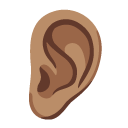


Appearance varies by platform and device. Google Noto, Twemoji, and OpenMoji are open-source.