🦻🏾
The Emoji
Ear With Hearing Aid: Medium-dark Skin Tone
U+1F9BB U+1F3FE · :ear_with_hearing_aid_mediumdark_skin_tone:
Trend 38
Meaning layers
- interpretation
- Used to signal 'I'm listening closely' or 'say that again louder,' often with a cheeky tone. Also reclaimed proudly by Deaf and HoH Gen Z users as identity expression.
- tiktok usage
- Appears in disability awareness content, Deaf culture TikToks, and occasionally used humorously when someone mishears something or needs info repeated.
- irony level
- 3 / 10
Platform meanings
- meaning
- Represents Deaf/HoH identity, accessibility advocacy, or humorous 'I can't hear you' moments. Also used in ASL and Deaf culture educational content.
- trend usage
- Common in #DeafTikTok and #HardOfHearing trends; used by creators sharing hearing aid experiences, audiologist visits, or sound-related life hacks.
- hashtags
- #DeafTikTok#HardOfHearing#HearingAid#DisabilityAwareness#DeafCommunity
- virality score
- 42 / 100
Cultural meanings
🇺🇸
Western / Gen-Z
Widely embraced as a disability-pride and identity symbol; Gen Z in the West uses it to destigmatize hearing aids and celebrate Deaf culture authentically.
🇵🇰
Pakistan & India
Primarily used in literal contexts related to hearing health; growing usage among urban disability advocates and accessibility NGOs promoting awareness.
🌍
Middle East
Used in health and awareness contexts; disability advocacy organizations in the region use it on social media to promote hearing health resources.
🌐
Global Neutral
Universally recognized as representing hearing assistance and the HoH community; the skin tone adds a layer of personal racial representation.
🇧🇩
Bangladesh
Mostly literal usage related to hearing health campaigns by NGOs; digital disability advocacy communities are beginning to adopt it more widely.
🇱🇰
Sri Lanka
Used in health-awareness social media contexts, particularly by organizations working with hearing-impaired communities in urban centers.
🇨🇳
China
Used primarily in medical and health information contexts; disability advocacy on Chinese social media platforms incorporates it in accessibility discussions.
🇯🇵
Japan
Appears in disability-awareness campaigns and content from Japan's hard-of-hearing community; treated with seriousness and respect in digital spaces.
🇰🇷
South Korea
Used by Korean Deaf content creators on platforms like Naver and Instagram; gaining visibility through K-content that includes hearing-impaired characters.
🇹🇼
Taiwan
Active in disability-rights digital communities; used alongside Taiwanese Sign Language (TSL) educational content and hearing health awareness posts.
🇭🇰
Hong Kong
Used in both English and Cantonese-language disability advocacy content; Hong Kong's accessibility movement incorporates it in awareness campaigns.
🇵🇭
Philippines
Used in disability-awareness posts by Filipino NGOs and HoH communities; also appears in content normalizing hearing aid use among Filipino youth.
🇮🇩
Indonesia
Featured in disability inclusion posts and health awareness content; Indonesian Deaf organizations use it to signal community belonging online.
🇹🇭
Thailand
Appears in Thai disability advocacy content and hearing health campaigns; Thai Deaf community social media accounts use it as an identity marker.
🇻🇳
Vietnam
Used in health-education content and by Vietnamese disability advocates; growing presence in content about hearing aid accessibility and affordability.
🇲🇾
Malaysia
Used in Malay and English-language disability content; Malaysian Deaf community members use it as an identity symbol on social platforms.
🇸🇦
Saudi Arabia
Primarily appears in health and awareness contexts; Saudi disability advocacy organizations use it during official awareness campaigns.
🇦🇪
UAE
Used in the UAE's multilingual digital space for disability inclusion posts; prominent during accessibility-themed campaigns by government and NGOs.
🇪🇬
Egypt
Appears in Egyptian disability-awareness content, particularly from organizations supporting HoH children and adults; used respectfully in online communities.
🇹🇷
Turkey
Used in Turkish disability advocacy social media; the HoH community in Turkey uses it to represent identity and call for better accessibility in public life.
🇮🇷
Iran
Used in Persian-language health content and by Iranian disability advocates; carries meaning of resilience and community among HoH Iranians online.
🇳🇬
Nigeria
Embraced by Nigerian disability advocates and Deaf community organizations; used to push for better hearing healthcare access and social inclusion.
🇿🇦
South Africa
Used by South African Deaf community creators and disability rights organizations; often paired with SASL (South African Sign Language) educational content.
🇬🇧
UK & Ireland
Widely used in Deaf-awareness content; embraced by the National Deaf Children's Society and similar UK charities to represent hearing aid users positively.
🇫🇷
France
Used by the French Deaf community (Sourd) and hearing health advocates; appears during Semaine Européenne pour l'Emploi des Personnes Handicapées.
🇩🇪
Germany
Used in German disability inclusion content and by Schwerhörigen (hard-of-hearing) advocacy groups; treated professionally and with strong community respect.
🇪🇸
Spain & Italy
Featured in Spanish and Italian disability awareness campaigns; used by HoH communities to normalize hearing aids and celebrate Deaf culture.
🇧🇷
Brazil
Embraced by Brazilian Deaf community (comunidade surda) creators; used alongside LIBRAS (Brazilian Sign Language) content and disability-pride posts.
🇲🇽
Mexico
Used in Mexican disability advocacy content and hearing health awareness campaigns; growing presence among HoH Mexican youth on TikTok and Instagram.
🌎
Latin America
Broadly used across Latin America in disability inclusion posts; regional Deaf organizations use it to signal community identity and advocate for accessibility.
🇦🇺
Australia & NZ
Widely positive reception; used by Australian Hearing and New Zealand disability organizations, and by HoH creators building community on social media.
How its meaning shifted
- 2010
This emoji did not yet exist in 2010; hearing-related concepts were represented with generic ear or medical emojis, and disability representation was minimal in emoji sets.
- 2015
Still pre-release; disability advocates were beginning to push Unicode Consortium for more inclusive and disability-representative emoji options.
- 2020
Newly released (Unicode 12.0, 2019); initial adoption was primarily by Deaf/HoH communities and disability advocates, with skin tone variants adding representation depth.
- 2026
Established as a key disability-pride symbol; widely used in accessibility advocacy, Deaf culture content, and normalized in mainstream media discussions about inclusion.
See it on every platform
Adjacent emojis
- Opposite
- muted speakerno entryeyes closed
- Often confused with
- earcall me handpinching hand
- Can replace
- eardeaf personraised hand
Share & embed
Frequently asked
01What does the 🦻🏾 Ear With Hearing Aid: Medium-dark Skin Tone emoji mean?
An ear with a hearing aid device, shown in medium-dark skin tone. Represents hearing loss, auditory assistance devices, and the Deaf/hard-of-hearing community.
02What does 🦻🏾 mean on TikTok?
Represents Deaf/HoH identity, accessibility advocacy, or humorous 'I can't hear you' moments. Also used in ASL and Deaf culture educational content.
03What does 🦻🏾 mean on WhatsApp?
Sent when someone didn't understand a voice note or message, or to indicate the sender uses a hearing aid. Also used to say 'I'm all ears.'
04What does 🦻🏾 mean in Gen-Z slang?
Used to signal 'I'm listening closely' or 'say that again louder,' often with a cheeky tone. Also reclaimed proudly by Deaf and HoH Gen Z users as identity expression.
05Is the 🦻🏾 emoji safe to use?
Represents hearing aids, the Deaf/HoH community, disability pride, and accessibility advocacy in a fully positive and identity-affirming way.
06What does 🦻🏾 mean in texting?
Carries strong identity-affirmation weight for those in the Deaf/HoH community. For others, it signals empathy and allyship. The skin tone modifier adds a layer of personal representation and intersectional pride.
07What is the shortcode for 🦻🏾?
The shortcode for Ear With Hearing Aid: Medium-dark Skin Tone is :ear_with_hearing_aid_mediumdark_skin_tone:
08What does 🦻🏾 mean in dating?
Rarely used flirtatiously; occasionally placed humorously after 'I heard you like me' or playful mishearing scenarios.
Safety & usage
- Safe meaning
- Represents hearing aids, the Deaf/HoH community, disability pride, and accessibility advocacy in a fully positive and identity-affirming way.
- Caution
- Could be used mockingly to imply someone is deaf to reason or willfully ignorant, though this is rare and context-dependent.
Generally very safe; the medium-dark skin tone adds representation importance — avoid using to mock or stereotype disability in any context.
How it looks across platforms
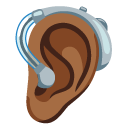


Appearance varies by platform and device. Google Noto, Twemoji, and OpenMoji are open-source.