🧏
The Emoji
Deaf Person
U+1F9CF · :deaf_person:
Trend 58
Meaning layers
- interpretation
- Used to signal 'not listening,' selective hearing, ignoring someone, or tuning out unwanted noise/drama. Also used genuinely by Deaf community members as identity expression.
- tiktok usage
- Appears in videos about ignoring toxic people, blocking out negativity, or humorously pretending not to hear something inconvenient. Also used in Deaf TikTok (#DeafTikTok) for genuine community content.
- irony level
- 6 / 10
Platform meanings
- meaning
- Represents ignoring drama, tuning out negativity, or genuine Deaf identity and community content.
- trend usage
- Heavily used in #DeafTikTok for authentic Deaf/HoH creator content. Also used in trending 'not listening' humor skits.
- hashtags
- #DeafTikTok#DeafCommunity#NotListening#IgnoreThemAll#SignLanguage
- virality score
- 62 / 100
Cultural meanings
🇺🇸
Western / Gen-Z
Widely used as a 'not listening' gesture to dismiss drama or signal boundaries; also embraced as a proud identity marker by the thriving Western Deaf/HoH community online.
🇵🇰
Pakistan & India
Primarily understood literally as representing a deaf person; used in disability awareness posts on social media and occasionally in humor to mean 'I'm not listening to you.'
🌍
Middle East
Used mainly in disability awareness and accessibility advocacy contexts; less common in ironic or meme usage, though urban youth may adopt the 'ignoring' interpretation from Western social media.
🌐
Global Neutral
Universally recognized as a symbol of deafness or hard-of-hearing identity; broadly interpreted as 'not listening' in casual digital communication across cultures.
🇧🇩
Bangladesh
Primarily understood as representing a deaf person in literal or disability-related contexts; not widely used in ironic or humorous digital communication yet.
🇱🇰
Sri Lanka
Used mainly in educational and disability advocacy content; emerging use among younger social media users to signal ignoring or tuning out drama.
🇨🇳
China
Used in disability awareness contexts and occasionally in youth meme culture to indicate ignoring someone; the Deaf community in China uses it for identity representation online.
🇯🇵
Japan
Appears in disability inclusion discourse and sign language promotion content; younger users may use it humorously to indicate deliberately not hearing something unpleasant.
🇰🇷
South Korea
Used in K-community discussions about accessibility and in meme formats among Gen Z to signal selective hearing or ignoring criticism and hate comments.
🇹🇼
Taiwan
Used in inclusive design and disability rights discussions; also adopted by younger users in meme contexts to imply not hearing someone's bad take.
🇭🇰
Hong Kong
Appears in disability advocacy content and among young social media users as an 'unbothered' emoji, reflecting global Gen Z meme trends.
🇵🇭
Philippines
Primarily used in disability representation and advocacy posts; younger Filipino users on TikTok and Twitter adopt the global meme usage of ignoring/not listening.
🇮🇩
Indonesia
Seen in Deaf community groups and disability awareness content; increasingly used by youth in casual social media to mean 'I didn't hear that' humorously.
🇹🇭
Thailand
Used in disability inclusion campaigns and sign language promotion; younger Thai netizens use it humorously in response to unwanted opinions or gossip.
🇻🇳
Vietnam
Mainly appears in disability awareness and educational content about sign language; limited but growing meme adoption among younger internet users.
🇲🇾
Malaysia
Used in Deaf community and disability rights spaces; bilingual (English/Malay) social media users have adopted the ironic 'not listening' usage from English meme culture.
🇸🇦
Saudi Arabia
Used in disability awareness content aligned with Vision 2030 inclusivity goals; urban youth also use it casually online to signal ignoring negativity.
🇦🇪
UAE
Appears in diversity and inclusion campaigns by brands and government entities; cosmopolitan youth culture in Dubai and Abu Dhabi also adopt the ironic 'tuning out' usage.
🇪🇬
Egypt
Primarily used in disability advocacy posts; younger Egyptian social media users on TikTok and Twitter occasionally use it in the 'not listening' meme context.
🇹🇷
Turkey
Used in Deaf community digital spaces and disability rights discourse; Turkish Gen Z users on social media increasingly mirror Western ironic uses of this emoji.
🇮🇷
Iran
Used mainly in disability representation and awareness contexts on platforms like Instagram; limited but emerging use among younger users to signal ignoring something.
🇳🇬
Nigeria
Used in disability inclusion discussions; Nigerian Twitter (X) users have adopted the dismissive meme usage — dropping 🧏 to shut down a bad argument — with enthusiasm.
🇿🇦
South Africa
Appears in disability rights and inclusivity campaigns; among South African youth on TikTok and Twitter, the 'not listening' ironic usage is gaining popularity.
🇬🇧
UK & Ireland
Widely used both as a genuine Deaf identity marker and in Gen Z humor online; the sarcastic 'can't hear the negativity' usage is common in British and Irish social media slang.
🇫🇷
France
Used in disability inclusion and sign language (LSF) promotion contexts; French internet users also adopt it humorously to dismiss opinions they find absurd.
🇩🇪
Germany
Appears in accessibility advocacy and DGS (German Sign Language) promotion; German online culture increasingly uses it as a polite but firm dismissal emoji.
🇪🇸
Spain & Italy
Used in Deaf community advocacy and in casual social media humor; Spanish and Italian youth incorporate it into meme formats to signal not wanting to engage with drama.
🇧🇷
Brazil
Brazilian social media users widely use it both in disability representation posts and as a popular dismissal meme — 'sou 🧏' (I'm deaf) as a humorous shutdown.
🇲🇽
Mexico
Used in disability advocacy content and in Mexican social media humor to mean 'no escuché nada' (I didn't hear anything) as a playful or sarcastic deflection.
🌎
Latin America
Across Latin America, the emoji is used in disability inclusion discussions and increasingly in viral meme formats to signal deliberate selective hearing among younger users.
🇦🇺
Australia & NZ
Used genuinely in Auslan (Australian Sign Language) community advocacy and by Deaf creators; also adopted in casual Australian Gen Z humor to mean 'not hearing this drama.'
How its meaning shifted
- 2010
This emoji did not exist yet; disability representation in digital communication was extremely limited, with no standardized way to express Deaf identity via emoji.
- 2015
Still pre-release; Deaf communities relied on text-based expressions, hashtags like #DeafCommunity, and ASL video content to represent identity online.
- 2020
Newly introduced (Unicode 12.0, 2019), the emoji was adopted rapidly by the Deaf community and disability advocates; hearing users began using it as a 'not listening' gesture in early meme formats.
- 2026
Firmly established in dual usage — as a proud Deaf identity symbol in authentic community spaces, and as a mainstream Gen Z meme emoji meaning selective hearing, ignoring drama, or tuning out negativity.
See it on every platform
Adjacent emojis
- Often confused with
- person shruggingperson gesturing okear with hearing aid
Share & embed
Frequently asked
01What does the 🧏 Deaf Person emoji mean?
A person making the sign for 'deaf' in American Sign Language (ASL), typically depicted touching the ear and then the mouth or chin to indicate deafness.
02What does 🧏 mean on TikTok?
Represents ignoring drama, tuning out negativity, or genuine Deaf identity and community content.
03What does 🧏 mean on WhatsApp?
Used casually to mean 'I'm not listening to this' or 'I tuned out.' Among Deaf users, signals Deaf identity or ASL conversation.
04What does 🧏 mean in Gen-Z slang?
Used to signal 'not listening,' selective hearing, ignoring someone, or tuning out unwanted noise/drama. Also used genuinely by Deaf community members as identity expression.
05Is the 🧏 emoji safe to use?
Represents Deaf identity, sign language, disability inclusion, and community pride. Also used humorously to signal ignoring something.
06What does 🧏 mean in texting?
For Deaf individuals, this emoji carries strong identity and pride. For hearing users, it is often deployed as a coping mechanism — symbolically 'tuning out' anxiety, criticism, or stress — reflecting modern boundaries-setting behavior.
07What is the shortcode for 🧏?
The shortcode for Deaf Person is :deaf_person:
08What does 🧏 mean in dating?
Rarely used flirtatiously; could be used playfully to mean 'I can't hear your excuses' after being ghosted or ignored.
Safety & usage
- Safe meaning
- Represents Deaf identity, sign language, disability inclusion, and community pride. Also used humorously to signal ignoring something.
- Caution
- Can be used mockingly toward Deaf individuals or as a passive-aggressive tool to completely dismiss someone in an online argument.
While generally safe, using this emoji to mock or belittle Deaf people, or deploying it to dismiss accessibility concerns, is considered ableist and disrespectful. Context matters greatly.
How it looks across platforms
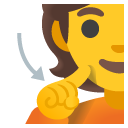


Appearance varies by platform and device. Google Noto, Twemoji, and OpenMoji are open-source.