🦻🏼
The Emoji
Ear With Hearing Aid: Medium-light Skin Tone
U+1F9BB U+1F3FC · :ear_with_hearing_aid_mediumlight_skin_tone:
Trend 35
Meaning layers
- interpretation
- Used to signal 'I can't hear you' or 'say that again' but also adopted ironically to mean 'I'm choosing not to listen' or 'not my problem.' Sometimes used in disability pride contexts.
- tiktok usage
- Appears in deaf/HoH creator content, disability awareness videos, and ironically in 'ignoring bad vibes' content. Also used humorously when someone mishears something funny.
- irony level
- 4 / 10
Platform meanings
- meaning
- Used by deaf/HoH creators to identify content, in ASL tutorials, and ironically for 'I choose not to hear negativity' narratives.
- trend usage
- Appears in disability pride trends, 'things deaf people relate to' videos, and as a reaction to mishearing compilations.
- hashtags
- #DeafTikTok#HearingAid#HardOfHearing#DisabilityPride#DeafCommunity
- virality score
- 42 / 100
Cultural meanings
🇺🇸
Western / Gen-Z
Widely recognized as a disability pride symbol; used by deaf/HoH Gen Z creators to reclaim identity and normalize hearing aids with casual, confident energy.
🇵🇰
Pakistan & India
Primarily taken literally to reference hearing impairment or hearing aids; growing awareness in urban communities, though disability stigma may limit casual ironic use.
🌍
Middle East
Used mainly in medical or awareness contexts; hearing impairment carries some stigma in traditional settings, so the emoji is more clinical than expressive.
🌐
Global Neutral
Universally understood as referencing hearing loss or hearing aids; a safe, informative symbol across most cultural contexts.
🇧🇩
Bangladesh
Recognized in medical contexts; limited cultural use in casual communication, often appearing in health awareness content.
🇱🇰
Sri Lanka
Understood as a disability or hearing health symbol; not commonly used in everyday casual chat but appears in health and advocacy content.
🇨🇳
China
Associated with hearing impairment and assistive devices; used in medical and disability support contexts, and occasionally in government accessibility campaigns.
🇯🇵
Japan
Used respectfully in contexts of hearing impairment; Japan's strong disability etiquette culture means it's used carefully and informatively rather than ironically.
🇰🇷
South Korea
Appears in disability awareness content and occasionally in K-content communities when discussing hard-of-hearing characters or accessibility features.
🇹🇼
Taiwan
Used in health and disability advocacy contexts; Taiwan's progressive disability rights scene gives it some positive community signaling.
🇭🇰
Hong Kong
Recognized as a disability symbol; used in accessibility advocacy and medical contexts, occasionally by HoH individuals in personal identification.
🇵🇭
Philippines
Primarily understood in medical/health contexts; growing use in disability awareness campaigns and OFW communities sharing health experiences.
🇮🇩
Indonesia
Used in health communication and disability awareness; Muslim community context sometimes frames it around gratitude narratives for health.
🇹🇭
Thailand
Associated with hearing health and medical awareness; used in disability support groups and occasionally in humor about mishearing in noisy environments.
🇻🇳
Vietnam
Primarily literal and medical in usage; seen in health campaigns and disability support networks, less common in casual ironic use.
🇲🇾
Malaysia
Used in medical and accessibility contexts; multicultural Malaysian social media sees it in disability awareness posts across Malay, Chinese, and Indian communities.
🇸🇦
Saudi Arabia
Appears in medical and health contexts; disability representation is growing in Saudi digital spaces following Vision 2030 inclusion initiatives.
🇦🇪
UAE
Used in inclusive workplace and accessibility discussions; the UAE's multicultural expat community means it's recognized across medical and advocacy contexts.
🇪🇬
Egypt
Primarily medical in context; used in health awareness content and by NGOs working on disability rights in Egyptian communities.
🇹🇷
Turkey
Recognized as a hearing impairment symbol; used in medical contexts and disability advocacy, with growing social media visibility.
🇮🇷
Iran
Used mainly in health and medical contexts; deaf community members use it for identity signaling in online spaces with limited public awareness otherwise.
🇳🇬
Nigeria
Appears in health awareness content; Nigeria's growing disability advocacy movement uses it in educational campaigns about hearing health.
🇿🇦
South Africa
Used in disability rights and accessibility contexts; South Africa's progressive constitution means disability visibility is valued in digital advocacy spaces.
🇬🇧
UK & Ireland
Well understood as a disability pride and hearing aid symbol; British deaf culture is vibrant and the emoji is used in both serious advocacy and light-hearted humor.
🇫🇷
France
Recognized in medical and accessibility contexts; French deaf culture (Langue des Signes Française community) uses it for identity and awareness.
🇩🇪
Germany
Used in medical, workplace accessibility, and disability rights contexts; Germany's strong disability legislation awareness makes it appear in professional and advocacy posts.
🇪🇸
Spain & Italy
Primarily medical or awareness usage; growing disability pride movements in both countries are increasing its presence in social advocacy content.
🇧🇷
Brazil
Used in disability awareness and health contexts; Brazil's vibrant disability community and LIBRAS (Brazilian Sign Language) culture lend it positive community connotations.
🇲🇽
Mexico
Appears in health communication and disability advocacy; Mexican deaf community members use it for identity and awareness in social posts.
🌎
Latin America
Broadly recognized as a hearing impairment symbol across Latin America; used in medical and disability rights contexts with growing casual recognition.
🇦🇺
Australia & NZ
Well understood and used comfortably in both disability pride and casual humor contexts; Australia's inclusive culture normalizes its use across communities.
How its meaning shifted
- 2010
The emoji did not exist in 2010; hearing impairment was represented only by generic disability symbols or text.
- 2015
Still not introduced; deaf communities relied on text, ASL hand emojis, and workarounds like 👂 to signal hearing identity online.
- 2020
Newly introduced in 2019, it gained traction in 2020 among deaf/HoH communities and disability advocates celebrating representation; used earnestly for identity and awareness.
- 2026
Established as both a genuine disability identity marker and a light ironic symbol for 'selective hearing'; normalized in mainstream digital communication with consistent use in DEI, health, and humor contexts.
See it on every platform
Adjacent emojis
- Often confused with
- eartelephone receiverperson gesturing no
- Can replace
- earno entry signface with hand over mouth
Share & embed
Frequently asked
01What does the 🦻🏼 Ear With Hearing Aid: Medium-light Skin Tone emoji mean?
An ear with a hearing aid device attached, shown with medium-light skin tone. Represents hearing impairment, hearing aids, and the deaf and hard-of-hearing community.
02What does 🦻🏼 mean on TikTok?
Used by deaf/HoH creators to identify content, in ASL tutorials, and ironically for 'I choose not to hear negativity' narratives.
03What does 🦻🏼 mean on WhatsApp?
Signals 'what did you say?' or 'I missed that, repeat please.' Also used humorously to say 'I'm not listening to this.'
04What does 🦻🏼 mean in Gen-Z slang?
Used to signal 'I can't hear you' or 'say that again' but also adopted ironically to mean 'I'm choosing not to listen' or 'not my problem.' Sometimes used in disability pride contexts.
05Is the 🦻🏼 emoji safe to use?
Represents hearing impairment, hearing aids, and the deaf/hard-of-hearing community in a positive, inclusive way.
06What does 🦻🏼 mean in texting?
Carries dual emotional weight — genuine representation and community pride for deaf/HoH individuals, while also serving as a lighthearted symbol of selective listening or tuning out for neurotypical users.
07What is the shortcode for 🦻🏼?
The shortcode for Ear With Hearing Aid: Medium-light Skin Tone is :ear_with_hearing_aid_mediumlight_skin_tone:
08What does 🦻🏼 mean in dating?
Rarely used in flirting; might appear if someone playfully says 'I couldn't hear you, say it again?' in a teasing tone.
Safety & usage
- Safe meaning
- Represents hearing impairment, hearing aids, and the deaf/hard-of-hearing community in a positive, inclusive way.
- Caution
- Extremely rarely used toxically; could theoretically be used to mock someone's hearing impairment, but this is uncommon.
Essentially safe in all contexts. Non-disabled users should be mindful not to use it in ways that trivialize or mock hearing impairment. The ironic 'not listening' usage is generally mild and low-risk.
How it looks across platforms
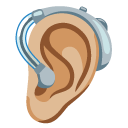

Appearance varies by platform and device. Google Noto, Twemoji, and OpenMoji are open-source.