🌏
The Emoji
Globe Showing Asia-Australia
U+1F30F · :globe_showing_asiaaustralia:
Trend 58
Meaning layers
- interpretation
- Used to signal worldliness, travel ambitions, or acknowledging something is a global or Asia-Pacific issue. Often used ironically when someone thinks they're more cultured than they are.
- tiktok usage
- Appears in travel content, 'this side of the world' commentary, K-pop/anime fandom posts, and geography flex videos about Asia-Pacific countries.
- irony level
- 3 / 10
Platform meanings
- meaning
- Represents Asia-Pacific content, travel vlogs, diaspora identity, and K-pop/anime culture markers.
- trend usage
- Used in hashtags for Asian travel content, 'growing up Asian' videos, geography challenge trends, and Southeast Asian food content.
- hashtags
- #AsiaTravel#APAClife#AsianDiaspora#KpopWorld#ExploreAsia
- virality score
- 62 / 100
Cultural meanings
🇺🇸
Western / Gen-Z
Used primarily to signal worldliness and curiosity about Asian culture, often accompanying K-pop, anime, or travel content. Slightly performative in usage by those who want to appear globally aware.
🇵🇰
Pakistan & India
Carries a strong sense of national and regional pride; used frequently in diaspora communities abroad to represent home and in nationalist contexts to assert South Asian presence on the global stage.
🌍
Middle East
Used to express connection to a broader global community or to signal news from the Asia-Pacific region; common in expat and business communities connected to Asia.
🌐
Global Neutral
Universally understood as a representation of the Eastern Hemisphere, used straightforwardly in educational, news, and travel contexts worldwide.
🇧🇩
Bangladesh
Used in diaspora communities to represent homeland pride and in social media to signal Bangladeshi identity within the global South Asian community.
🇱🇰
Sri Lanka
Used to represent Sri Lankan pride and to signal the island's place within the Asia-Pacific world; common in travel and cultural content.
🇨🇳
China
Strongly associated with Chinese national identity and pride; used in patriotic contexts, global business discussions, and to assert China's role in world affairs.
🇯🇵
Japan
Used to represent Japan's place in the Asia-Pacific region and in global culture discussions; popular in travel content and Japanese pop culture exports like anime and manga.
🇰🇷
South Korea
Closely tied to the Korean Wave (Hallyu); used alongside K-pop, K-drama, and Korean food content to assert Korea's global cultural influence.
🇹🇼
Taiwan
Used to assert Taiwanese identity and presence on the world stage, particularly in geopolitical discussions, as well as in travel and tech industry contexts.
🇭🇰
Hong Kong
Used in both local identity contexts and international discussions about Hong Kong's geopolitical status; common in diaspora communities abroad.
🇵🇭
Philippines
Widely used by Filipino diaspora (OFWs) to represent global connection to home and in travel content highlighting the Philippines' natural beauty.
🇮🇩
Indonesia
Used to celebrate Indonesia's vast archipelago and its position in the Asia-Pacific; common in tourism content, national pride posts, and ASEAN discussions.
🇹🇭
Thailand
Popular in Thai travel content and tourism promotions; used to represent Thailand's place in Southeast Asia and its global appeal as a destination.
🇻🇳
Vietnam
Used in contexts celebrating Vietnamese culture, diaspora identity, and Southeast Asian pride; increasingly visible in young Vietnamese creators' content.
🇲🇾
Malaysia
Common in multicultural Malaysian social media to express pride in Malaysia's position in Southeast Asia and in ASEAN community discussions.
🇸🇦
Saudi Arabia
Primarily used in business and geopolitical contexts to reference Asia-Pacific affairs; also used by Saudi nationals traveling or studying in APAC countries.
🇦🇪
UAE
Frequently used in Dubai and Abu Dhabi's cosmopolitan expat communities, particularly by Asian workers representing their home regions in this international hub.
🇪🇬
Egypt
Used mainly in global news sharing and educational contexts; less culturally specific but appears in content about Asian affairs among engaged Egyptian users.
🇹🇷
Turkey
Used in geopolitical and economic discussions about Asia-Pacific as Turkey navigates its Eurasian identity and growing ties with Asian economies.
🇮🇷
Iran
Used in contexts discussing Iran's relationships with Asian powers, particularly China and ASEAN nations, as well as in diaspora content.
🇳🇬
Nigeria
Used to reference Asia-Pacific in global conversations and by the significant Nigerian-Asian diaspora community; also tied to Nollywood's growing cultural exchanges with Asia.
🇿🇦
South Africa
Used in BRICS-related discussions and in contexts emphasizing South Africa's growing ties with Asian economies and the Global South.
🇬🇧
UK & Ireland
Used by British and Irish users with Asian heritage or connections, as well as in post-Brexit discussions about trade and relationships with the Asia-Pacific region.
🇫🇷
France
Appears in Francophone discussions about the Indo-Pacific strategy, as well as by the significant French-Asian diaspora and in travel content.
🇩🇪
Germany
Used in business and trade contexts relating to German-Asian economic relationships, as well as by the German-Asian diaspora community.
🇪🇸
Spain & Italy
Less commonly used but appears in travel content about Asia, cultural exchange discussions, and among diaspora communities from Asian countries.
🇧🇷
Brazil
Used in Brazil's growing cultural conversations with Asia, particularly around K-pop fandom (Brazil has one of the world's largest K-pop fan bases) and Asian immigration communities.
🇲🇽
Mexico
Appears in Mexican social media alongside K-pop culture, anime fandom, and increasingly in trade and geopolitical discussions about the Asia-Pacific.
🌎
Latin America
Broadly used across Latin America in K-pop and anime fan communities; also appears in discussions about Latin America's growing ties with Asian economies.
🇦🇺
Australia & NZ
Highly relevant culturally given Australia and New Zealand's physical location in the Asia-Pacific; used to assert regional identity, in news contexts, and in discussions about Asian immigration and multicultural society.
How its meaning shifted
- 2010
Primarily used in educational and news contexts to indicate Asia or the Pacific region; minimal cultural or social cachet beyond literal geographic reference.
- 2015
Gained traction with the rise of K-pop and Asian content on social media; began appearing in travel content and diaspora communities expressing pride in their heritage.
- 2020
Saw a significant spike during COVID-19 discussions (originating in Asia), BTS and K-pop global dominance, and increased awareness of Asian identity issues especially during anti-Asian racism conversations.
- 2026
Fully integrated into cultural identity expression for Asian diaspora creators, K-pop and anime fandoms, and travel influencers; also prominent in geopolitical discussions about the Indo-Pacific amid US-China tensions and ASEAN developments.
See it on every platform
Emoji combinations
Adjacent emojis
- Often confused with
- globe showing europe africaglobe with meridiansglobe showing americas
- Can replace
- world mapairplaneflying saucer
Share & embed
Frequently asked
01What does the 🌏 Globe Showing Asia-Australia emoji mean?
A globe emoji depicting the Earth with Asia and Australia visible, centered roughly on the Pacific Ocean side showing countries like China, Japan, India, Southeast Asia, and Australia.
02What does 🌏 mean on TikTok?
Represents Asia-Pacific content, travel vlogs, diaspora identity, and K-pop/anime culture markers.
03What does 🌏 mean on WhatsApp?
Signals that something is happening globally or specifically in the Asia-Pacific region; used in news-sharing contexts.
04What does 🌏 mean in Gen-Z slang?
Used to signal worldliness, travel ambitions, or acknowledging something is a global or Asia-Pacific issue. Often used ironically when someone thinks they're more cultured than they are.
05Is the 🌏 emoji safe to use?
Universally safe; represents geographic and cultural diversity, travel, and global awareness.
06What does 🌏 mean in texting?
Psychologically tied to a sense of global citizenship and the cognitive expansion that comes with cross-cultural awareness; evokes longing for travel or nostalgia for homeland in diaspora communities.
07What is the shortcode for 🌏?
The shortcode for Globe Showing Asia-Australia is :globe_showing_asiaaustralia:
08What does 🌏 mean in dating?
Used to suggest sophistication or worldliness in a romantic context, implying 'I travel' or 'I appreciate diverse cultures' — can be a subtle flex.
Safety & usage
- Safe meaning
- Universally safe; represents geographic and cultural diversity, travel, and global awareness.
- Caution
- Occasionally weaponized in nationalist rhetoric to assert geopolitical dominance claims, particularly in Taiwan-China or South China Sea territory disputes online.
In highly charged geopolitical discussions on platforms like X or Weibo, this emoji can appear alongside sensitive territorial claims. Generally harmless but context-dependent in political discussions.
How it looks across platforms
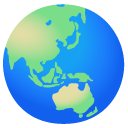


Appearance varies by platform and device. Google Noto, Twemoji, and OpenMoji are open-source.