👨🏿❤️💋👨🏼
The Emoji
Kiss: Man, Man, Dark Skin Tone, Medium-light Skin Tone
U+1F468 U+1F3FF U+200D U+2764 U+FE0F U+200D U+1F48B U+200D U+1F468 U+1F3FC · :kiss_man_man_dark_skin_tone_mediumlight_skin_tone:
Trend 65
Meaning layers
- interpretation
- Used to celebrate gay/queer male relationships, interracial love, and intersectional LGBTQ+ pride. Gen Z uses it naturally and without hesitation to represent their relationships or allies.
- tiktok usage
- Appears in coming-out videos, couples duets, pride content, and 'relationship goals' posts celebrating queer interracial couples.
- irony level
- 1 / 10
Platform meanings
- meaning
- Represents queer male romance and interracial love; used in couples content, pride storytelling, and LGBTQ+ representation videos.
- trend usage
- Heavily used during Pride Month, National Coming Out Day, and viral queer couples challenges.
- hashtags
- #GayCouple#QueerLove#InterracialCouple#PrideMonth#LoveIsLove
- virality score
- 72 / 100
Cultural meanings
🇺🇸
Western / Gen-Z
Widely accepted and celebrated; used naturally by queer individuals and straight allies alike to show love, support, and inclusivity without stigma.
🇵🇰
Pakistan & India
Largely considered taboo and rarely used openly due to social and legal pressures on same-sex relationships; may appear in underground LGBTQ+ communities or diaspora spaces.
🌍
Middle East
Considered highly inappropriate in most Middle Eastern contexts due to legal prohibitions and cultural norms against same-sex relationships; avoided in public digital communication.
🌐
Global Neutral
Universally recognized as a same-sex male couple kiss emoji; interpretation varies widely based on local cultural attitudes toward LGBTQ+ relationships.
🇧🇩
Bangladesh
Rarely used openly; same-sex relationships face legal and social stigma, so this emoji is largely confined to private LGBTQ+ spaces or diaspora communities abroad.
🇱🇰
Sri Lanka
Used cautiously if at all; conservative social norms and legal ambiguity around same-sex relationships mean this emoji is uncommon in mainstream digital communication.
🇨🇳
China
Rarely displayed openly due to increasing censorship of LGBTQ+ content; may be used in private chats or niche queer communities but risks platform removal.
🇯🇵
Japan
Used in LGBTQ+ communities and BL (Boys' Love) fan culture; generally tolerated but not widely mainstream, with usage concentrated in queer and fandom spaces.
🇰🇷
South Korea
Gaining visibility in younger LGBTQ+ communities and K-culture fan spaces, though broader societal acceptance remains limited and usage is mostly private or activist.
🇹🇼
Taiwan
Commonly used and celebrated, as Taiwan is the first Asian country to legalize same-sex marriage; widely accepted across generations in digital communication.
🇭🇰
Hong Kong
Used in LGBTQ+ communities and increasingly among youth, though political climate has affected open expression; recognized positively in activist circles.
🇵🇭
Philippines
Mixed reception; LGBTQ+ culture is visible and the community is relatively large, but same-sex marriage is not legally recognized, so usage is common in queer spaces but not universally accepted.
🇮🇩
Indonesia
Strongly avoided in public digital spaces due to legal risks and strong conservative religious sentiment; confined to private LGBTQ+ underground communities.
🇹🇭
Thailand
Used openly in Thailand's vibrant LGBTQ+ community; Thailand has strong queer visibility and this emoji is well-understood and positively received.
🇻🇳
Vietnam
Emerging use among younger LGBTQ+ Vietnamese users; societal acceptance is growing but still limited, and public use remains cautious.
🇲🇾
Malaysia
Rarely used openly due to legal prohibition of same-sex relationships; confined to private or diaspora LGBTQ+ digital spaces.
🇸🇦
Saudi Arabia
Extremely rare and considered highly inappropriate; same-sex relationships are criminalized, making public use of this emoji potentially dangerous.
🇦🇪
UAE
Avoided in public digital communication due to legal restrictions on same-sex relationships; may appear in private expat LGBTQ+ communities.
🇪🇬
Egypt
Rarely used openly; social and legal environment is hostile to LGBTQ+ expression, limiting this emoji to private or diaspora usage.
🇹🇷
Turkey
Mixed usage; while Turkey has had a historical LGBTQ+ presence in cities like Istanbul, increasing government restrictions have pushed usage to private queer spaces.
🇮🇷
Iran
Extremely rare and potentially dangerous to use publicly; same-sex relationships are criminalized and this emoji is confined strictly to private underground LGBTQ+ communication.
🇳🇬
Nigeria
Avoided in public digital spaces due to strict anti-LGBTQ+ laws; used privately within underground queer communities or by diaspora Nigerians abroad.
🇿🇦
South Africa
Widely used and accepted; South Africa has constitutional protections for LGBTQ+ rights and one of Africa's most visible queer communities.
🇬🇧
UK & Ireland
Commonly used and celebrated; both countries have strong LGBTQ+ rights frameworks and this emoji is widely embraced across generations.
🇫🇷
France
Broadly accepted and used; France has a long history of LGBTQ+ rights and this emoji is commonplace in queer and ally digital communication.
🇩🇪
Germany
Widely used in Germany's robust LGBTQ+ community; the skin tone diversity aspect is also appreciated in the context of multicultural Berlin and other cities.
🇪🇸
Spain & Italy
Commonly used in Spain where LGBTQ+ rights are well-established; more cautious use in conservative parts of Italy, though urban queer communities use it freely.
🇧🇷
Brazil
Widely used in Brazil's large and vibrant LGBTQ+ community; the interracial element is especially resonant in Brazil's diverse demographic landscape.
🇲🇽
Mexico
Used within LGBTQ+ communities in urban areas; acceptance varies by region, with progressive cities like Mexico City embracing it widely while rural areas remain conservative.
🌎
Latin America
Usage varies significantly by country; more open use in Argentina, Chile, and Uruguay where LGBTQ+ rights are progressive, and more restricted in conservative nations.
🇦🇺
Australia & NZ
Widely accepted and celebrated following marriage equality legalization; used freely by queer communities and allies across both countries.
How its meaning shifted
- 2010
Did not exist; same-sex couple emojis with skin tone modifiers were not available, and LGBTQ+ representation in emoji sets was virtually nonexistent.
- 2015
Early versions of same-sex couple emojis were being introduced, but skin tone combinations were extremely limited; awareness of this specific combination was minimal.
- 2020
Increasingly used as LGBTQ+ visibility surged on social media, skin tone modifier combinations became widely supported, and Pride Month digital activism grew significantly.
- 2026
Normalized and widely used in inclusive digital communication; seen as a baseline representation of diverse queer love rather than a novelty, with growing use across mainstream platforms.
See it on every platform
Adjacent emojis
- Often confused with
- two men holding handspeople hugginghandshake
Share & embed
Frequently asked
01What does the 👨🏿❤️💋👨🏼 Kiss: Man, Man, Dark Skin Tone, Medium-light Skin Tone emoji mean?
A kiss emoji depicting two men with dark skin tone and medium-light skin tone, formed by combining the man emoji with dark skin tone, a red heart, a kiss mark, and a man emoji with medium-light skin tone via ZWJ sequences.
02What does 👨🏿❤️💋👨🏼 mean on TikTok?
Represents queer male romance and interracial love; used in couples content, pride storytelling, and LGBTQ+ representation videos.
03What does 👨🏿❤️💋👨🏼 mean on WhatsApp?
Sent between romantic male partners to express a kiss or deep affection; also used by allies celebrating LGBTQ+ loved ones.
04What does 👨🏿❤️💋👨🏼 mean in Gen-Z slang?
Used to celebrate gay/queer male relationships, interracial love, and intersectional LGBTQ+ pride. Gen Z uses it naturally and without hesitation to represent their relationships or allies.
05Is the 👨🏿❤️💋👨🏼 emoji safe to use?
Represents love and affection between two men of different skin tones; used to celebrate LGBTQ+ relationships and interracial love.
06What does 👨🏿❤️💋👨🏼 mean in texting?
Representation matters deeply — this emoji carries emotional weight for queer men of color who rarely see themselves reflected in mainstream digital communication. Using it can feel validating and affirming.
07What is the shortcode for 👨🏿❤️💋👨🏼?
The shortcode for Kiss: Man, Man, Dark Skin Tone, Medium-light Skin Tone is :kiss_man_man_dark_skin_tone_mediumlight_skin_tone:
08What does 👨🏿❤️💋👨🏼 mean in dating?
Sent between gay or queer male partners to express romantic affection, longing, or flirtation. Also used to signal availability and identity on dating apps.
Safety & usage
- Safe meaning
- Represents love and affection between two men of different skin tones; used to celebrate LGBTQ+ relationships and interracial love.
- Caution
- Could be weaponized by bad actors to harass LGBTQ+ individuals in hostile online environments by sending it mockingly or aggressively.
In regions where same-sex relationships are criminalized, using this emoji publicly could expose individuals to social or legal risk. Platforms should be aware of contextual safety.
How it looks across platforms
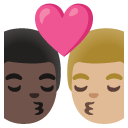
Appearance varies by platform and device. Google Noto, Twemoji, and OpenMoji are open-source.