👩🏻❤️💋👩🏾
The Emoji
Kiss: Woman, Woman, Light Skin Tone, Medium-dark Skin Tone
U+1F469 U+1F3FB U+200D U+2764 U+FE0F U+200D U+1F48B U+200D U+1F469 U+1F3FE · :kiss_woman_woman_light_skin_tone_mediumdark_skin_tone:
Trend 68
Meaning layers
- interpretation
- Used by WLW (women who love women) couples or friends to express deep romantic affection, queer love, or sapphic solidarity. Also casually used between close female friends in some contexts.
- tiktok usage
- Appears in couple reveal videos, sapphic romance content, pride-related edits, and 'my girlfriend and I' storytelling videos.
- irony level
- 1 / 10
Platform meanings
- meaning
- Represents WLW relationships, sapphic love, and queer female couples. Heavily used in pride content and couple showcases.
- trend usage
- Appears in trending sounds overlaid on couple moments, 'day in the life with my girlfriend' videos, and LGBTQ+ coming out stories.
- hashtags
- #WLW#SapphicTikTok#PrideTikTok#LesbianCouple#QueerLove
- virality score
- 72 / 100
Cultural meanings
🇺🇸
Western / Gen-Z
Widely embraced and celebrated as a symbol of WLW love, sapphic identity, and queer visibility. Commonly used openly on all platforms.
🇵🇰
Pakistan & India
Rarely used openly due to social and legal stigma around same-sex relationships. When used, it is often within private or anonymous LGBTQ+ online spaces.
🌍
Middle East
Highly taboo in most Middle Eastern countries where same-sex relationships are criminalized or heavily stigmatized. Use is extremely limited and primarily underground.
🌐
Global Neutral
Universally recognized as representing a romantic kiss between two women, though reception varies dramatically based on local attitudes toward LGBTQ+ rights.
🇧🇩
Bangladesh
Very rarely used publicly due to strong cultural and legal prohibitions on same-sex relationships. Limited to private LGBTQ+ digital communities.
🇱🇰
Sri Lanka
Seldom used openly given societal conservatism, but present in smaller urban queer communities and LGBTQ+ activist digital spaces.
🇨🇳
China
Usage is limited due to government censorship of LGBTQ+ content on major platforms. Within niche communities and VPN-accessed spaces it circulates among WLW individuals.
🇯🇵
Japan
Carries a nuanced cultural position; while Japan is relatively tolerant of yuri (female-female romantic) media, public same-sex couple expression remains socially reserved. Used in fandom and queer communities.
🇰🇷
South Korea
Used within LGBTQ+ communities and progressive youth circles, though overall public display remains constrained by societal conservatism. More common in online queer spaces.
🇹🇼
Taiwan
Widely accepted and celebrated, especially since Taiwan legalized same-sex marriage in 2019. Freely used by WLW couples and allies.
🇭🇰
Hong Kong
Used openly by LGBTQ+ individuals and allies, particularly among younger urban demographics, though with increasing political sensitivity in recent years.
🇵🇭
Philippines
Used within LGBTQ+ communities and in spaces influenced by relatively visible queer culture, though conservative religious values mean broader public use is mixed.
🇮🇩
Indonesia
Largely avoided in public digital spaces due to strong conservative and religious sentiment against same-sex relationships. Present only in private or activist LGBTQ+ communities.
🇹🇭
Thailand
Relatively normalized among younger Thais and in entertainment culture influenced by GL (girls-love) media, though formal legal recognition of same-sex couples is still evolving.
🇻🇳
Vietnam
Used discreetly within LGBTQ+ circles. Societal tolerance has increased among youth, but public display remains cautious in mainstream contexts.
🇲🇾
Malaysia
Rarely used openly due to legal prohibitions on same-sex relationships and strong conservative Islamic influence. Confined to private or diaspora LGBTQ+ communities.
🇸🇦
Saudi Arabia
Extremely taboo and virtually absent from public digital communication given strict laws against same-sex relationships. Any use is highly private and underground.
🇦🇪
UAE
Similar to Saudi Arabia, same-sex relationships are criminalized, making open use of this emoji socially and legally risky. Extremely rare in public contexts.
🇪🇬
Egypt
Seldom used openly due to societal and legal hostility toward LGBTQ+ expression. Limited to anonymous or private queer online communities.
🇹🇷
Turkey
Usage has declined as LGBTQ+ rights have come under increasing pressure. Active within underground queer communities but avoided in mainstream public posts.
🇮🇷
Iran
Virtually unused publicly given severe legal penalties for same-sex relationships. Exists only in diaspora and secretive digital queer spaces.
🇳🇬
Nigeria
Rarely used openly due to strict anti-same-sex laws and strong societal stigma. Confined to LGBTQ+ diaspora communities and private messaging.
🇿🇦
South Africa
Relatively openly used, as South Africa has constitutional protections for same-sex relationships and an active LGBTQ+ community, especially in urban centers.
🇬🇧
UK & Ireland
Widely used and celebrated. Both countries have strong LGBTQ+ rights frameworks and open queer communities where this emoji is normalized.
🇫🇷
France
Broadly accepted and used openly in mainstream digital culture, reflecting France's relatively liberal attitudes toward LGBTQ+ relationships.
🇩🇪
Germany
Widely embraced in a society with strong LGBTQ+ legal protections and visible queer communities, especially in cities like Berlin.
🇪🇸
Spain & Italy
Spain uses it freely given a progressive LGBTQ+ legal and social environment. Italy has a more mixed reception, with acceptance higher among youth and in northern urban areas.
🇧🇷
Brazil
Widely used given Brazil's large and vibrant LGBTQ+ community and significant pride culture, despite political tensions around LGBTQ+ rights in recent years.
🇲🇽
Mexico
Increasingly used openly as LGBTQ+ visibility grows, especially in urban centers like Mexico City. Rural and conservative regions remain more resistant.
🌎
Latin America
Usage varies widely across Latin America — more open in Argentina and Chile where same-sex marriage is legal, more reserved in more conservative Central American countries.
🇦🇺
Australia & NZ
Freely used and celebrated in both countries, which have strong LGBTQ+ rights frameworks and inclusive mainstream digital cultures.
How its meaning shifted
- 2010
This specific emoji did not exist in 2010. Couple and kiss emojis were limited and did not include same-sex or skin tone variants. LGBTQ+ digital expression relied on text symbols and generic heart emojis.
- 2015
Interracial same-sex couple emojis began emerging following Unicode expansions. Early adoption was mainly by LGBTQ+ activists, early adopters, and pride-focused accounts.
- 2020
Gained significant visibility alongside the global Black Lives Matter movement and renewed Pride Month energy. The interracial skin tone pairing took on added meaning around intersectionality and representation.
- 2026
Standard and normalized in WLW digital expression globally. Widely integrated into mainstream couple communication, pride content, and increasingly featured in brand and media representation campaigns.
See it on every platform
Compare with
Adjacent emojis
- Often confused with
- two heartskiss marksmiling face with heart eyes
Share & embed
Frequently asked
01What does the 👩🏻❤️💋👩🏾 Kiss: Woman, Woman, Light Skin Tone, Medium-dark Skin Tone emoji mean?
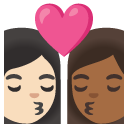
A kiss emoji depicting two women with light skin tone and medium-dark skin tone, represented by two female faces with a red heart and lips between them.
02What does 👩🏻❤️💋👩🏾 mean on TikTok?
Represents WLW relationships, sapphic love, and queer female couples. Heavily used in pride content and couple showcases.
03What does 👩🏻❤️💋👩🏾 mean on WhatsApp?
Sent between romantic female partners to express a kiss or deep affection. Also used between close female friends in cultures where it is normalized.
04What does 👩🏻❤️💋👩🏾 mean in Gen-Z slang?
Used by WLW (women who love women) couples or friends to express deep romantic affection, queer love, or sapphic solidarity. Also casually used between close female friends in some contexts.
05Is the 👩🏻❤️💋👩🏾 emoji safe to use?
A positive, affirming symbol of romantic love and intimacy between two women. Widely used to celebrate queer relationships and LGBTQ+ identity.
06What does 👩🏻❤️💋👩🏾 mean in texting?
Carries significant emotional weight for LGBTQ+ individuals as a symbol of representation and validation. For many, using this emoji publicly is an act of visibility and self-expression.
07What is the shortcode for 👩🏻❤️💋👩🏾?
The shortcode for Kiss: Woman, Woman, Light Skin Tone, Medium-dark Skin Tone is :kiss_woman_woman_light_skin_tone_mediumdark_skin_tone:
08What does 👩🏻❤️💋👩🏾 mean in dating?
Sent between women in a romantic context to express desire, love, or a kiss. Can be used early in dating to signal romantic interest or later to express deep affection.
Safety & usage
- Safe meaning
- A positive, affirming symbol of romantic love and intimacy between two women. Widely used to celebrate queer relationships and LGBTQ+ identity.
- Caution
- Could be weaponized in homophobic harassment contexts where it is used mockingly, or exploited by bad actors in fetishizing or non-consensual sexualization of WLW relationships.
While the emoji itself is benign, its use in certain conservative cultural or legal contexts could expose LGBTQ+ individuals to discrimination or risk. Always consider audience and platform context.
How it looks across platforms
Appearance varies by platform and device. Google Noto, Twemoji, and OpenMoji are open-source.