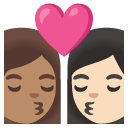
👩🏽❤️💋👩🏻
The Emoji
Kiss: Woman, Woman, Medium Skin Tone, Light Skin Tone
U+1F469 U+1F3FD U+200D U+2764 U+FE0F U+200D U+1F48B U+200D U+1F469 U+1F3FB · :kiss_woman_woman_medium_skin_tone_light_skin_tone:
Trend 68
Meaning layers
- interpretation
- Used to express WLW (women loving women) affection, sapphic pride, or to hype up a cute queer couple moment. Also casually dropped between close female friends in some contexts.
- tiktok usage
- Frequently appears in WLW couple content, sapphic TikTok, pride month videos, and 'ship' content for fictional or real female pairs.
- irony level
- 2 / 10
Platform meanings
- meaning
- Symbol of WLW romance and sapphic identity; used in couple reveals, pride content, and queer storytelling videos.
- trend usage
- Appears in 'couples check' trends, pride month challenges, sapphic aesthetic videos, and WLW storytime content.
- hashtags
- #WLW#SapphicTikTok#QueerCouple#PrideMonth#LesbiansOfTikTok
- virality score
- 72 / 100
Cultural meanings
🇺🇸
Western / Gen-Z
Widely embraced and celebrated as a symbol of WLW love and sapphic pride; used openly and frequently in digital spaces without hesitation.
🇵🇰
Pakistan & India
Largely taboo due to cultural and legal stigmas around homosexuality; rarely used openly and may cause controversy if shared publicly.
🌍
Middle East
Considered highly inappropriate in most Middle Eastern contexts due to legal and religious prohibitions on same-sex relationships; essentially unused openly.
🌐
Global Neutral
Recognized as a same-sex couple emoji; interpretation varies widely by cultural context but its visual meaning is generally understood.
🇧🇩
Bangladesh
Not commonly used due to strong social and religious conservatism around LGBTQ+ topics; may provoke negative reactions if used publicly.
🇱🇰
Sri Lanka
Rarely used in mainstream contexts; LGBTQ+ expression is socially sensitive and this emoji would primarily circulate in private or underground queer spaces.
🇨🇳
China
Censored or restricted on some platforms; while a queer community exists, open use is discouraged by state-level social media policies.
🇯🇵
Japan
Used within Japan's yuri (WLW manga/anime) community and LGBTQ+ circles; relatively niche but growing in visibility with younger generations.
🇰🇷
South Korea
Gaining traction among younger, progressive South Koreans and K-pop fan communities that celebrate female idol pairings; still controversial in mainstream culture.
🇹🇼
Taiwan
Widely accepted, especially since Taiwan legalized same-sex marriage in 2019; used proudly and openly as a symbol of WLW love.
🇭🇰
Hong Kong
Used within the LGBTQ+ community and among progressive younger populations; less visible in mainstream public discourse.
🇵🇭
Philippines
Mixed reception; while Filipino culture has visible LGBTQ+ communities, public expression of WLW relationships can still attract social stigma.
🇮🇩
Indonesia
Very rarely used openly due to strong religious and social conservatism; LGBTQ+ expression faces significant societal pressure.
🇹🇭
Thailand
Accepted within the Thai LGBTQ+ community and popular culture to some degree; 'Tom-Dee' (Thai lesbian) culture has its own visual language but this emoji is understood.
🇻🇳
Vietnam
Slowly becoming more visible among younger urban Vietnamese youth; still sensitive in broader social contexts but tolerated more than a decade ago.
🇲🇾
Malaysia
Largely avoided in public-facing digital content due to legal and religious prohibitions; used privately within underground LGBTQ+ communities.
🇸🇦
Saudi Arabia
Essentially unused publicly due to strict legal and religious prohibitions on homosexuality; would be considered deeply offensive in mainstream contexts.
🇦🇪
UAE
Not used openly due to legal restrictions on same-sex relationships; any usage is confined to private and highly discreet digital spaces.
🇪🇬
Egypt
Rarely used and considered highly inappropriate; LGBTQ+ expression faces legal and social persecution in Egypt.
🇹🇷
Turkey
Increasingly censored amid growing government restrictions on LGBTQ+ expression; used primarily within the underground queer community in cities like Istanbul.
🇮🇷
Iran
Essentially forbidden in public expression; any LGBTQ+ symbolism carries serious legal risk and this emoji would only appear in highly private or diaspora contexts.
🇳🇬
Nigeria
Not used openly due to strong legal prohibitions and social stigma around homosexuality; confined to diaspora and underground online spaces.
🇿🇦
South Africa
One of the most LGBTQ+-affirming African nations; this emoji is used with pride and celebration in urban queer communities and pride events.
🇬🇧
UK & Ireland
Widely accepted and commonly used; part of everyday digital expression for WLW individuals and their allies across the UK and Ireland.
🇫🇷
France
Embraced in France's relatively liberal social climate; used openly in LGBTQ+ communities and increasingly in mainstream digital culture.
🇩🇪
Germany
Used comfortably in Germany's progressive cultural landscape; common in LGBTQ+ spaces and increasingly normalized in broader youth culture.
🇪🇸
Spain & Italy
Accepted in Spain, which has strong LGBTQ+ protections; more nuanced in Italy where LGBTQ+ visibility is growing but faces political headwinds.
🇧🇷
Brazil
Used enthusiastically within Brazil's large and vibrant LGBTQ+ community; one of the world's biggest Pride events happens in São Paulo, and this emoji reflects that energy.
🇲🇽
Mexico
Increasingly visible in Mexico City and major urban centers with growing LGBTQ+ communities; still sensitive in more conservative rural regions.
🌎
Latin America
Usage varies significantly by country; embraced in progressive urban centers while remaining sensitive or taboo in more conservative Latin American regions.
🇦🇺
Australia & NZ
Freely and proudly used across Australia and New Zealand, both of which have strong LGBTQ+ legal protections and vibrant queer communities.
How its meaning shifted
- 2010
Emoji with this level of specificity did not exist; same-sex couples had no dedicated representation in the emoji keyboard, and LGBTQ+ digital expression relied on text-based symbols.
- 2015
Early same-sex couple emojis began appearing following Unicode updates; usage was groundbreaking but skin tone variants were not yet available, making representation incomplete.
- 2020
Skin tone combination emojis became more widely supported; WLW couples embraced the emoji as a proud identity marker, especially during the surge in LGBTQ+ digital visibility during Pride Month.
- 2026
A normalized and widely recognized symbol of WLW love; integrated into mainstream digital culture while retaining strong significance for sapphic and LGBTQ+ communities globally.
See it on every platform
Adjacent emojis
- Opposite
- kiss man manno entrybroken heart
- Often confused with
- kiss markwoman and man holding handshugging face
- Can replace
- red heartrainbow flagkiss mark
Share & embed
Frequently asked
01What does the 👩🏽❤️💋👩🏻 Kiss: Woman, Woman, Medium Skin Tone, Light Skin Tone emoji mean?
A kiss emoji depicting two women with medium and light skin tones, shown with a heart and kiss mark between them, representing a same-sex female couple sharing a kiss.
02What does 👩🏽❤️💋👩🏻 mean on TikTok?
Symbol of WLW romance and sapphic identity; used in couple reveals, pride content, and queer storytelling videos.
03What does 👩🏽❤️💋👩🏻 mean on WhatsApp?
Sent between female partners to express love and affection in private chats; also used among close friends in supportive group chats.
04What does 👩🏽❤️💋👩🏻 mean in Gen-Z slang?
Used to express WLW (women loving women) affection, sapphic pride, or to hype up a cute queer couple moment. Also casually dropped between close female friends in some contexts.
05Is the 👩🏽❤️💋👩🏻 emoji safe to use?
A celebration of WLW romantic love and LGBTQ+ identity; used positively in affirming communities and personal expression.
06What does 👩🏽❤️💋👩🏻 mean in texting?
This emoji carries deep emotional weight for WLW individuals as it provides visible representation in digital spaces, reinforcing identity validation and relationship visibility.
07What is the shortcode for 👩🏽❤️💋👩🏻?
The shortcode for Kiss: Woman, Woman, Medium Skin Tone, Light Skin Tone is :kiss_woman_woman_medium_skin_tone_light_skin_tone:
08What does 👩🏽❤️💋👩🏻 mean in dating?
Sent between women who are flirting or in a relationship to signal romantic intent, affection, or playful intimacy.
Safety & usage
- Safe meaning
- A celebration of WLW romantic love and LGBTQ+ identity; used positively in affirming communities and personal expression.
- Caution
- Can be used to fetishize or mock WLW relationships in bad-faith contexts; may also be used to bait homophobic reactions online.
In regions with anti-LGBTQ+ laws, sharing this emoji publicly could expose individuals to legal risk or social harm. Platforms should be aware of regional sensitivity.
How it looks across platforms
Appearance varies by platform and device. Google Noto, Twemoji, and OpenMoji are open-source.