🤛🏾
The Emoji
Left-facing Fist: Medium-dark Skin Tone
U+1F91B U+1F3FE · :leftfacing_fist_mediumdark_skin_tone:
Trend 58
Meaning layers
- interpretation
- Used to initiate a virtual fist bump, show solidarity, agreement, or hype someone up. Often paired with 🤜🏾 for the full bump effect. Also signals 'I'm with you' or 'let's go' energy.
- tiktok usage
- Appears in comment sections to hype creators, often paired with the right-facing fist emoji from another commenter to complete the bump. Used in duo challenges and reaction videos.
- irony level
- 2 / 10
Platform meanings
- meaning
- Solidarity bump in comment sections; used to hype up creators or agree with a take
- trend usage
- Part of the comment fist bump ritual where strangers complete the bump together; used in motivational and sports content
- hashtags
- #fistbump#solidarity#hype#teamwork#vibes
- virality score
- 62 / 100
Cultural meanings
🇺🇸
Western / Gen-Z
A universally understood solidarity and hype gesture; the medium-dark skin tone is embraced as part of diverse emoji representation without altering core meaning.
🇵🇰
Pakistan & India
Recognized as a fist bump or power gesture; the medium-dark skin tone resonates well and is frequently used in youth and sports contexts to signal strength and brotherhood.
🌍
Middle East
Interpreted as a gesture of strength and solidarity; used among youth in sports and gaming contexts, though older generations may associate a raised fist with protest.
🌐
Global Neutral
Broadly understood as a fist bump or show of solidarity and mutual respect, transcending most cultural barriers due to its universal sporting connotations.
🇧🇩
Bangladesh
Used among younger demographics in sports and online gaming communities to signal teamwork and encouragement; the skin tone modifier is positively received.
🇱🇰
Sri Lanka
Predominantly used in sports fan communities and youth online spaces to show team support and shared excitement.
🇨🇳
China
Recognized as a Western-origin fist bump gesture; used in gaming and esports communities on platforms like Bilibili and WeChat to signal respect and team spirit.
🇯🇵
Japan
Understood within gaming and sports contexts as a power-up or solidarity gesture; less common in formal digital communication but popular among youth.
🇰🇷
South Korea
Frequently used in esports, K-pop fan communities, and sports discussions to hype up team members or show fandom solidarity.
🇹🇼
Taiwan
Used in gaming, sports, and social media to represent strength and agreement; the skin tone diversity aspect is generally positively noted.
🇭🇰
Hong Kong
Used in protest and solidarity contexts as well as sports; the raised fist association carries additional sociopolitical weight given recent history.
🇵🇭
Philippines
Widely used in basketball fan communities and online gaming groups to signal team spirit and mutual encouragement.
🇮🇩
Indonesia
Popular in gaming and sports contexts among youth; signals camaraderie and shared energy in online communities.
🇹🇭
Thailand
Used among youth in gaming, Muay Thai fan communities, and sports discussions as a show of strength and solidarity.
🇻🇳
Vietnam
Common in gaming and esports communities; signals respect between players and team solidarity in competitive contexts.
🇲🇾
Malaysia
Used in sports, gaming, and youth culture to signal team spirit; the medium-dark skin tone is well-received as representative.
🇸🇦
Saudi Arabia
Used primarily in sports and gaming contexts among youth; a fist gesture in this context is recognized as a Western solidarity symbol rather than aggression.
🇦🇪
UAE
Embraced by the diverse, cosmopolitan youth population in sports and social contexts; the skin tone modifier is positively received in a diverse society.
🇪🇬
Egypt
Used in sports fan groups and online communities to show solidarity and team support; sometimes carries revolutionary undertone given the region's activist history.
🇹🇷
Turkey
Common in sports, gaming, and youth culture to signal readiness and team spirit; recognized as a solidarity gesture.
🇮🇷
Iran
Used among youth in gaming and sports contexts online; the raised fist can carry subtle political connotations in certain discourse contexts.
🇳🇬
Nigeria
Strongly resonates as a symbol of strength, pride, and solidarity; the medium-dark skin tone is particularly embraced as representative and empowering.
🇿🇦
South Africa
Carries powerful cultural weight as a solidarity and strength symbol; medium-dark skin tone is well-received and the gesture connects to broader themes of unity.
🇬🇧
UK & Ireland
Used in sports fan culture, gaming, and youth online spaces to signal team support and mutual respect; straightforward fist bump interpretation dominates.
🇫🇷
France
Recognized as an anglophone internet culture gesture; used in sports and gaming communities, sometimes with ironic distance in more intellectual online spaces.
🇩🇪
Germany
Interpreted as a direct show of solidarity and strength; used in gaming, sports, and professional achievement contexts with characteristic straightforwardness.
🇪🇸
Spain & Italy
Used with enthusiasm in sports and social media contexts to show team spirit; Latin expressiveness makes it a natural fit for celebratory and supportive messaging.
🇧🇷
Brazil
Widely used in football fan culture, gaming, and social media to signal hype, solidarity, and team energy; one of the more commonly deployed fist emojis.
🇲🇽
Mexico
Common in sports, gaming, and youth culture to signal strength and camaraderie; the medium-dark skin tone resonates well with diverse Mexican demographics.
🌎
Latin America
Broadly understood as a solidarity and strength gesture across Latin American countries; used in sports, gaming, and social causes to signal collective energy.
🇦🇺
Australia & NZ
Used casually in sports fan culture, gaming, and social media to signal a virtual fist bump or show of support; straightforward and positive interpretation.
How its meaning shifted
- 2010
Emoji fist sequences were not yet widely available or culturally embedded; physical fist bump gestures existed in digital text as (*fistbump*) but emoji representation was nascent.
- 2015
Basic fist emojis began appearing with Unicode 7.0 and 8.0; used primarily in sports and gaming contexts without skin tone modifiers being widely adopted yet.
- 2020
Skin tone modifiers became more culturally significant post-2020 social movements; the medium-dark skin tone variant gained usage as representation and inclusivity became central online discourse themes.
- 2026
Normalized across all age groups and platforms as part of standard solidarity vocabulary; skin tone variants are casually selected based on personal identity or preference, with the fist bump ritual in comment sections becoming an enduring internet tradition.
See it on every platform
Compare with
Adjacent emojis
Share & embed
Frequently asked
01What does the 🤛🏾 Left-facing Fist: Medium-dark Skin Tone emoji mean?
A left-facing fist with medium-dark skin tone, representing a fist bump gesture directed to the left side.
02What does 🤛🏾 mean on TikTok?
Solidarity bump in comment sections; used to hype up creators or agree with a take
03What does 🤛🏾 mean on WhatsApp?
Virtual fist bump to a friend; shows agreement or shared excitement
04What does 🤛🏾 mean in Gen-Z slang?
Used to initiate a virtual fist bump, show solidarity, agreement, or hype someone up. Often paired with 🤜🏾 for the full bump effect. Also signals 'I'm with you' or 'let's go' energy.
05Is the 🤛🏾 emoji safe to use?
A fist bump gesture signaling solidarity, strength, mutual respect, and shared energy in positive social contexts.
06What does 🤛🏾 mean in texting?
The fist bump is psychologically linked to trust, mutual respect, and shared energy without the intimacy of a hug. It signals belonging and peer validation, making it a low-vulnerability yet high-connection gesture.
07What is the shortcode for 🤛🏾?
The shortcode for Left-facing Fist: Medium-dark Skin Tone is :leftfacing_fist_mediumdark_skin_tone:
08What does 🤛🏾 mean in dating?
Rarely used as a flirt tool; more commonly used as a friendly, platonic gesture. Could signal 'we're on the same team' early in a connection.
Safety & usage
- Safe meaning
- A fist bump gesture signaling solidarity, strength, mutual respect, and shared energy in positive social contexts.
- Caution
- Can be misinterpreted as a threatening or aggressive fist in contexts without clear fist-bump framing; occasionally used in heated arguments to signal confrontation.
Generally safe and positive. Context matters — in politically charged or conflict-oriented discussions, any fist emoji can take on more aggressive connotations. The skin tone modifier does not add risk but may be subject to misappropriation concerns if used inauthentically.
How it looks across platforms
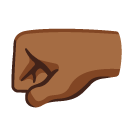


Appearance varies by platform and device. Google Noto, Twemoji, and OpenMoji are open-source.