🤜🏾
The Emoji
Right-facing Fist: Medium-dark Skin Tone
U+1F91C U+1F3FE · :rightfacing_fist_mediumdark_skin_tone:
Trend 65
Meaning layers
- interpretation
- Used to initiate a virtual fist bump, show hype, solidarity, or agreement with someone. Often paired with 🤛 for the complete fist bump exchange.
- tiktok usage
- Dropped in comment sections to show camaraderie or hype someone up, often as a wordless 'respect' or 'we're in this together' signal.
- irony level
- 2 / 10
Platform meanings
- meaning
- Virtual fist bump to hype up a creator or commenter; shows respect and shared energy.
- trend usage
- Commonly appears in comment chains where users find a shared opinion, pairing 🤜🏾 with 🤛🏾 to simulate a fist bump across the thread.
- hashtags
- #fistbump#solidarity#hype#respect#blacktiktok
- virality score
- 62 / 100
Cultural meanings
🇺🇸
Western / Gen-Z
Used widely as a virtual fist bump to show hype and solidarity; the skin tone is embraced as an expression of identity and representation.
🇵🇰
Pakistan & India
Interpreted as a sign of strength or solidarity; the fist can sometimes read as more aggressive than intended in conservative contexts.
🌍
Middle East
Generally understood as a power or strength symbol; the fist bump context may not be as culturally ingrained, so it can read as a generic strength gesture.
🌐
Global Neutral
Universally recognized as a fist or power gesture; the skin tone adds specificity of identity representation across cultures.
🇧🇩
Bangladesh
Seen as a strength or determination symbol; cultural nuance of fist bumping may not be fully recognized, more likely read as a power fist.
🇱🇰
Sri Lanka
Interpreted as a gesture of strength or solidarity; the fist bump nuance may be less familiar but the power symbolism is clear.
🇨🇳
China
The fist gesture is associated with determination and effort; the skin tone variation is noted but diversity emoji use is less prevalent.
🇯🇵
Japan
Seen as a 'fight on' or encouragement symbol (similar to 'ganbatte' energy); the directionality of the fist bump may not be fully grasped.
🇰🇷
South Korea
Used to express fighting spirit and encouragement; often paired with motivational content on social media.
🇹🇼
Taiwan
Interpreted as a power and encouragement symbol; fist bump cultural context is understood among younger, globally connected users.
🇭🇰
Hong Kong
Used among younger demographics to show solidarity and encouragement, especially in protest and community contexts.
🇵🇭
Philippines
Embraced as a hype and solidarity emoji; fist bump culture is familiar through American cultural influence.
🇮🇩
Indonesia
Seen as a strength and solidarity signal; widely used in motivational and community-focused content.
🇹🇭
Thailand
Interpreted as a power or encouragement gesture; fist bump context understood by younger, digitally fluent users.
🇻🇳
Vietnam
Used to express determination and support; the cultural nuance of fist bumping is recognized in urban, younger demographics.
🇲🇾
Malaysia
Embraced as a solidarity and hype symbol; multicultural context means it reads broadly as respect and strength.
🇸🇦
Saudi Arabia
Understood as a strength or victory symbol; the fist bump social gesture is recognized but less culturally central.
🇦🇪
UAE
Interpreted as solidarity and strength, especially in diverse, cosmopolitan digital communities; fist bump context understood across expat communities.
🇪🇬
Egypt
Seen as a power and solidarity symbol; used in protest and community contexts as well as casual encouragement.
🇹🇷
Turkey
Used to signal strength, determination, and camaraderie; fist bump interpretation familiar through global media influence.
🇮🇷
Iran
Interpreted as a power or resistance symbol; can carry political connotations in certain contexts.
🇳🇬
Nigeria
Strongly embraced as a cultural pride and solidarity symbol; frequently used in Afrobeats, sports, and community content.
🇿🇦
South Africa
Used to express Ubuntu-style solidarity and community strength; the medium-dark skin tone resonates deeply with cultural identity.
🇬🇧
UK & Ireland
Used casually as a fist bump or respect gesture; the skin tone is recognized as a representation statement.
🇫🇷
France
Interpreted as a solidarity and power symbol; used in social justice and sports contexts; skin tone diversity is politically noted.
🇩🇪
Germany
Understood as a team spirit and solidarity gesture; used in sports and professional achievement contexts.
🇪🇸
Spain & Italy
Seen as a hype and solidarity symbol; fist bump culture is familiar through sports and American media influence.
🇧🇷
Brazil
Enthusiastically used to show hype, solidarity, and cultural pride, especially in sports and Afro-Brazilian cultural contexts.
🇲🇽
Mexico
Used to signal strength, solidarity, and community; fist bump context is widely understood through American cultural proximity.
🌎
Latin America
Broadly interpreted as a solidarity and power gesture; skin tone representation resonates strongly in Afro-Latino communities.
🇦🇺
Australia & NZ
Used casually as a virtual fist bump to show respect and hype; the skin tone is appreciated as an inclusivity signal.
How its meaning shifted
- 2010
Emoji diversity with skin tones did not yet exist; the base fist emoji was used generically without cultural specificity.
- 2015
Skin tone modifiers were introduced; medium-dark skin tone fist emojis became tools of representation and identity expression online.
- 2020
Usage surged during the Black Lives Matter movement as a symbol of solidarity and cultural pride across all major platforms.
- 2026
Firmly established as a multi-context emoji representing solidarity, hype, and identity; a staple in Gen Z communication and cultural communities worldwide.
See it on every platform
Compare with
Adjacent emojis
Share & embed
Frequently asked
01What does the 🤜🏾 Right-facing Fist: Medium-dark Skin Tone emoji mean?
A right-facing fist with medium-dark skin tone, representing a fist bump gesture or solidarity punch directed to the right.
02What does 🤜🏾 mean on TikTok?
Virtual fist bump to hype up a creator or commenter; shows respect and shared energy.
03What does 🤜🏾 mean on WhatsApp?
Greeting or agreement bump; sent to signal 'I'm with you' or 'respect' in casual conversation.
04What does 🤜🏾 mean in Gen-Z slang?
Used to initiate a virtual fist bump, show hype, solidarity, or agreement with someone. Often paired with 🤛 for the complete fist bump exchange.
05Is the 🤜🏾 emoji safe to use?
A friendly fist bump, solidarity gesture, or hype signal used to show respect, encouragement, and community.
06What does 🤜🏾 mean in texting?
The fist bump is a universal symbol of mutual respect and shared energy; the medium-dark skin tone adds a layer of cultural identity and representation pride.
07What is the shortcode for 🤜🏾?
The shortcode for Right-facing Fist: Medium-dark Skin Tone is :rightfacing_fist_mediumdark_skin_tone:
08What does 🤜🏾 mean in dating?
Rarely used as a flirt tool; may signal playful competitiveness or a 'you've got this' encouragement vibe toward a crush.
Safety & usage
- Safe meaning
- A friendly fist bump, solidarity gesture, or hype signal used to show respect, encouragement, and community.
- Caution
- Could be interpreted as a threatening punch gesture if context is unclear or if used in an aggressive conversation.
Rarely misused, but in heated arguments it may be perceived as a threatening fist rather than a friendly bump. The skin tone aspect has occasionally been weaponized in racist trolling contexts to mock or stereotype.
How it looks across platforms
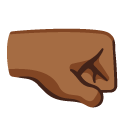


Appearance varies by platform and device. Google Noto, Twemoji, and OpenMoji are open-source.