🫷🏿
The Emoji
Leftwards Pushing Hand: Dark Skin Tone
U+1FAF7 U+1F3FF · :leftwards_pushing_hand_dark_skin_tone:
Trend 58
Meaning layers
- interpretation
- Used to signal rejection, creating distance, setting boundaries, or telling someone/something to back off. Often used humorously to 'push away' bad vibes, toxic people, or unwanted situations.
- tiktok usage
- Paired in sequences like 🫷🏿🫸🏿 to show a crushing or squeezing motion, or used solo to reject an idea in reaction comments.
- irony level
- 5 / 10
Platform meanings
- meaning
- Represents pushing away, blocking, or rejecting something in comment reactions and video captions.
- trend usage
- Used in the 'squish' hand trend alongside 🫸🏿, and in reaction chains where creators push away a bad take or cringe content.
- hashtags
- #boundaries#pushaway#nothanks#handsequence#rejectvibes
- virality score
- 62 / 100
Cultural meanings
🇺🇸
Western / Gen-Z
Widely used to express setting boundaries, rejecting drama, or humorously pushing away responsibilities. Often used in emoji sequences for meme-style communication.
🇵🇰
Pakistan & India
Used to signal refusal or telling someone to back off in casual digital conversation. The dark skin tone is appreciated for skin-tone diversity representation.
🌍
Middle East
Interpreted as a 'stop' or 'stay away' gesture, aligned with cultural gestures of warding off the evil eye or rejecting negativity. Relatively neutral in tone.
🌐
Global Neutral
Universally understood as a pushing or stopping gesture, used to reject, block, or create distance across all digital platforms.
🇧🇩
Bangladesh
Used similarly to the Indian subcontinent — a casual rejection or 'go away' signal in messaging apps like WhatsApp and Facebook.
🇱🇰
Sri Lanka
Deployed in casual chats to tell someone to stop or back off, often in a playful rather than aggressive tone.
🇨🇳
China
Less commonly used but understood as a pushing-away or refusing gesture; skin tone modifiers carry significance in representing diversity.
🇯🇵
Japan
Understood as a 'stop' or 'no' gesture; Japan's emoji culture tends to favor more stylized representations, so this may feel more direct and blunt.
🇰🇷
South Korea
Used in digital conversations to reject plans, people, or situations; fits well into the Korean internet culture of expressive emoji communication.
🇹🇼
Taiwan
Used similarly to South Korea — expressive rejection in group chats, often combined with other hand emojis for dramatic effect.
🇭🇰
Hong Kong
Adopted in casual Cantonese digital culture to push away unwanted situations or people, often with a humorous undertone.
🇵🇭
Philippines
Widely used in Filipino group chats on Facebook and Messenger to reject or refuse something, often in a joking manner.
🇮🇩
Indonesia
Used to signal refusal or to tell someone to back off in WhatsApp chats; sometimes combined with laughing emojis for a light-hearted tone.
🇹🇭
Thailand
Interpreted as a stop or rejection gesture; used in LINE messaging and Facebook to push away bad vibes or unwanted attention.
🇻🇳
Vietnam
Casual rejection signal used in Zalo and Facebook chats; the directional specificity (leftward) may be less culturally significant than the gesture itself.
🇲🇾
Malaysia
Used in Malaysian group chats to playfully reject ideas or tell people to stop, often mixed with Malaysian internet slang.
🇸🇦
Saudi Arabia
Used to signal stopping or refusing, aligning with cultural gestures of saying no without confrontation. The dark skin tone is seen as inclusive representation.
🇦🇪
UAE
In the diverse UAE digital space, used broadly to reject or push away — the dark skin tone modifier is especially appreciated for representing South Asian and African communities.
🇪🇬
Egypt
Used in Egyptian social media to push away someone's opinion or reject a bad suggestion in a discussion thread.
🇹🇷
Turkey
Deployed on Twitter and WhatsApp to signal rejection or dismissal in the straightforward Turkish digital communication style.
🇮🇷
Iran
Used on Telegram and Instagram to push back on unwanted content or comments, fitting the assertive tone common in Iranian online discourse.
🇳🇬
Nigeria
Highly popular in Nigerian social media to push away bad energy, toxic people, or nonsense — aligns deeply with the cultural concept of self-preservation and rejecting drama.
🇿🇦
South Africa
Used in South African WhatsApp and Twitter culture to reject, back off, or signal 'not today' energy — resonates especially in youth culture.
🇬🇧
UK & Ireland
Used in British and Irish digital banter to push away someone's terrible suggestion or a mate's bad joke, often sarcastically.
🇫🇷
France
Used in French social media to dismiss an opinion or push back on a take; fits the French cultural affinity for direct disagreement.
🇩🇪
Germany
Used in a relatively straightforward manner to signal rejection or stopping; Germans appreciate its directness as a communication tool.
🇪🇸
Spain & Italy
Used in expressive Southern European digital culture to dramatically push away bad ideas, toxic energy, or annoying situations — often with other emojis for added flair.
🇧🇷
Brazil
Very popular in Brazilian WhatsApp and Instagram culture to 'push away' bad vibes or an ex's memory; fits the expressive Brazilian communication style.
🇲🇽
Mexico
Used in Mexican digital culture to reject drama or tell someone to back off, often paired with humor and meme culture.
🌎
Latin America
Broadly used across Latin America to signal refusal, rejection, or setting boundaries; resonates with the expressive emoji culture in the region.
🇦🇺
Australia & NZ
Used in a casual, often humorous way to push away someone's ridiculous suggestion or bad idea — fits the Australian/NZ culture of blunt, lighthearted communication.
How its meaning shifted
- 2010
Did not exist — Unicode 14.0 was released in 2021, and directional hand emojis with skin tones were not yet part of the standard.
- 2015
Still did not exist; hand gesture emojis were more limited and lacked directional pushing variants.
- 2020
Still pre-release; the concept was under Unicode development. Similar pushing intent was expressed with ✋ or 🖐️.
- 2026
Established as a standard boundary-setting and rejection emoji, frequently used in mental health, Gen Z, and meme contexts across all major platforms.
See it on every platform
Adjacent emojis
Share & embed
Frequently asked
01What does the 🫷🏿 Leftwards Pushing Hand: Dark Skin Tone emoji mean?
A hand with dark skin tone pushed out to the left side, palm facing leftward, as if pushing something away or creating a boundary.
02What does 🫷🏿 mean on TikTok?
Represents pushing away, blocking, or rejecting something in comment reactions and video captions.
03What does 🫷🏿 mean on WhatsApp?
Telling someone to back off or expressing playful rejection in casual conversation.
04What does 🫷🏿 mean in Gen-Z slang?
Used to signal rejection, creating distance, setting boundaries, or telling someone/something to back off. Often used humorously to 'push away' bad vibes, toxic people, or unwanted situations.
05Is the 🫷🏿 emoji safe to use?
Setting boundaries, rejecting negativity, saying no, playful pushing away of ideas or people.
06What does 🫷🏿 mean in texting?
The pushing gesture taps into primal body language of self-protection and boundary enforcement, and using it digitally serves as a low-stakes way to assert personal space or reject unwanted stimuli.
07What is the shortcode for 🫷🏿?
The shortcode for Leftwards Pushing Hand: Dark Skin Tone is :leftwards_pushing_hand_dark_skin_tone:
08What does 🫷🏿 mean in dating?
Can be used playfully to 'push away' a flirty comment before pulling them back in — a classic push-pull dynamic in texting.
Safety & usage
- Safe meaning
- Setting boundaries, rejecting negativity, saying no, playful pushing away of ideas or people.
- Caution
- Can be used aggressively in harassment contexts to intimidate or signal a threatening push toward someone.
Generally safe but like any gesture emoji, context matters — in aggressive conversations it can amplify threatening tone.
How it looks across platforms
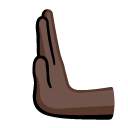

Appearance varies by platform and device. Google Noto, Twemoji, and OpenMoji are open-source.