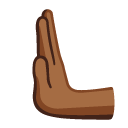
🫷🏾
The Emoji
Leftwards Pushing Hand: Medium-dark Skin Tone
U+1FAF7 U+1F3FE · :leftwards_pushing_hand_mediumdark_skin_tone:
Trend 65
Meaning layers
- interpretation
- Used to symbolize pushing something away, setting boundaries, rejecting vibes or people, or saying 'back off' without words. Often used in tandem with the rightwards pushing hand to create a 'stay back' wall gesture.
- tiktok usage
- Appears in reaction videos where creators push away bad takes, cringe content, or unwanted opinions. Paired with 🫸🏾 to form a double-hand barrier wall effect in comments.
- irony level
- 5 / 10
Platform meanings
- meaning
- Represents pushing away content, people, or energy that is unwanted. Used in comment reactions to signal 'nope' or 'get away from me.'
- trend usage
- Paired with text like 'pushing this off my FYP' or used in duets where creators physically mirror the emoji's gesture to react to cringe or controversial content.
- hashtags
- #boundaries#pushingaway#nope#rejectvibe#handgesture
- virality score
- 62 / 100
Cultural meanings
🇺🇸
Western / Gen-Z
Core slang emoji for Gen Z boundary-setting culture in the West; often paired with 🫸🏾 for dramatic effect and used heavily in self-care discourse.
🇵🇰
Pakistan & India
Interpreted as a 'stay away' or 'stop' gesture, culturally resonant with the concept of setting limits in family or social contexts, gaining traction in urban Gen Z communities.
🌍
Middle East
Read as a firm 'halt' or 'stop' gesture with cultural weight, used in digital spaces to assert disagreement or signal personal limits respectfully.
🌐
Global Neutral
Universally understood as a pushing or stopping hand gesture, making it one of the more cross-culturally legible directional hand emojis.
🇧🇩
Bangladesh
Used primarily by younger, internet-savvy users to express rejection or to tell someone to stop in casual digital communication.
🇱🇰
Sri Lanka
Found in social media posts and messaging apps among younger demographics, generally interpreted as a stop or rejection symbol.
🇨🇳
China
Less common due to platform differences (WeChat/Weibo dominant) but read as a 'don't come near' or 'stop' gesture in contexts where it appears.
🇯🇵
Japan
Interpreted similarly to the 'te wo furu' (waving off) gesture — polite but firm rejection; skin tone variation less culturally salient in Japan.
🇰🇷
South Korea
Used in digital communication to reject unwanted advances or bad ideas, fitting well within Korean internet culture's expressive emoji use.
🇹🇼
Taiwan
Understood as a dismissal or 'back off' emoji, used on platforms like PTT and Instagram by younger Taiwanese users in relatable content.
🇭🇰
Hong Kong
Used in Cantonese-language social media to signal rejection or to humorously push away problems in meme formats common on LIHKG.
🇵🇭
Philippines
Popular among Filipino social media users as a way to express 'wag' (don't) or to playfully push back in comment sections on TikTok and Facebook.
🇮🇩
Indonesia
Commonly used in Indonesian group chats and Twitter to signal refusal or to tell someone to stop in a non-confrontational, humorous way.
🇹🇭
Thailand
Interpreted as a gentle but firm signal to stop or back away; used in Thai social media to reject negative energy or unwanted interactions.
🇻🇳
Vietnam
Used by younger Vietnamese social media users to signal rejection or to push away bad luck, drama, or negativity in a culturally relatable way.
🇲🇾
Malaysia
Appears in Malaysian social media posts and group chats as a casual way to signal 'tak nak' (don't want) or to reject something playfully.
🇸🇦
Saudi Arabia
Interpreted as a formal stop gesture with some cultural resonance; used in social media to push back against opinions or to signal limits in public digital discourse.
🇦🇪
UAE
Used in Dubai and Abu Dhabi social media culture by younger, cosmopolitan users to signal boundary-setting in a multicultural digital context.
🇪🇬
Egypt
Understood as a firm rejection gesture, used humorously in Egyptian Twitter and TikTok comment sections to push away ridiculous claims or drama.
🇹🇷
Turkey
Read as a 'dur' (stop) signal in Turkish digital communication; used by Gen Z Turks on Twitter and Instagram to reject content they disagree with.
🇮🇷
Iran
Used in Persian-language social media to signal rejection or to humorously push away stress, censorship jokes, or unwanted situations.
🇳🇬
Nigeria
Highly used in Nigerian Twitter (now X) culture to dismiss bad takes with iconic brevity — '🫷🏾' alone is considered a full and devastating reply.
🇿🇦
South Africa
Used across South African social media to push back against opinions in a characteristically direct and humorous digital communication style.
🇬🇧
UK & Ireland
Used with dry British and Irish humor to dismiss nonsense, paired with sardonic captions like 'off you go then 🫷🏾' for comedic effect.
🇫🇷
France
Used in French social media to signal a Gallic-style dismissal — effortlessly cool rejection of ideas or people without lengthy explanation.
🇩🇪
Germany
Interpreted as a direct, no-nonsense rejection gesture fitting German communication directness; used clearly and without ambiguity online.
🇪🇸
Spain & Italy
Used expressively in Spanish and Italian social media to push away drama, add to passionate disagreements, or signal a theatrical rejection.
🇧🇷
Brazil
Extremely popular in Brazilian internet culture where it amplifies 'tô fora' (I'm out) energy — used in memes, comment sections, and viral posts.
🇲🇽
Mexico
Used by Mexican social media users to signal 'ya no' (no more) or to push away drama and toxic situations with characteristic humor.
🌎
Latin America
Across Latin America, used to express rejection of bad vibes, unsolicited advice, and drama — a unifying gesture across diverse regional digital cultures.
🇦🇺
Australia & NZ
Used with classic Aussie and Kiwi no-nonsense energy to tell people or ideas to 'rack off' — casual, direct, and slightly humorous.
How its meaning shifted
- 2010
Did not exist — Unicode 15.0 had not yet been released and directional pushing hand emojis were not part of the standard emoji set.
- 2015
Still non-existent in the emoji lexicon; the concept was partially covered by 🤚 or ✋ as stop/halt gestures without directional specificity.
- 2020
Not yet introduced; users relied on ✋, 🖐️, or 🛑 to convey similar pushing-away or stop gestures in digital communication.
- 2026
Firmly established in Gen Z vocabulary as the boundary-setting emoji of choice, paired with 🫸🏾 for dramatic barrier effects, and embedded in mental health, self-care, and empowerment digital culture.
See it on every platform
Compare with
Adjacent emojis
Share & embed
Frequently asked
01What does the 🫷🏾 Leftwards Pushing Hand: Medium-dark Skin Tone emoji mean?
A hand with palm facing left, pushing outward in a leftward direction, shown with a medium-dark skin tone modifier. Represents a pushing gesture directed to the left.
02What does 🫷🏾 mean on TikTok?
Represents pushing away content, people, or energy that is unwanted. Used in comment reactions to signal 'nope' or 'get away from me.'
03What does 🫷🏾 mean on WhatsApp?
Used to tell someone to back off or give space in a casual, non-confrontational way. Can also mean 'hold on' or 'wait a moment.'
04What does 🫷🏾 mean in Gen-Z slang?
Used to symbolize pushing something away, setting boundaries, rejecting vibes or people, or saying 'back off' without words. Often used in tandem with the rightwards pushing hand to create a 'stay back' wall gesture.
05Is the 🫷🏾 emoji safe to use?
Setting boundaries, pushing away negativity, saying stop or no, asserting personal space, expressing rejection humorously.
06What does 🫷🏾 mean in texting?
Psychologically linked to the concept of personal space and self-protection. The pushing motion signals a need for distance, autonomy, or refusal, which can be empowering or defensive depending on context.
07What is the shortcode for 🫷🏾?
The shortcode for Leftwards Pushing Hand: Medium-dark Skin Tone is :leftwards_pushing_hand_mediumdark_skin_tone:
08What does 🫷🏾 mean in dating?
Rarely used in flirting; more often signals playful rejection like 'stop it, you're too much' in a teasing way. Can be used humorously to push away cheesy pickup lines.
Safety & usage
- Safe meaning
- Setting boundaries, pushing away negativity, saying stop or no, asserting personal space, expressing rejection humorously.
- Caution
- Could be used to aggressively dismiss or silence someone in online arguments; in rare cases used to threaten or intimidate when combined with hostile language.
Generally safe and non-threatening on its own. Context-dependent — combined with hostile text it could contribute to aggressive dismissal or online bullying dynamics. No inherently NSFW connotations.
How it looks across platforms

Appearance varies by platform and device. Google Noto, Twemoji, and OpenMoji are open-source.