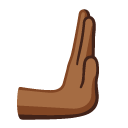
🫸🏾
The Emoji
Rightwards Pushing Hand: Medium-dark Skin Tone
U+1FAF8 U+1F3FE · :rightwards_pushing_hand_mediumdark_skin_tone:
Trend 58
Meaning layers
- interpretation
- Used to signal 'back off,' 'not now,' or 'stay in your lane.' Often deployed as a dismissive gesture toward drama, toxic energy, or unwanted opinions. Also used playfully to 'push' something away metaphorically.
- tiktok usage
- Appears in comment sections to push back against cringe content or bad takes. Paired with 🫷🏾 for a 'squishing' meme format or used in duets to react to wild videos.
- irony level
- 5 / 10
Platform meanings
- meaning
- Represents pushing away bad vibes, unwanted advice, drama, or toxic people. Used in comment battles or reaction videos to signal dismissal.
- trend usage
- Used in the 'sandwiching' trend alongside 🫷🏾 to squish things. Also appears in 'main character energy' videos where the creator pushes away negativity.
- hashtags
- #boundaries#notmyproblem#pushingaway#nope#maincharacter
- virality score
- 62 / 100
Cultural meanings
🇺🇸
Western / Gen-Z
Widely used in the US, Canada, and Western Europe by Gen Z as a boundary-setting or dismissive gesture in digital communication, especially in meme culture with the sandwiching format.
🇵🇰
Pakistan & India
Used to signal 'don't come close' or rejection in informal digital conversations; the medium-dark skin tone is relatable and increases identification. Sometimes used humorously in Bollywood reaction memes.
🌍
Middle East
Interpreted as a 'stop' or 'go away' gesture, which carries social weight in cultures with strong interpersonal distance norms. Used online mostly by youth in casual social media contexts.
🌐
Global Neutral
Universally readable as a pushing or stopping gesture regardless of cultural background, making it one of the more cross-culturally interpretable hand emojis.
🇧🇩
Bangladesh
Used informally by younger social media users to express rejection or to push away unwanted attention; the medium-dark skin tone resonates with local representation preferences.
🇱🇰
Sri Lanka
Relatively niche usage but growing among younger Instagram and WhatsApp users to signal dismissal or playful resistance in group chats.
🇨🇳
China
Less commonly used due to dominant local emoji ecosystems on WeChat, but on international platforms signals rejection or directional movement; skin tone emojis are less culturally emphasized.
🇯🇵
Japan
Interpreted carefully — pushing gestures can carry impolite connotations in Japanese communication norms. More likely used ironically or in humor contexts by younger users on Twitter/X.
🇰🇷
South Korea
Popular among Korean Gen Z on platforms like KakaoTalk exports and Twitter/X, often in combination with other emojis to create expressive emotional sequences, especially for 'pushing away stress' content.
🇹🇼
Taiwan
Used similarly to South Korea's Gen Z culture — appears in meme formats and emotional expression posts, often paired with text about mental wellness or aesthetic self-care.
🇭🇰
Hong Kong
Used in Cantonese-language social media to signal 'back off' or rejection with a mix of humor and bluntness that aligns with Hong Kong's direct communication style.
🇵🇭
Philippines
Very popular in Filipino social media culture where expressive emojis are heavily used; signals playful rejection or 'wag kang lumapit' (don't come close) energy in Tagalog comment sections.
🇮🇩
Indonesia
Used in casual chat on WhatsApp and Instagram to push away drama or signal a light-hearted 'no.' Relatable medium-dark skin tone increases usage frequency.
🇹🇭
Thailand
Appears in Thai social media to express gentle rejection or 'mai ao' (don't want) sentiment; often used humorously in reaction to cringe content.
🇻🇳
Vietnam
Gaining traction among Vietnamese youth on TikTok and Zalo for dismissing bad news, toxic energy, or ex-related content in a visually expressive way.
🇲🇾
Malaysia
Commonly used on Malaysian social media, especially in mixed-language (Malay/English) contexts, to signal rejection or to push away unwanted situations with a humorous tone.
🇸🇦
Saudi Arabia
Used among younger Saudi social media users, particularly women, to signal personal space and boundary-setting — carries empowerment undertones in that context.
🇦🇪
UAE
In the cosmopolitan UAE digital space, used casually by youth across expat and local communities to signal dismissal or boundary-setting, fitting into global meme culture.
🇪🇬
Egypt
Used on Egyptian Twitter/X and TikTok to push away political stress, bad news, or drama — often with comedic undertones reflecting Egyptian humor's resilience character.
🇹🇷
Turkey
Appears in Turkish social media to signal 'dur' (stop) or rejection, occasionally used in meme formats; the skin tone is culturally relatable for some Turkish users.
🇮🇷
Iran
Used on Instagram and Telegram (popular platforms in Iran) among youth to express rejection or boundary-setting, often in the context of personal freedom expression.
🇳🇬
Nigeria
Highly relatable medium-dark skin tone drives frequent use in Nigerian Twitter, WhatsApp, and Instagram — used for dramatic dismissals, Nollywood reaction memes, and 'leaving the drama' content.
🇿🇦
South Africa
Used across South African social media communities with the medium-dark skin tone being widely identified with; signals boundary-setting or dismissal in both serious and humorous contexts.
🇬🇧
UK & Ireland
Used with dry British humor to push away bad takes, rainy weather complaints, or cringe content; fits the understated rejection communication style of UK digital culture.
🇫🇷
France
Used occasionally in French social media for rejection or disagreement but competes with more verbally oriented communication styles; more popular among younger Gen Z users.
🇩🇪
Germany
Relatively literal interpretation — used to signal 'stop' or 'no further' in digital conversations; direct communication culture means it's used straightforwardly rather than ironically.
🇪🇸
Spain & Italy
Used expressively in Spanish and Italian social media to push away drama, bad energy, or unwanted situations — fits expressive Mediterranean communication culture well.
🇧🇷
Brazil
Extremely popular in Brazilian social media where expressive emoji use is very high; used to push away bad vibes, toxic exes, or Monday mornings with characteristic Brazilian humor.
🇲🇽
Mexico
Used heavily on Mexican TikTok and Instagram to signal 'no gracias' energy or dramatic rejection of bad situations; fits seamlessly into the expressive meme culture.
🌎
Latin America
Across Latin America, the emoji is used expressively to signal rejection, limit-setting, or comedic pushback; medium-dark skin tone resonates with diverse regional populations.
🇦🇺
Australia & NZ
Used with casual Aussie/Kiwi humor to push away bad vibes, bad sports results, or cringe moments; fits the laid-back but blunt communication style of the region.
How its meaning shifted
- 2010
Did not exist — Unicode 15.0 was not yet released and directional hand push emojis were not part of the emoji vocabulary. Hand gestures were limited to basic waves and pointing fingers.
- 2015
Still nonexistent as a specific emoji. Pushing gestures were approximated using ✋ or 👋 with directional context provided by surrounding text.
- 2020
Emoji did not yet exist but the cultural concept of 'pushing away' toxic energy was already trending digitally; users improvised with hand and arrow emoji combinations.
- 2026
Established as a key emoji in boundary-setting and meme culture, particularly the sandwiching format with 🫷🏾. Medium-dark skin tone version sees strong adoption in communities prioritizing representation.
See it on every platform
Adjacent emojis
- Often confused with
- waving handraised back of handbackhand index pointing right
- Can replace
- raised handstop signprohibited
Share & embed
Frequently asked
01What does the 🫸🏾 Rightwards Pushing Hand: Medium-dark Skin Tone emoji mean?
A hand with palm facing right, pushing outward, shown with a medium-dark skin tone. Part of the Unicode 15.0 set of directional hand gestures.
02What does 🫸🏾 mean on TikTok?
Represents pushing away bad vibes, unwanted advice, drama, or toxic people. Used in comment battles or reaction videos to signal dismissal.
03What does 🫸🏾 mean on WhatsApp?
Tells someone to back off or gives a playful 'stop it' in casual conversation. Signals personal space in text form.
04What does 🫸🏾 mean in Gen-Z slang?
Used to signal 'back off,' 'not now,' or 'stay in your lane.' Often deployed as a dismissive gesture toward drama, toxic energy, or unwanted opinions. Also used playfully to 'push' something away metaphorically.
05Is the 🫸🏾 emoji safe to use?
Setting personal limits, playfully dismissing someone, rejecting negativity, expressing 'stop' or 'back off' in a non-violent digital way.
06What does 🫸🏾 mean in texting?
Psychologically reflects a self-protective impulse — the act of pushing away represents emotional distancing. When used online it can express healthy boundary-setting or, depending on context, cold dismissal or social aggression.
07What is the shortcode for 🫸🏾?
The shortcode for Rightwards Pushing Hand: Medium-dark Skin Tone is :rightwards_pushing_hand_mediumdark_skin_tone:
08What does 🫸🏾 mean in dating?
Can be used playfully to 'push' a flirty comment away in a teasing 'stop it, you're too much' sense, implying endearment rather than true rejection.
Safety & usage
- Safe meaning
- Setting personal limits, playfully dismissing someone, rejecting negativity, expressing 'stop' or 'back off' in a non-violent digital way.
- Caution
- Can be used as part of online harassment campaigns to 'push out' individuals from conversations or communities, or to signal coordinated rejection of a person.
Generally safe. In rare cases may appear in contexts of coordinated exclusion or cyberbullying where groups use it to signal rejection of a targeted individual.
How it looks across platforms

Appearance varies by platform and device. Google Noto, Twemoji, and OpenMoji are open-source.