🤷🏿♂️
The Emoji
Man Shrugging: Dark Skin Tone
U+1F937 U+1F3FF U+200D U+2642 U+FE0F · :man_shrugging_dark_skin_tone:
Trend 78
Meaning layers
- interpretation
- Used to express unbothered energy, plausible deniability, or a 'not my problem' attitude with a cool, detached vibe.
- tiktok usage
- Appears in comment sections to dismiss drama or respond to criticism with maximum nonchalance, often paired with dark humor captions.
- irony level
- 7 / 10
Platform meanings
- meaning
- Unbothered reaction to drama, hate comments, or chaotic situations; signals cool detachment or 'idc' energy.
- trend usage
- Used heavily in duets and reply videos to dismiss criticism or troll responses, often combined with trending audio.
- hashtags
- #unbothered#idgaf#notmyproblem#vibes#icanteven
- virality score
- 82 / 100
Cultural meanings
🇺🇸
Western / Gen-Z
Quintessential unbothered emoji in Gen Z digital vocabulary — represents the 'I ate and left no crumbs and I don't care' energy, especially popular with cool, low-drama online personas.
🇵🇰
Pakistan & India
Used in urban youth digital culture to signal detachment from family pressure or to respond to nosy questions about career or marriage with playful deflection.
🌍
Middle East
Deployed in casual group chats to respond to family or social obligations with light humor, though the 'man' variant is culturally more accepted among male users in conservative contexts.
🌐
Global Neutral
Universally recognized as 'I don't know' or 'whatever' — the skin tone modifier makes it more authentic and representative for darker-skinned users globally.
🇧🇩
Bangladesh
Gaining traction in urban youth social media culture, primarily on Facebook and TikTok, to express resignation about socioeconomic situations or exam results.
🇱🇰
Sri Lanka
Used among younger social media users to express casual indifference, particularly on WhatsApp and TikTok, in response to life uncertainty or political news.
🇨🇳
China
Less commonly used due to platform restrictions on international emoji sets; on WeChat or Weibo, similar meaning is conveyed through local sticker packs rather than this emoji.
🇯🇵
Japan
The shrug gesture itself is less culturally ingrained in Japan where subtle expressions dominate, making this emoji feel somewhat foreign; used mainly by internationally-exposed youth.
🇰🇷
South Korea
Adopted by K-pop fan communities and younger users on platforms like KakaoTalk to express 'molla (모르겠다 / I don't know)' energy in a visually punchy way.
🇹🇼
Taiwan
Used casually in LINE chats and Instagram among Taiwanese youth to express uncertainty or a devil-may-care attitude toward everyday decisions.
🇭🇰
Hong Kong
Popular in Cantonese social media culture to express the local concept of 'mou liu (無聊 / whatever, who cares)' with an added layer of cool nonchalance.
🇵🇭
Philippines
Extremely common in Filipino Twitter and TikTok — often used in reaction to chaotic news, political absurdity, or relatable life struggles with dark humor.
🇮🇩
Indonesia
Used widely on Twitter (X) and TikTok among Indonesian youth to signal 'terserah (whatever)' or detachment from drama, especially political content.
🇹🇭
Thailand
Appears in Thai social media to express 'ช่างเถอะ (mai pen rai / never mind)' — the cultural philosophy of not sweating small things aligns well with this emoji.
🇻🇳
Vietnam
Used on TikTok and Facebook among younger Vietnamese users to signal indifference or a chill response to peer pressure and social expectations.
🇲🇾
Malaysia
Popular in Malaysian social media to express 'takpe lah (never mind)' attitudes, especially in response to government decisions or daily frustrations.
🇸🇦
Saudi Arabia
Used primarily by younger male Saudi social media users on Snapchat and Twitter to express casual indifference, sometimes in response to sports results or social plans.
🇦🇪
UAE
Common in the diverse, multicultural UAE digital sphere — used across nationalities to signal nonchalance, especially in English-language social media interactions.
🇪🇬
Egypt
Frequently used on Egyptian Facebook and TikTok to respond to country-specific absurdities, political news, or with the phrase 'mesh mohem (it doesn't matter).'
🇹🇷
Turkey
Deployed in Turkish Twitter and Instagram to express 'ne bileyim (how should I know)' or indifference to polarizing social issues among Gen Z users.
🇮🇷
Iran
Used in Instagram and Telegram among Iranian youth — often carries a subtler connotation of resigned helplessness in the face of societal limitations.
🇳🇬
Nigeria
Hugely popular in Nigerian Twitter (Naija Twitter) culture — used with Yoruba, Igbo, or Pidgin captions to express detachment from drama or 'e no concern me' energy.
🇿🇦
South Africa
Common in South African social media across racial communities to express 'eish (what can you do)' sentiment about daily frustrations or load shedding.
🇬🇧
UK & Ireland
Used with classic British/Irish dry humor — the emoji equivalent of 'could be worse, could be better' or a deadpan response to someone's outrageous claim.
🇫🇷
France
Mirrors the cultural concept of the French shrug ('bof'), making this one of the most culturally resonant emoji choices for French internet users expressing indifference.
🇩🇪
Germany
Deployed in a more literal sense to express genuine uncertainty in German social media contexts, where performative indifference is less culturally valued than directness.
🇪🇸
Spain & Italy
Used expansively in Mediterranean social media culture to pair with 'boh' or 'qué sé yo' expressions — a digital version of the deeply ingrained shrug gesture.
🇧🇷
Brazil
Extremely popular in Brazilian internet culture on Twitter and TikTok, often used with 'sei lá' or as part of humorous reactions to Brazilian bureaucracy and daily chaos.
🇲🇽
Mexico
Common in Mexican social media to signal 'qué se le va a hacer (what can you do)' — used humorously to respond to everyday absurdities or government actions.
🌎
Latin America
Broadly understood across Latin America as representing resigned indifference or the cultural norm of 'ni modo' — accepting uncontrollable circumstances with humor.
🇦🇺
Australia & NZ
Used with classic antipodean 'she'll be right' energy — fits perfectly into Australian and New Zealand casual internet culture of downplaying everything.
How its meaning shifted
- 2010
This specific emoji combination did not exist yet — skin tone modifiers for emoji were not introduced until 2015, and shrugging emoji came later.
- 2015
Skin tone modifiers were introduced via Unicode 8.0; the base shrugging emoji began emerging, though the dark skin tone variant had limited adoption initially.
- 2020
Gained significant cultural momentum as representation conversations intensified — more Black and Brown users actively chose skin-tone-appropriate emoji, making this variant widely used.
- 2026
Firmly established as a high-frequency emoji in Black digital culture and global Gen Z vocabulary; the dark skin tone variant is increasingly selected by default by users with darker skin tones.
See it on every platform
Adjacent emojis
- Often confused with
- person gesturing nowaving handraised hands
Share & embed
Frequently asked
01What does the 🤷🏿♂️ Man Shrugging: Dark Skin Tone emoji mean?
A man with dark skin tone raising both hands with shoulders raised in a shrug gesture, indicating uncertainty, indifference, or lack of knowledge.
02What does 🤷🏿♂️ mean on TikTok?
Unbothered reaction to drama, hate comments, or chaotic situations; signals cool detachment or 'idc' energy.
03What does 🤷🏿♂️ mean on WhatsApp?
Quick response to plans or questions when you genuinely don't know or don't mind — casual and low-effort.
04What does 🤷🏿♂️ mean in Gen-Z slang?
Used to express unbothered energy, plausible deniability, or a 'not my problem' attitude with a cool, detached vibe.
05Is the 🤷🏿♂️ emoji safe to use?
Expression of uncertainty, indifference, or nonchalance in casual digital communication.
06What does 🤷🏿♂️ mean in texting?
Psychologically represents a defense mechanism of emotional detachment — shielding oneself from vulnerability by performing apathy or helplessness.
07What is the shortcode for 🤷🏿♂️?
The shortcode for Man Shrugging: Dark Skin Tone is :man_shrugging_dark_skin_tone:
08What does 🤷🏿♂️ mean in dating?
Used to play coy or hard to get, implying 'maybe' to a date suggestion while maintaining mystery and not appearing too eager.
Safety & usage
- Safe meaning
- Expression of uncertainty, indifference, or nonchalance in casual digital communication.
- Caution
- Can be used to gaslight, dismiss serious concerns, or deflect accountability in interpersonal conflicts.
In sensitive conversations about mental health, relationships, or serious topics, this emoji can come across as deeply dismissive or invalidating if used carelessly.
How it looks across platforms
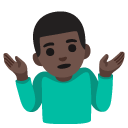
Appearance varies by platform and device. Google Noto, Twemoji, and OpenMoji are open-source.