🤷🏾♂️
The Emoji
Man Shrugging: Medium-dark Skin Tone
U+1F937 U+1F3FE U+200D U+2642 U+FE0F · :man_shrugging_mediumdark_skin_tone:
Trend 72
Meaning layers
- interpretation
- The go-to response for unbothered energy, plausible deniability, or when you literally have no explanation for your own behavior. Signals detachment with a hint of 'not my problem.'
- tiktok usage
- Used in comment sections when someone can't explain a trend, a reaction, or their own chaotic choices — often paired with 'idk man' captions.
- irony level
- 6 / 10
Platform meanings
- meaning
- Expresses unbothered energy, cluelessness, or the 'I simply do not know' vibe — especially in comment wars or response videos.
- trend usage
- Used in duets and stitch replies when creators have no rebuttal but won't concede, or in POV videos depicting a character who doesn't care.
- hashtags
- #unbothered#idk#notmyproblem#shrug#icantexplain
- virality score
- 74 / 100
Cultural meanings
🇺🇸
Western / Gen-Z
The definitive unbothered emoji — used constantly across all platforms to signal detachment, plausible deniability, and effortless cool. Irony is almost always present.
🇵🇰
Pakistan & India
Used widely in urban youth digital culture to express 'kya pata yaar' (who knows, man) energy — relatable across both Hindi and Urdu speaking communities online.
🌍
Middle East
Common in Gulf youth digital culture to express 'wallah ma adri' (I swear I don't know) — casual, non-committal, and generally well understood in Arabic-speaking social media circles.
🌐
Global Neutral
Universally understood as a gesture of not knowing or not caring — the least culturally loaded of shrug variants due to the near-universal recognition of the shoulder shrug gesture.
🇧🇩
Bangladesh
Used among Dhaka's young urban internet users to express 'ki jani' (who knows) energy — growing in popularity on Facebook and WhatsApp.
🇱🇰
Sri Lanka
Adopted in Sri Lankan youth online culture, particularly on Facebook and Instagram, to signal casual indifference or genuine lack of information in local group chats.
🇨🇳
China
Less commonly used due to preference for platform-specific emoticons on WeChat and Weibo, but understood among younger users familiar with Western social media as a 'no idea' signal.
🇯🇵
Japan
The shrug gesture is less culturally native in Japan, so this emoji is read more as a foreign internet expression of uncertainty rather than a culturally local gesture.
🇰🇷
South Korea
Used among Korean youth on KakaoTalk and Instagram to express 'molla' (I don't know) energy, often mixed with Korean-specific emoji combinations.
🇹🇼
Taiwan
Understood in its Western internet context among younger Taiwanese users on Instagram and Dcard — carries the 'idk, whatever' vibe without much cultural friction.
🇭🇰
Hong Kong
Popular in Hong Kong's bilingual digital culture, used on Instagram and WhatsApp to express casual indifference — fits well with the city's pragmatic 'ho yeh' (it'll do) attitude.
🇵🇭
Philippines
Extremely popular in Filipino internet culture — used extensively in Facebook and TikTok comments to express 'ewan ko' (I don't know) with a laid-back, humor-forward tone.
🇮🇩
Indonesia
Common on Twitter (X) and Instagram among Indonesian youth to express 'ga tau deh' (I don't know) — frequently paired with other emojis for humorous effect.
🇹🇭
Thailand
Used in Thai social media to express casual 'mai ru' (don't know) energy — popular on Twitter and TikTok among younger users who are highly engaged with Western internet culture.
🇻🇳
Vietnam
Growing in usage among Vietnamese youth on TikTok and Zalo to express genuine cluelessness or casual indifference, often in response to trending topics.
🇲🇾
Malaysia
Widely used in Malaysian group chats and social media to express 'tak tau la' (don't know la) — the 'la' particle makes the shrug energy especially fitting in Malaysian digital communication.
🇸🇦
Saudi Arabia
Used by Saudi youth on Snapchat and Twitter to express casual indifference or uncertainty — the medium-dark skin tone variant is particularly resonant in the region for representation reasons.
🇦🇪
UAE
Popular in Dubai and Abu Dhabi's cosmopolitan, multicultural youth culture — used across WhatsApp, Instagram, and Snapchat to signal the city's characteristic 'whatever, it's fine' energy.
🇪🇬
Egypt
Common in Egyptian social media humor — used on Facebook and Twitter to express 'mish arif' (I don't know) with a comedic or self-deprecating tone in discussions about daily frustrations.
🇹🇷
Turkey
Used on Twitter and Instagram by Turkish youth to express 'bilmiyorum işte' (I just don't know) energy — often appears in reactions to political or cultural absurdities.
🇮🇷
Iran
Used on Instagram and Telegram by Iranian youth as a safe, neutral expression of indifference or uncertainty — politically neutral enough to be used without concern.
🇳🇬
Nigeria
Hugely popular in Nigerian Twitter (now X) culture — used to express 'I no sabi' (I don't know) energy and often deployed in heated discourse as a dismissal or expression of exhaustion.
🇿🇦
South Africa
Common in South African social media across communities — used in WhatsApp groups and Twitter to express 'eish, I don't know' energy with a broadly relatable and humor-forward tone.
🇬🇧
UK & Ireland
Used extensively in British and Irish internet culture with heavy sarcasm — often means 'not a clue, mate' and fits naturally into the deadpan, self-deprecating humor style of the region.
🇫🇷
France
Fits naturally with the culturally iconic French shrug — used online to express the quintessential 'bof' (meh) attitude and is one of the most culturally resonant emoji for French users.
🇩🇪
Germany
Used more literally in German digital communication — signals genuine uncertainty or a practical 'I don't have this information' without as much ironic or sarcastic layering.
🇪🇸
Spain & Italy
Used expansively in Spanish and Italian WhatsApp and Instagram culture — the expressive gesture culture of both countries makes the shrug feel native and it's used with warmth and humor.
🇧🇷
Brazil
Extremely popular in Brazilian digital culture — used on WhatsApp, Twitter, and Instagram to express 'sei lá' (who knows) with high energy, humor, and frequent irony.
🇲🇽
Mexico
Common in Mexican social media to express 'quién sabe' (who knows) energy — used with humor and self-awareness in response to chaotic situations or unanswerable questions.
🌎
Latin America
Broadly understood across Latin America as a casual 'no sé' (I don't know) expression — one of the most universally used emojis across the region's youth digital culture.
🇦🇺
Australia & NZ
Used with characteristically Australian and Kiwi laid-back irony — signals 'dunno, she'll be right' energy and fits perfectly into the region's casual, understated digital communication style.
How its meaning shifted
- 2010
The shrug emoji as a concept barely existed in formal Unicode form — shoulder shrugging was expressed through ASCII art '¯\_(ツ)_/¯' which predates this emoji entirely.
- 2015
The base shrug emoji was introduced and quickly became popular; skin tone variants were just rolling out, and the gendered male version was gaining traction as a symbol of casual indifference.
- 2020
Fully embedded in Gen Z communication — used across all platforms as a versatile signal of uncertainty, unbothered energy, and soft sarcasm; the medium-dark skin tone variant gained cultural visibility alongside broader emoji diversity conversations.
- 2026
A staple emoji with deeply layered ironic meaning — used as much for strategic emotional deflection as for genuine uncertainty; the skin-tone variant is celebrated for representation while the gesture itself has evolved into a complex social signal across global digital culture.
See it on every platform
Adjacent emojis
- Often confused with
- person gesturing okwaving handraised hand
Share & embed
Frequently asked
01What does the 🤷🏾♂️ Man Shrugging: Medium-dark Skin Tone emoji mean?
A man with medium-dark skin tone raising both hands in a shrugging gesture, indicating uncertainty, indifference, or lack of knowledge.
02What does 🤷🏾♂️ mean on TikTok?
Expresses unbothered energy, cluelessness, or the 'I simply do not know' vibe — especially in comment wars or response videos.
03What does 🤷🏾♂️ mean on WhatsApp?
Quick signal that the sender has no answer, no opinion, or genuinely doesn't care — often ends a conversation thread.
04What does 🤷🏾♂️ mean in Gen-Z slang?
The go-to response for unbothered energy, plausible deniability, or when you literally have no explanation for your own behavior. Signals detachment with a hint of 'not my problem.'
05Is the 🤷🏾♂️ emoji safe to use?
Casual expression of uncertainty, indifference, or not having an answer — broadly non-offensive and socially neutral in most contexts.
06What does 🤷🏾♂️ mean in texting?
Psychologically signals a desire to disengage from responsibility or conflict without appearing overtly hostile; a socially acceptable form of avoidance that maintains deniability.
07What is the shortcode for 🤷🏾♂️?
The shortcode for Man Shrugging: Medium-dark Skin Tone is :man_shrugging_mediumdark_skin_tone:
08What does 🤷🏾♂️ mean in dating?
Used flirtatiously to play coy — like saying 'maybe I like you, who knows?' without putting feelings on the line.
Safety & usage
- Safe meaning
- Casual expression of uncertainty, indifference, or not having an answer — broadly non-offensive and socially neutral in most contexts.
- Caution
- Can be used as a dismissive tool in arguments to gaslight or minimize someone's concerns — the 'not my problem' energy can come across as callous or invalidating in sensitive conversations.
In conflict or emotional conversations, this emoji can escalate tension by signaling complete disengagement; in professional contexts it may undermine credibility if overused.
How it looks across platforms
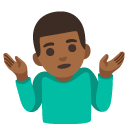
Appearance varies by platform and device. Google Noto, Twemoji, and OpenMoji are open-source.