🧍🏾♂️
The Emoji
Man Standing: Medium-dark Skin Tone
U+1F9CD U+1F3FE U+200D U+2642 U+FE0F · :man_standing_mediumdark_skin_tone:
Trend 38
Meaning layers
- interpretation
- Used to convey awkward stillness, doing absolutely nothing, or being present but unbothered. Often expresses the 'I'm just standing here' energy of someone who has checked out.
- tiktok usage
- Appears in videos about being idle, zoning out, or passive participation — often paired with captions like 'me at the party knowing nobody'.
- irony level
- 7 / 10
Platform meanings
- meaning
- Symbol of passive presence, awkward idling, or the 'I'm just standing here' meme persona.
- trend usage
- Paired with trending audio about doing nothing or being the odd one out at social gatherings.
- hashtags
- #standing#awkwardmoments#doingnothing#justme#unbothered
- virality score
- 42 / 100
Cultural meanings
🇺🇸
Western / Gen-Z
Widely used to represent the 'NPC energy' or doing absolutely nothing as an ironic flex — a hallmark of Gen Z humor about passive existence.
🇵🇰
Pakistan & India
Used to represent a calm, grounded individual or to indicate someone who is present but idle; skin tone modifier resonates with South Asian users as a form of self-representation.
🌍
Middle East
Generally interpreted as a neutral human figure; the medium-dark skin tone is positively received in communities where it aligns with common complexions.
🌐
Global Neutral
Universally understood as a person standing still; functions as a default neutral human presence emoji across most global contexts.
🇧🇩
Bangladesh
Appreciated as a more representative emoji for South Asian complexions; used to express being idle, waiting, or simply existing.
🇱🇰
Sri Lanka
Used similarly to neighboring South Asian cultures — a relatable skin tone combined with the universally understood 'just standing' posture.
🇨🇳
China
Less commonly used; standing human emojis are sometimes seen as filler or background-character representations in casual chat contexts.
🇯🇵
Japan
Used sparingly in Japanese digital culture; may evoke the image of an NPC character from video games, fitting into gaming humor contexts.
🇰🇷
South Korea
Appears in contexts related to awkward moments, being the 'extra' in a group, or standing alone — resonant in highly social Korean digital spaces.
🇹🇼
Taiwan
Used casually to indicate presence without engagement; the skin tone aspect is noted but the idle posture carries more communicative weight.
🇭🇰
Hong Kong
Employed in conversations about waiting, being unbothered, or representing the quiet observer role in social dynamics.
🇵🇭
Philippines
Medium-dark skin tone is embraced positively as representational; used in contexts of casual presence and everyday relatable moments.
🇮🇩
Indonesia
Resonates with users who identify with the skin tone; commonly used to signal a relaxed or idle state in casual messaging.
🇹🇭
Thailand
Used in lighthearted contexts to indicate doing nothing or waiting; the human figure emoji is generally interpreted neutrally.
🇻🇳
Vietnam
Deployed in casual chat to indicate passivity or waiting; the skin tone modifier is seen as inclusive representation.
🇲🇾
Malaysia
Embraced as a relatable skin tone representative; used across contexts of idle presence and calm, unbothered attitudes.
🇸🇦
Saudi Arabia
Interpreted as a neutral standing male figure; the skin tone aligns with common complexions in the region and is used without notable cultural friction.
🇦🇪
UAE
Used in diverse digital communities to represent neutral male presence; appreciated in multicultural chat contexts for its skin tone inclusivity.
🇪🇬
Egypt
Generally interpreted as a man standing still; the medium-dark skin tone resonates with many Egyptian users as a closer representation.
🇹🇷
Turkey
Used in casual contexts to represent an idle or unbothered person; the standing posture is associated with being steady or grounded.
🇮🇷
Iran
Deployed in informal chats to signal passive presence or waiting; human figure emojis are generally used without deep cultural layering.
🇳🇬
Nigeria
Positively received as the medium-dark skin tone is widely relatable; used across social media to express confidence, presence, and unbothered energy.
🇿🇦
South Africa
Embraced for its skin tone representation in a diverse society; used to signal calm, collective presence or individual idle moments.
🇬🇧
UK & Ireland
Used with dry humor typical of British culture to represent the awkward person standing alone — often ironic and self-deprecating.
🇫🇷
France
Deployed in casual online spaces to signal neutrality or indifference — aligning with French cultural appreciation for detached cool.
🇩🇪
Germany
Used straightforwardly to indicate presence or waiting; German digital users tend to interpret it more literally than ironically.
🇪🇸
Spain & Italy
Used in social contexts to signal waiting for someone or being present at an event; the expressive cultures add warmth to its casual use.
🇧🇷
Brazil
Used playfully in Brazilian meme culture to represent the 'cara parado' (guy just standing there) trope in social situations.
🇲🇽
Mexico
Appears in humorous contexts about being the awkward one at a gathering or standing firm during disagreements.
🌎
Latin America
Broadly used across Latin American digital spaces to represent idle presence, waiting, or the quietly confident bystander figure.
🇦🇺
Australia & NZ
Used with casual humor to represent doing nothing or being the relaxed bystander — fits the laid-back cultural attitude perfectly.
How its meaning shifted
- 2010
This emoji did not exist yet; skin tone modifiers and standing person emojis were not part of the Unicode standard in 2010.
- 2015
Introduced as part of Unicode 9.0 groundwork; early adoption was limited with users experimenting with skin tone diversity modifiers for the first time.
- 2020
Gained traction as NPC memes and 'doing nothing' humor surged; used increasingly to represent passive, unbothered, or background character energy.
- 2026
Firmly embedded in Gen Z irony culture as a shorthand for idle existence, unbothered detachment, and skin tone self-representation across all major platforms.
See it on every platform
Compare with
Adjacent emojis
- Often confused with
- man standing light skin toneperson standingman in suit levitating
- Can replace
- person standingman shruggingneutral face
Share & embed
Frequently asked
01What does the 🧍🏾♂️ Man Standing: Medium-dark Skin Tone emoji mean?
A man standing upright in a neutral, stationary pose with medium-dark skin tone applied via modifier.
02What does 🧍🏾♂️ mean on TikTok?
Symbol of passive presence, awkward idling, or the 'I'm just standing here' meme persona.
03What does 🧍🏾♂️ mean on WhatsApp?
Signals the sender is idle, waiting, or present but not actively participating in the conversation.
04What does 🧍🏾♂️ mean in Gen-Z slang?
Used to convey awkward stillness, doing absolutely nothing, or being present but unbothered. Often expresses the 'I'm just standing here' energy of someone who has checked out.
05Is the 🧍🏾♂️ emoji safe to use?
A neutral depiction of a man standing with medium-dark skin tone — inclusive, representational, and harmless in the vast majority of contexts.
06What does 🧍🏾♂️ mean in texting?
The standing-still posture evokes a psychological state of waiting, uncertainty, or deliberate disengagement — commonly associated with social anxiety or intentional boundary-setting.
07What is the shortcode for 🧍🏾♂️?
The shortcode for Man Standing: Medium-dark Skin Tone is :man_standing_mediumdark_skin_tone:
08What does 🧍🏾♂️ mean in dating?
Rarely used flirtatiously; if sent alone it can suggest the person is waiting for you to make a move or is playing it cool.
Safety & usage
- Safe meaning
- A neutral depiction of a man standing with medium-dark skin tone — inclusive, representational, and harmless in the vast majority of contexts.
- Caution
- Could theoretically be used in coordinated harassment to depict a specific person, though this is highly situational and not an inherent property of the emoji.
No known widespread toxic or NSFW usage patterns; generally considered a safe and neutral emoji.
How it looks across platforms
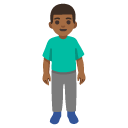
Appearance varies by platform and device. Google Noto, Twemoji, and OpenMoji are open-source.