🦸🏼♂️
The Emoji
Man Superhero: Medium-light Skin Tone
U+1F9B8 U+1F3FC U+200D U+2642 U+FE0F · :man_superhero_mediumlight_skin_tone:
Trend 62
Meaning layers
- interpretation
- Used to hype someone up, celebrate a heroic or clutch moment, or ironically call yourself the main character in a situation. Can also be used to simp for someone who 'saved' you emotionally.
- tiktok usage
- Appears in 'main character' energy videos, hype comment sections, or when someone does something unexpectedly impressive or wholesome.
- irony level
- 5 / 10
Platform meanings
- meaning
- Symbol of main character energy, hype, and clutch moments; used when someone does something unexpectedly impressive
- trend usage
- Appears in POV videos, hype comment chains, and 'main character' aesthetic content
- hashtags
- #mainchracter#superhero#hypeup#clutch#heroic
- virality score
- 68 / 100
Cultural meanings
🇺🇸
Western / Gen-Z
Widely used as ironic self-hype or genuine admiration, often paired with 'main character' culture and Marvel/DC fandom references.
🇵🇰
Pakistan & India
Used to praise someone who did something helpful or impressive; also popular among younger audiences celebrating cricket heroes or Bollywood action stars.
🌍
Middle East
Generally understood as praise for bravery or helpfulness; skin tone diversity in emojis is noticed and the medium-light tone may be consciously chosen for personal identification.
🌐
Global Neutral
Universally recognized as a symbol of heroism, strength, and admiration across most digital contexts.
🇧🇩
Bangladesh
Used by youth on social media to hype up friends or celebrate national heroes; less ironic usage compared to Western contexts.
🇱🇰
Sri Lanka
Appears in motivational content and sports fan communities; used to praise local heroes or helpful community members.
🇨🇳
China
Superhero emojis have moderate usage; more popular among youth familiar with Marvel/DC; the concept maps to 'hero' (英雄) which carries cultural weight in storytelling traditions.
🇯🇵
Japan
Used in gaming and anime communities with enthusiasm; Japan's deep superhero culture (tokusatsu, manga) makes this emoji resonate strongly with specific fandoms.
🇰🇷
South Korea
Popular in K-pop fan communities praising idols and in gaming culture; used heavily in hype comments on social media.
🇹🇼
Taiwan
Used similarly to South Korea — strong in gaming and pop culture communities as a hype and admiration emoji.
🇭🇰
Hong Kong
Adopted in digital youth culture for hype and admiration; also carries political undertones in some protest-related contexts where individuals are praised as community heroes.
🇵🇭
Philippines
Frequently used to praise OFW (Overseas Filipino Workers) as 'bagong bayani' (modern heroes) or to hype celebrities and athletes.
🇮🇩
Indonesia
Used in gaming and social media hype culture; popular among younger generations to praise friends or content creators.
🇹🇭
Thailand
Appears in motivational posts and fan communities; used to celebrate local sports stars, streamers, or helpful individuals.
🇻🇳
Vietnam
Popular in gaming communities and youth culture for praising clutch moments; also used in wholesome content praising helpful people.
🇲🇾
Malaysia
Used across multicultural social media communities for hype and admiration; appears in gaming, sports, and motivational content.
🇸🇦
Saudi Arabia
Used by younger audiences on social media to praise helpful or impressive individuals; Marvel/DC influence makes the imagery immediately recognizable.
🇦🇪
UAE
Common among the diverse, globally connected youth population; used in hype culture and motivational social media content.
🇪🇬
Egypt
Used to praise public figures, activists, and friends who do courageous things; carries genuine admiration more than irony in most contexts.
🇹🇷
Turkey
Popular in gaming and social media; used to praise brave or helpful individuals, with some ironic usage emerging in meme culture.
🇮🇷
Iran
Used among younger social media users, particularly in gaming and fandom spaces; represents admiration and strength.
🇳🇬
Nigeria
Used to hype friends and celebrate impressive acts; Nollywood action hero culture and sports pride (especially football) make this emoji culturally resonant.
🇿🇦
South Africa
Used across diverse communities to celebrate personal and community heroes; appears in sports fan content and motivational posts.
🇬🇧
UK & Ireland
Used with significant irony and self-deprecation — often employed sarcastically for minor accomplishments, fitting British humor culture.
🇫🇷
France
Moderate usage; appears in hype and admiration contexts but the French digital culture tends toward wit, so ironic usage is common.
🇩🇪
Germany
Used straightforwardly for admiration and achievement; less ironic usage than UK — appears in motivational and sports content.
🇪🇸
Spain & Italy
Used expressively to praise someone's impressive action or personality; fits into the expressive, social emoji culture of Southern Europe.
🇧🇷
Brazil
High-energy usage aligned with Brazilian social media culture — used to hype friends, celebrate athletes, and express admiration in an enthusiastic way.
🇲🇽
Mexico
Used to celebrate local heroes, sports stars, and friends who come through in difficult situations; genuine admiration over irony.
🌎
Latin America
Broadly used across Latin America for hype and admiration; resonates with strong cultural narratives of resilience and heroism.
🇦🇺
Australia & NZ
Used with dry humor and irony similar to UK culture; also appears genuinely in sports hype contexts and community praise.
How its meaning shifted
- 2010
This emoji did not exist yet; superhero concepts online were conveyed through text emoticons or early image macros.
- 2015
Still pre-release; superhero emojis were not yet standardized, and users relied on costume or cape descriptions in text.
- 2020
Freshly adopted post-Unicode 11.0; usage was primarily Marvel/DC fandom, gaming, and motivational content with early ironic usage beginning to emerge.
- 2026
Firmly embedded in ironic self-hype culture, main character aesthetics, and genuine admiration contexts; skin tone variants are increasingly consciously chosen for self-representation.
See it on every platform
Adjacent emojis
- Often confused with
- man in tuxedoguardpolice officer
- Can replace
- flexed bicepsstar struckraised fist
Share & embed
Frequently asked
01What does the 🦸🏼♂️ Man Superhero: Medium-light Skin Tone emoji mean?
A male superhero figure with medium-light skin tone, typically depicted wearing a cape and superhero costume, representing heroism, strength, and courage.
02What does 🦸🏼♂️ mean on TikTok?
Symbol of main character energy, hype, and clutch moments; used when someone does something unexpectedly impressive
03What does 🦸🏼♂️ mean on WhatsApp?
Praising someone for helping out or handling a difficult situation
04What does 🦸🏼♂️ mean in Gen-Z slang?
Used to hype someone up, celebrate a heroic or clutch moment, or ironically call yourself the main character in a situation. Can also be used to simp for someone who 'saved' you emotionally.
05Is the 🦸🏼♂️ emoji safe to use?
Celebration of heroism, admiration, personal empowerment, and hype for others' achievements.
06What does 🦸🏼♂️ mean in texting?
Activates associations with protection, idealized self-image, and the human desire to be seen as capable and heroic; often used to project confidence or admire others.
07What is the shortcode for 🦸🏼♂️?
The shortcode for Man Superhero: Medium-light Skin Tone is :man_superhero_mediumlight_skin_tone:
08What does 🦸🏼♂️ mean in dating?
Sent to signal that someone sees their crush as their 'hero' or to playfully say 'you saved me' after someone helped them emotionally or practically.
Safety & usage
- Safe meaning
- Celebration of heroism, admiration, personal empowerment, and hype for others' achievements.
- Caution
- Rarely used toxically; in some contexts may be used sarcastically to mock someone's self-aggrandizement or delusion.
Essentially benign; no significant misuse patterns documented. Ironic usage is the closest to negative connotation.
How it looks across platforms
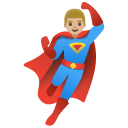
Appearance varies by platform and device. Google Noto, Twemoji, and OpenMoji are open-source.