🦹♂️
The Emoji
Man Supervillain
U+1F9B9 U+200D U+2642 U+FE0F · :man_supervillain:
Trend 72
Meaning layers
- interpretation
- Used ironically to represent someone acting shady, doing something morally questionable, or embracing their 'villain era' — a Gen Z concept of unapologetically prioritizing yourself without guilt.
- tiktok usage
- Heavily used in 'villain era' content where creators announce they're done being nice and are now focused entirely on themselves, ambition, or petty revenge.
- irony level
- 8 / 10
Platform meanings
- meaning
- Symbol of the 'villain era' trend — unbothered, self-serving, unapologetically ambitious
- trend usage
- Used in videos where creators announce they're cutting off toxic people, setting harsh boundaries, or pursuing success without caring about others' opinions
- hashtags
- #VillainEra#ManSupervillain#EvilArc#NoMoreMrNiceGuy#DarkAesthetic
- virality score
- 74 / 100
Cultural meanings
🇺🇸
Western / Gen-Z
Central to the 'villain era' trend — a cultural rite of passage where young people declare they are done people-pleasing and are now unapologetically self-focused. Carries strong ironic empowerment energy.
🇵🇰
Pakistan & India
Used largely among urban, internet-savvy youth to signal confidence or playful mischief; the villain archetype resonates through Bollywood antagonist culture, often used humorously in group chats.
🌍
Middle East
Occasionally used in youth online spaces to signal being the 'bad guy' in a fun or dramatic story, but less common as the villain aesthetic is more niche; can carry heavier moral weight in more conservative contexts.
🌐
Global Neutral
Universally understood as representing a villainous or mischievous character; used across cultures in gaming, storytelling, and internet humor contexts without significant cultural distortion.
🇧🇩
Bangladesh
Used mostly in gaming and meme contexts among young people; the concept of a 'villain era' is emerging in urban youth culture but is less widespread than in Western contexts.
🇱🇰
Sri Lanka
Found primarily in gaming and social media spaces among youth; villain characters are popular in local content creation and this emoji appears in playful rivalry or competitive contexts.
🇨🇳
China
Less common due to platform restrictions limiting Unicode emoji expressiveness, but appears in gaming communities and on platforms like Bilibili to represent antagonist characters or dark humor personas.
🇯🇵
Japan
Used in gaming and anime fan communities to represent antagonist characters (villains/悪役 akuyaku); the ironic self-villain framing exists but is less culturally dominant than in Western spaces.
🇰🇷
South Korea
Popular in gaming contexts and among fans of villain characters in dramas and webtoons; the 'villain era' concept resonates strongly with hustle and self-improvement culture under a darker framing.
🇹🇼
Taiwan
Used among gaming and pop culture communities, often to represent antagonist characters in games or dramas; carries playful rather than serious connotations in most online contexts.
🇭🇰
Hong Kong
Appears in meme culture and gaming contexts; sometimes used politically to satirize figures perceived as corrupt or authoritarian, adding a layer of social commentary beyond mere playfulness.
🇵🇭
Philippines
Widely used in meme culture and hugot (emotional expression) content; Filipinos use it to humorously own being the villain in a story or to call out genuinely bad actors in pop culture commentary.
🇮🇩
Indonesia
Common in gaming communities and meme spaces; used to represent antagonist characters or to humorously declare a 'no more being nice' phase, resonating with youth culture online.
🇹🇭
Thailand
Used in gaming and online entertainment contexts; villain aesthetics are popular in Thai online culture tied to BL dramas and fantasy content, making this emoji moderately familiar.
🇻🇳
Vietnam
Appears in gaming and social media contexts; used humorously among youth to signal mischief or to represent antagonist characters in game streams and pop culture discussions.
🇲🇾
Malaysia
Used across English and Malay-speaking online communities for gaming, memes, and the emerging villain era trend; the bilingual internet culture means it carries both Western ironic and local playful meanings.
🇸🇦
Saudi Arabia
Used cautiously in online spaces — gaming contexts are the primary use case; the villain era concept exists but is less openly celebrated due to cultural emphasis on moral character.
🇦🇪
UAE
More cosmopolitan usage due to diverse expat population; used in gaming, meme culture, and among younger demographics who are plugged into global internet trends including villain era content.
🇪🇬
Egypt
Used in gaming and meme contexts; Egyptian internet culture has a strong tradition of dark humor and schadenfreude, making the villain archetype resonate well in satirical online commentary.
🇹🇷
Turkey
Common in gaming communities and among youth who follow global meme culture; Turkish internet humor embraces dark and ironic characters, making this emoji fit naturally into local online expression.
🇮🇷
Iran
Used primarily in gaming contexts among youth; access to global platforms is restricted, but this emoji appears in local gaming communities and on VPN-accessed platforms in ironic contexts.
🇳🇬
Nigeria
Used in Afrobeats and pop culture discourse to represent artists or personalities with villain-coded swagger; fits into Nigerian internet culture's love of bold, unapologetic self-expression.
🇿🇦
South Africa
Used in meme culture and gaming contexts; the villain era concept resonates in youth culture blending local and global internet trends, often deployed in commentary about public figures.
🇬🇧
UK & Ireland
Used with dry British irony — often deployed to describe someone doing something shamelessly self-serving or to mock politicians and celebrities behaving badly with maximum understatement.
🇫🇷
France
Used in gaming and internet meme contexts; French internet culture applies it with philosophical irony, sometimes referencing literary anti-hero traditions alongside the more modern meme usage.
🇩🇪
Germany
Appears primarily in gaming and meme communities; German internet culture tends toward literal interpretation, so it's most commonly used in straightforward gaming or comic-book contexts rather than ironic reframing.
🇪🇸
Spain & Italy
Used in gaming and social media with expressive flair; Mediterranean internet culture embraces dramatic storytelling, making the villain archetype popular in playful personal narratives and rivalry content.
🇧🇷
Brazil
Widely embraced in meme culture and gaming; Brazilian internet humor is highly ironic and expressive, making the villain era concept a natural fit — used abundantly in memes about bold life decisions and social commentary.
🇲🇽
Mexico
Used in meme culture with characteristic Mexican dark humor; appears in commentary about corrupt politicians, narco-culture satire, and personal empowerment narratives with an ironic edge.
🌎
Latin America
Broadly used across Latin American youth internet culture for gaming, memes, and villain era content; telenovela villain traditions give the archetype deep cultural resonance across the region.
🇦🇺
Australia & NZ
Used with classic Antipodean self-deprecating humor and irony; Australians deploy it to own being the 'bad guy' in a situation with maximum nonchalance, often in sports rivalry contexts as well.
How its meaning shifted
- 2010
This emoji did not exist yet (Unicode 11.0 was released in 2018); supervillain concepts were expressed through 😈, 💀, or text descriptions in this era.
- 2015
Still non-existent as an emoji; the supervillain archetype was growing in pop culture relevance through Marvel/DC cinematic universes but lacked dedicated emoji representation.
- 2020
Newly introduced and gaining traction primarily in gaming contexts and comic/film fan communities; the 'villain era' concept was just beginning to emerge in early social media usage.
- 2026
Fully entrenched as a cultural symbol of the villain era movement; used across all major platforms for self-empowerment narratives, ironic commentary, gaming content, and dark aesthetic branding.
See it on every platform
Adjacent emojis
- Often confused with
- man in tuxedosmiling face with hornsninja
Share & embed
Frequently asked
01What does the 🦹♂️ Man Supervillain emoji mean?
A male-presenting person dressed in a supervillain costume, typically depicted with a dark cape, mask, and menacing expression. Part of the superhero/supervillain emoji family introduced in Unicode 11.0.
02What does 🦹♂️ mean on TikTok?
Symbol of the 'villain era' trend — unbothered, self-serving, unapologetically ambitious
03What does 🦹♂️ mean on WhatsApp?
Playful signal that someone is up to no good or planning something mischievous
04What does 🦹♂️ mean in Gen-Z slang?
Used ironically to represent someone acting shady, doing something morally questionable, or embracing their 'villain era' — a Gen Z concept of unapologetically prioritizing yourself without guilt.
05Is the 🦹♂️ emoji safe to use?
Playful representation of a supervillain character used in gaming, pop culture, memes, and the ironic 'villain era' self-empowerment trend.
06What does 🦹♂️ mean in texting?
Psychologically tied to the concept of the 'shadow self' — embracing darker, more assertive parts of one's personality. Often used as a coping mechanism for people reclaiming power after feeling victimized.
07What is the shortcode for 🦹♂️?
The shortcode for Man Supervillain is :man_supervillain:
08What does 🦹♂️ mean in dating?
Used flirtatiously to signal 'I'm a bad boy but in a fun way' — often paired with teasing messages like 'you knew what you were getting into 🦹♂️'.
Safety & usage
- Safe meaning
- Playful representation of a supervillain character used in gaming, pop culture, memes, and the ironic 'villain era' self-empowerment trend.
- Caution
- Can be used to glorify genuinely harmful, manipulative, or antisocial behavior under the guise of 'being in your villain era'; occasionally used to celebrate real-world bad actors or to mock victims.
Generally safe but monitor context — in some conversations it may signal someone bragging about genuinely harmful behavior (manipulation, ghosting, cheating) framed as empowerment. Not NSFW but contextually sensitive.
How it looks across platforms
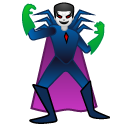
Appearance varies by platform and device. Google Noto, Twemoji, and OpenMoji are open-source.