🦹🏿♂️
The Emoji
Man Supervillain: Dark Skin Tone
U+1F9B9 U+1F3FF U+200D U+2642 U+FE0F · :man_supervillain_dark_skin_tone:
Trend 68
Meaning layers
- interpretation
- Used to represent someone acting chaotic, devious, or unapologetically self-interested — often with a sense of playful swagger. Also used to own 'villain era' identity.
- tiktok usage
- Appears in 'villain era' content where someone proudly announces they're done being nice and are embracing their selfish or ruthless side.
- irony level
- 7 / 10
Platform meanings
- meaning
- Symbol of the 'villain era' trend — embracing a ruthless, self-first attitude as a coping or empowerment mechanism.
- trend usage
- Used in videos where creators announce life changes that cut off toxic people or embrace selfish-but-healthy decisions.
- hashtags
- #VillainEra#UnbotheredVibes#DarkEnergy#EvilSzn#ChaosMode
- virality score
- 72 / 100
Cultural meanings
🇺🇸
Western / Gen-Z
Central to the 'villain era' cultural moment — Gen Z uses it to reclaim power after being over-accommodating, with dark humor and irony baked in.
🇵🇰
Pakistan & India
Used in urban youth culture on Instagram and WhatsApp to signal a bold, unbothered mood; associated with Bollywood antagonists and street swagger.
🌍
Middle East
Appears in youth meme culture to represent the 'bad boy' or someone acting boldly outside social norms, often with humor.
🌐
Global Neutral
Universally understood as representing a villain or evil character in a playful, comic-book-inspired context.
🇧🇩
Bangladesh
Used among younger social media users to express defiance or attitude, often in meme contexts inspired by Indian and global pop culture.
🇱🇰
Sri Lanka
Niche usage mainly among social media-savvy youth; associated with action movie villains and bold personal declarations.
🇨🇳
China
Used on platforms like Weibo and Douyin to represent 'big villain energy' (大反派气场) or someone ruthlessly pursuing their goals.
🇯🇵
Japan
Connected to anime villain archetypes; used to signal 'edgelord' or 'dark protagonist' energy in otaku communities.
🇰🇷
South Korea
Associated with K-drama villains and 'dark concept' idol aesthetics; used in fan communities and self-expression on KakaoTalk.
🇹🇼
Taiwan
Used similarly to South Korea — tied to drama and idol culture, placed in social posts to signal mysterious or cool-bad energy.
🇭🇰
Hong Kong
Used in meme culture and WhatsApp groups to label someone acting scheming or overly clever; generally humorous.
🇵🇭
Philippines
Popular in meme pages and group chats; used to describe someone who did something savage, bold, or shamelessly self-serving.
🇮🇩
Indonesia
Used on Twitter/X and TikTok Indonesia in 'villain arc' posts, often sarcastically when someone is labeled bad for doing something reasonable.
🇹🇭
Thailand
Appears in Thai TikTok and Twitter content tied to 'bad ending' memes and bold self-declarations; dark humor context.
🇻🇳
Vietnam
Used among Vietnamese youth on TikTok and Facebook to represent a cocky or fearless attitude, often in gaming content.
🇲🇾
Malaysia
Seen in meme culture and group chats; used to describe someone acting with calculated boldness or pulling a sneaky move.
🇸🇦
Saudi Arabia
Mostly used in gaming and pop culture contexts among youth; less common in everyday social media due to cultural conservatism.
🇦🇪
UAE
Used in cosmopolitan social media spaces to signal luxury confidence, power, and a 'villain who won' aesthetic.
🇪🇬
Egypt
Used in youth meme culture on Facebook and TikTok to call someone out as the schemer in a group, often with affection.
🇹🇷
Turkey
Common in gaming and pop culture discussions; used to label someone playing an antagonist role or acting boldly.
🇮🇷
Iran
Used among youth on Instagram and Telegram to signal a rebellious or rule-breaking attitude, often coded to avoid attention.
🇳🇬
Nigeria
Embraced enthusiastically — Afrobeats culture and Nollywood villain archetypes make this feel culturally resonant; used to flex ruthless confidence.
🇿🇦
South Africa
Used in South African youth culture to signal 'I'm not playing nice anymore'; fits urban township swagger and bold self-expression.
🇬🇧
UK & Ireland
Used with British dry humor — often ironically self-deprecating, as in 'apparently I'm the villain for not wanting to go to the pub 🦹🏿♂️'.
🇫🇷
France
Used in French meme culture and social media to represent someone acting with cool, calculated disregard for others' opinions.
🇩🇪
Germany
Practical usage — often appears in gaming communities and pop culture discussions; less ironic than Anglophone usage.
🇪🇸
Spain & Italy
Used in Mediterranean social media to signal dramatic, theatrical self-expression; tied to telenovela/soap opera villain archetypes.
🇧🇷
Brazil
Widely used in Brazilian meme culture and TikTok to represent the 'vilão' energy — someone unafraid to be bold or controversial.
🇲🇽
Mexico
Used in Mexican meme culture to signal 'cabrón' energy — someone cunning, bold, and unapologetically self-serving.
🌎
Latin America
Broadly adopted across Latin America to represent a charismatic, confident villain or someone in their 'no más tonterías' era.
🇦🇺
Australia & NZ
Used with Australian irreverence — often self-deprecating humor about being the 'baddie' in a mundane situation.
How its meaning shifted
- 2010
This emoji did not exist in 2010; supervillain emojis were not part of Unicode at this time.
- 2015
Still pre-release; villain-type expressions were conveyed through devil 😈 or skull 💀 emojis instead.
- 2020
Newly introduced and gaining traction in gaming and comic-book fan communities; early adoption in 'villain arc' meme formats.
- 2026
Firmly established as the go-to emoji for 'villain era' declarations, anti-hero aesthetics, and unapologetic self-prioritization across all major platforms.
See it on every platform
Adjacent emojis
- Often confused with
- ninjaman in tuxedoperson frowning
Share & embed
Frequently asked
01What does the 🦹🏿♂️ Man Supervillain: Dark Skin Tone emoji mean?
A male-presenting supervillain character with dark skin tone, wearing a villain costume with a mask, representing an evil or antagonistic comic-book-style character.
02What does 🦹🏿♂️ mean on TikTok?
Symbol of the 'villain era' trend — embracing a ruthless, self-first attitude as a coping or empowerment mechanism.
03What does 🦹🏿♂️ mean on WhatsApp?
Sent when someone is about to do something sneaky, bold, or morally grey. Often playful.
04What does 🦹🏿♂️ mean in Gen-Z slang?
Used to represent someone acting chaotic, devious, or unapologetically self-interested — often with a sense of playful swagger. Also used to own 'villain era' identity.
05Is the 🦹🏿♂️ emoji safe to use?
Playful representation of villain/anti-hero identity, villain era memes, comic book references, and bold self-expression.
06What does 🦹🏿♂️ mean in texting?
Taps into the psychological archetype of the shadow self — the suppressed desire to break rules and act purely for one's own benefit. The villain persona allows safe expression of antisocial impulses.
07What is the shortcode for 🦹🏿♂️?
The shortcode for Man Supervillain: Dark Skin Tone is :man_supervillain_dark_skin_tone:
08What does 🦹🏿♂️ mean in dating?
Used flirtatiously to signal 'I'm a little dangerous and mysterious, but in a fun way.' Can imply someone is plotting to win the other person over.
Safety & usage
- Safe meaning
- Playful representation of villain/anti-hero identity, villain era memes, comic book references, and bold self-expression.
- Caution
- Could potentially be used in harassment contexts to label or mock a specific person as an evil figure, or to glorify genuinely harmful behavior.
The dark skin tone modifier means this emoji should never be used in racialized contexts to stereotype or demonize. Context matters heavily — using it to call out a real person as a villain in a serious dispute can feel targeted.
How it looks across platforms
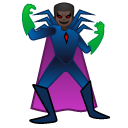
Appearance varies by platform and device. Google Noto, Twemoji, and OpenMoji are open-source.