🦹🏻♂️
The Emoji
Man Supervillain: Light Skin Tone
U+1F9B9 U+1F3FB U+200D U+2642 U+FE0F · :man_supervillain_light_skin_tone:
Trend 68
Meaning layers
- interpretation
- Used to self-identify as someone who is unapologetically doing something morally gray, chaotic, or antiestablishment — often worn as a badge of pride for being the 'villain' in someone else's story or just embracing your petty side.
- tiktok usage
- Appears in POV videos where the creator plays the antagonist role, chaotic 'villain era' content, and 'not the hero I needed to be' storytelling trends.
- irony level
- 7 / 10
Platform meanings
- meaning
- Symbol of someone fully embracing their chaotic, antagonist, or petty energy — used in villain POV content and 'I woke up and chose chaos' narratives.
- trend usage
- Featured in 'villain era' trends, dark academia aesthetics, antivillain character POVs, and dramatic voiceover content where the creator frames themselves as the antagonist.
- hashtags
- #VillainEra#NotTheHero#ChaoticEnergy#DarkSide#UnhingedException
- virality score
- 72 / 100
Cultural meanings
🇺🇸
Western / Gen-Z
Universally understood as the 'villain era' emoji — self-identifying as the chaotic, unapologetic bad guy in your own story is considered a vibe and a personality phase rather than a genuine moral statement.
🇵🇰
Pakistan & India
Used playfully among younger, urban, English-speaking users to signal mischief, petty behavior, or being the 'villain' in a friend group drama — gaining traction through Bollywood villain meme culture.
🌍
Middle East
Used among younger social media users to represent dramatic antagonist energy, often in the context of Arabic drama TV villain characters or self-deprecating humor about being difficult.
🌐
Global Neutral
Broadly understood as a representation of an evil or mischievous character — most users across cultures interpret it as villain-coded without needing the specific 'villain era' cultural context.
🇧🇩
Bangladesh
Primarily understood through superhero and villain media context — used among younger users familiar with Marvel/DC content to signal mischief or self-proclaimed bad-guy energy.
🇱🇰
Sri Lanka
Used in casual online contexts to represent being the villain or antagonist in a situation — popular among younger users who consume global superhero content.
🇨🇳
China
Less commonly used given limited Unicode/emoji standardization on domestic platforms — where used, interpreted through the lens of Chinese drama villain archetypes rather than Western superhero tropes.
🇯🇵
Japan
Contextualized through anime villain aesthetics — used by fans of antivillain characters, otaku culture, and those who identify with 'chaotic neutral' character archetypes from anime.
🇰🇷
South Korea
Popular in K-drama villain discussion contexts and among fans of villain characters in manhwa/webtoons — used ironically in self-deprecating humor about being the 'bad guy' in social situations.
🇹🇼
Taiwan
Used among younger users familiar with global superhero media — interpreted through both Western villain tropes and local drama villain character aesthetics.
🇭🇰
Hong Kong
Common in casual social media among younger users to signal mischief or petty energy — blends Western villain pop culture with Cantonese humor sensibilities.
🇵🇭
Philippines
Enthusiastically used by Filipino social media users who are heavy consumers of Marvel/DC content — signals villain energy in the context of teleserye drama antagonists and Western superhero villains.
🇮🇩
Indonesia
Used among younger, digitally active users to signal mischievous or antagonistic behavior — resonates through local sinetron villain character parallels and global superhero media.
🇹🇭
Thailand
Interpreted through Thai drama (lakorn) villain aesthetics and global superhero culture — younger users use it to signal petty or dramatic behavior online.
🇻🇳
Vietnam
Growing usage among younger Vietnamese social media users who are fans of superhero content — used to signal mischief or drama in casual online communication.
🇲🇾
Malaysia
Used in a mix of Malay and English social media contexts to signal villain energy — familiar to users through both Hollywood superhero media and local drama antagonist characters.
🇸🇦
Saudi Arabia
Used primarily among younger, globally connected users — interpreted through Marvel/DC villain tropes and occasionally through the lens of Arabic TV drama villains.
🇦🇪
UAE
Common among the young, cosmopolitan, and multilingual social media population — used freely to signal villain energy, dark humor, and mischief in English-dominant online spaces.
🇪🇬
Egypt
Used by younger Egyptian social media users familiar with global superhero culture — also resonates with Egyptian drama villain character archetypes in casual usage.
🇹🇷
Turkey
Interpreted through Turkish dizi (TV series) villain archetypes and global superhero media — used to signal dramatic antagonist energy or self-aware petty behavior.
🇮🇷
Iran
Limited but growing usage among younger, internet-savvy Iranians — understood through global superhero media context and used to signal mischief or chaotic energy.
🇳🇬
Nigeria
Used among younger, globally connected Nigerian social media users — signals villain energy in the context of Nollywood antagonist characters and global pop culture villains.
🇿🇦
South Africa
Widely understood through global superhero media consumption — used to signal villain/chaotic energy in English-dominant social media spaces and among pop culture fans.
🇬🇧
UK & Ireland
Used with British dry humor sensibility — often deployed with heavy irony to label minor bad behaviors, with a self-aware 'yes I'm the villain' energy that leans more comedic than dramatic.
🇫🇷
France
Used among younger French social media users familiar with global superhero content — occasionally applied with Gallic irony to political or social figures acting in self-interest.
🇩🇪
Germany
Interpreted straightforwardly as a villain character emoji — used in online gaming contexts, superhero fandom discussions, and among younger users for ironic self-labeling.
🇪🇸
Spain & Italy
Used with Mediterranean dramatic flair — signals villain energy in the context of telenovela/telenovela-adjacent drama and global superhero villain aesthetics among younger users.
🇧🇷
Brazil
Popular among Brazilian social media users who heavily consume Marvel/DC and anime content — used liberally to signal villain energy, petty behavior, and dramatic self-presentation.
🇲🇽
Mexico
Used among younger Mexican social media users to signal mischief, villain energy, and chaotic behavior — resonates through lucha libre villain (rudo) aesthetics and global superhero culture.
🌎
Latin America
Broadly understood across Latin America as a villain or antagonist signal — used to celebrate petty wins, chaotic behavior, and villain-coded personality moments in casual online communication.
🇦🇺
Australia & NZ
Used with Australian/NZ irreverent humor — signals villain energy with a comedic, self-aware tone, often in the context of minor life mischief rather than genuine antagonism.
How its meaning shifted
- 2010
This emoji did not exist in 2010 — the supervillain emoji set was not introduced until Unicode 11.0 in 2018, and skin tone modifiers followed shortly after.
- 2015
Still non-existent as an emoji — villain representation in digital communication was handled through skull emojis, devil faces, and text-based villain references.
- 2020
Newly established emoji beginning to gain traction — used primarily in literal contexts of supervillain Halloween costumes, comic book discussions, and early adoptions of villain-era self-identification.
- 2026
Fully integrated into the 'villain era' cultural lexicon — a go-to emoji for self-identifying as the antagonist of your own story, chaos-energy signaling, and ironic bad-guy humor across all major platforms.
See it on every platform
Adjacent emojis
- Often confused with
- man in stealth modesmiling face with hornsninja
- Can replace
- smiling face with hornsskulljapanese ogre
Share & embed
Frequently asked
01What does the 🦹🏻♂️ Man Supervillain: Light Skin Tone emoji mean?
A male-presenting person with light skin tone wearing a supervillain costume, typically depicted with a dark mask or hood and a dramatic cape, representing an evil or antagonistic character from comic book/superhero fiction.
02What does 🦹🏻♂️ mean on TikTok?
Symbol of someone fully embracing their chaotic, antagonist, or petty energy — used in villain POV content and 'I woke up and chose chaos' narratives.
03What does 🦹🏻♂️ mean on WhatsApp?
Signals the sender is about to do something sneaky, petty, or mischievous — a playful heads-up of incoming drama or a cheeky action.
04What does 🦹🏻♂️ mean in Gen-Z slang?
Used to self-identify as someone who is unapologetically doing something morally gray, chaotic, or antiestablishment — often worn as a badge of pride for being the 'villain' in someone else's story or just embracing your petty side.
05Is the 🦹🏻♂️ emoji safe to use?
Playful self-identification as a mischievous or antagonistic character — used humorously for villain aesthetics, petty behavior jokes, and pop culture references.
06What does 🦹🏻♂️ mean in texting?
Taps into the 'shadow self' concept — people use this emoji to safely express antisocial impulses, rebellious energy, or the desire to be seen as unpredictable and powerful without real-world consequences.
07What is the shortcode for 🦹🏻♂️?
The shortcode for Man Supervillain: Light Skin Tone is :man_supervillain_light_skin_tone:
08What does 🦹🏻♂️ mean in dating?
Used flirtatiously to signal 'I'm trouble but in a fun way' — a playful warning that they're about to do something bold or mischievous in a conversation.
Safety & usage
- Safe meaning
- Playful self-identification as a mischievous or antagonistic character — used humorously for villain aesthetics, petty behavior jokes, and pop culture references.
- Caution
- Can be used to glorify genuinely harmful, manipulative, or abusive behavior by framing it as 'villain coded' — potentially normalizing toxic relationship dynamics or antisocial conduct.
Watch for use in contexts where 'villain era' framing is used to justify genuinely harmful actions toward others, or when used in combination with threat-adjacent language in conflict situations.
How it looks across platforms
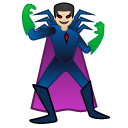
Appearance varies by platform and device. Google Noto, Twemoji, and OpenMoji are open-source.