🦹🏾♂️
The Emoji
Man Supervillain: Medium-dark Skin Tone
U+1F9B9 U+1F3FE U+200D U+2642 U+FE0F · :man_supervillain_mediumdark_skin_tone:
Trend 71
Meaning layers
- interpretation
- Used to signal being the 'villain era' — owning bad behavior, unbothered energy, or doing something morally questionable but unapologetically. Also used for chaotic, scheming, or petty behavior with dramatic flair.
- tiktok usage
- Appears in 'villain era' content, petty revenge stories, and 'I'm the problem' self-aware humor. Paired with dramatic music or evil laugh audios.
- irony level
- 8 / 10
Platform meanings
- meaning
- Represents the villain era, chaotic energy, or someone owning their messy behavior with zero remorse.
- trend usage
- Drops at the end of 'villain arc' storytimes, petty revenge videos, and POV content where the creator plays the antagonist.
- hashtags
- #VillainEra#ImTheProblem#ChaoticEnergy#Unbothered#EvilPlan
- virality score
- 74 / 100
Cultural meanings
🇺🇸
Western / Gen-Z
Core emoji for the 'villain era' cultural moment — widely understood as a self-aware, ironic badge of chaotic, unbothered energy.
🇵🇰
Pakistan & India
Used in dramatic fashion among younger urban users to signal being the 'bad guy' in a situation, often in Bollywood-villain-inspired humor contexts.
🌍
Middle East
Used among youth to signal cunning or dominance in social scenarios, often in the context of being strategically smart rather than morally evil.
🌐
Global Neutral
Broadly understood as representing a comic-book villain archetype — signals mischief, cunning, or dark humor universally.
🇧🇩
Bangladesh
Used by younger internet-savvy users for humor around being sly or scheming, influenced by Indian pop culture villain tropes.
🇱🇰
Sri Lanka
Relatively niche usage — appears in meme communities to signal dramatic, villain-coded behavior borrowed from Western and Indian media.
🇨🇳
China
Less commonly used organically; may appear in gaming communities or among fans of Western superhero content to represent antagonists.
🇯🇵
Japan
Used in anime-influenced contexts to represent the 'rival' or 'anti-hero' archetype — admired character type in Japanese storytelling tradition.
🇰🇷
South Korea
Used in fan communities referencing drama antagonists or idol 'dark concept' personas — villain aesthetics are culturally celebrated in K-pop.
🇹🇼
Taiwan
Appears in gaming and entertainment communities to signal antagonist energy — resonates with local love for complex villain characters in media.
🇭🇰
Hong Kong
Used in online spaces for playful scheming humor, often tied to competitive or business contexts where being calculated is respected.
🇵🇭
Philippines
Common in hugot (relatable emotion) culture — used to signal being the villain of your own love story or life narrative.
🇮🇩
Indonesia
Appears in youth meme culture to represent someone being dramatically petty or doing the 'kontroversial' thing unapologetically.
🇹🇭
Thailand
Used among Gen Z in social media to represent someone owning their messy behavior, influenced by Thai drama villain archetypes.
🇻🇳
Vietnam
Relatively emerging usage — found in gaming and youth meme communities to represent strategic cunning or villain-coded behavior.
🇲🇾
Malaysia
Used in casual chat and meme culture to signal being deliberately mischievous or playing the antagonist role in a friend group.
🇸🇦
Saudi Arabia
Used primarily among youth in gaming and entertainment contexts — villain energy is admired in competitive settings but used carefully socially.
🇦🇪
UAE
Cosmopolitan youth culture embraces the Western 'villain era' interpretation — common in English-language social media use among young people.
🇪🇬
Egypt
Used in internet meme culture to represent the dramatic antagonist figure, often tied to Egyptian entertainment media villain tropes.
🇹🇷
Turkey
Used by younger generations in ironic, self-aware meme contexts — the 'I'm the villain of this story' narrative resonates in Turkish social media.
🇮🇷
Iran
Limited public social media usage due to platform restrictions — used in private groups to signal being strategically uncompromising or slyly clever.
🇳🇬
Nigeria
Used in Naija meme culture to represent being 'sharp' or strategically cunning — admired trait often expressed through humor online.
🇿🇦
South Africa
Appears in youth social media to signal the villain era narrative — resonates with the 'no apologies' cultural confidence movement.
🇬🇧
UK & Ireland
Used with heavy irony and self-deprecation — 'Me being petty 🦹🏾♂️' is a quintessential British way to own minor bad behavior with humor.
🇫🇷
France
Used in meme and youth culture to signal someone playing the cunning antagonist role — fits French appreciation for morally complex characters.
🇩🇪
Germany
More literal in interpretation — used in gaming and superhero fan communities, with ironic villain era use growing among younger users.
🇪🇸
Spain & Italy
Embraced in youth culture for dramatic flair — the villain aesthetic resonates with Mediterranean love for expressive, larger-than-life characters.
🇧🇷
Brazil
Very popular in meme culture — Brazilian internet loves dramatic antagonist energy and the emoji fits perfectly in 'villão' (villain) humor.
🇲🇽
Mexico
Used in social media to claim villain status humorously — tied to Mexican pop culture's love for dramatic antagonist characters in telenovelas.
🌎
Latin America
Broadly understood as the telenovela villain archetype — widely used to signal dramatic, unapologetic, or strategically cunning behavior.
🇦🇺
Australia & NZ
Used with dry irony — 'doing the wrong thing but owning it' humor style fits perfectly with Australian self-deprecating comedic culture.
How its meaning shifted
- 2010
This emoji did not exist yet — supervillain emoji was introduced later in Unicode 11.0 (2018), so no usage existed in this period.
- 2015
Still pre-release — not available, though villain character tropes were being expressed through combinations like 💀😈 in this era.
- 2020
Newly mainstream — used primarily in gaming, superhero fandom, and early 'villain era' Gen Z content as the concept began emerging on TikTok.
- 2026
Fully cemented as a 'villain era' cultural symbol — used across generations to signal unbothered confidence, strategic cunning, and dramatic self-ownership in digital culture.
See it on every platform
Adjacent emojis
- Opposite
- man superheroangelhandshake
- Often confused with
- man in tuxedoninjadetective
- Can replace
- smiling face with hornsskullsunglasses face
Share & embed
Frequently asked
01What does the 🦹🏾♂️ Man Supervillain: Medium-dark Skin Tone emoji mean?
A male-presenting supervillain character with medium-dark skin tone, wearing a villain mask and dramatic costume, representing evil, mischief, or antagonistic power.
02What does 🦹🏾♂️ mean on TikTok?
Represents the villain era, chaotic energy, or someone owning their messy behavior with zero remorse.
03What does 🦹🏾♂️ mean on WhatsApp?
Signals you're being sneaky, scheming, or doing something mildly chaotic — usually lighthearted and self-aware.
04What does 🦹🏾♂️ mean in Gen-Z slang?
Used to signal being the 'villain era' — owning bad behavior, unbothered energy, or doing something morally questionable but unapologetically. Also used for chaotic, scheming, or petty behavior with dramatic flair.
05Is the 🦹🏾♂️ emoji safe to use?
Playful self-expression of chaotic, mischievous, or villain-coded energy — used for humor, irony, and pop culture references.
06What does 🦹🏾♂️ mean in texting?
Psychologically represents the appeal of the shadow self — using humor and fiction to safely explore darker impulses like revenge, dominance, or rule-breaking without real-world consequences.
07What is the shortcode for 🦹🏾♂️?
The shortcode for Man Supervillain: Medium-dark Skin Tone is :man_supervillain_mediumdark_skin_tone:
08What does 🦹🏾♂️ mean in dating?
Used flirtatiously to say 'I'm trouble and you know it' — signals charismatic bad-boy/dangerous energy without being overtly threatening. Often paired with smirks.
Safety & usage
- Safe meaning
- Playful self-expression of chaotic, mischievous, or villain-coded energy — used for humor, irony, and pop culture references.
- Caution
- In rare cases could be used to glorify genuinely harmful behavior, threaten someone dramatically, or signal predatory manipulation without irony.
Generally safe and humorous in intent — context matters significantly. Watch for use paired with threatening language or harassment patterns, though the standalone emoji is almost always ironic.
How it looks across platforms
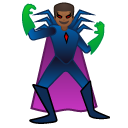
Appearance varies by platform and device. Google Noto, Twemoji, and OpenMoji are open-source.