🦹🏽♂️
The Emoji
Man Supervillain: Medium Skin Tone
U+1F9B9 U+1F3FD U+200D U+2642 U+FE0F · :man_supervillain_medium_skin_tone:
Trend 68
Meaning layers
- interpretation
- Used to signal chaotic, morally ambiguous, or 'villain era' energy — someone who is unapologetically doing what benefits them without caring about others' opinions. Often self-applied humorously.
- tiktok usage
- Appears in 'villain era' trend videos where creators announce they're done being nice and are prioritizing themselves, often with dramatic music.
- irony level
- 7 / 10
Platform meanings
- meaning
- Symbol of entering a 'villain era' — prioritizing yourself, being petty, or acting on chaotic impulses without guilt.
- trend usage
- Paired with dramatic audio clips (Hans Zimmer villain music, anime villain speeches) and transition videos showing a person's 'soft' vs 'villain' persona.
- hashtags
- #VillainEra#NotTheHero#ChaosAgent#UnapologeticallyMe#DarkArc
- virality score
- 72 / 100
Cultural meanings
🇺🇸
Western / Gen-Z
Embraced as a symbol of the 'villain era' — a reclaimed identity about self-prioritization and refusing to be the people-pleaser. Widely used ironically and with pride.
🇵🇰
Pakistan & India
Used in social media to denote a clever, cunning, or 'too smart for his own good' personality; also deployed in Bollywood villain comparisons and cricket trash talk.
🌍
Middle East
Associated with dramatic movie villain archetypes from Hollywood and Bollywood; used humorously in group chats to denote someone being strategically sneaky.
🌐
Global Neutral
Universally understood as representing a villain or mischievous character; used across cultures to signal playful evil or self-serving behavior.
🇧🇩
Bangladesh
Used similarly to the India/Pakistan context — referencing dramatic villain characters from Dhallywood or Bollywood; seen in meme culture for cunning behavior.
🇱🇰
Sri Lanka
Deployed humorously when someone acts selfishly in group chats or social media; also used in cricket banter and political commentary.
🇨🇳
China
Less commonly used due to differing emoji culture; when used, it references Western or Japanese manga villain archetypes, often in gaming contexts on platforms like Weibo.
🇯🇵
Japan
Resonates with manga and anime villain aesthetics (think Villain Deku, Light Yagami); used enthusiastically by anime fans to denote cool, morally complex characters.
🇰🇷
South Korea
Used in K-drama and webtoon fan discussions for charismatic villain characters; also in K-pop fandoms when an idol does something unexpectedly bold or 'bad boy'.
🇹🇼
Taiwan
Used in gaming communities and among anime fans; also pops up in political meme culture to reference politicians behaving in self-serving ways.
🇭🇰
Hong Kong
Appears in Cantonese meme culture and gaming communities; used to call out someone acting sneakily in group dynamics.
🇵🇭
Philippines
Very popular in hugot (emotional) meme culture and Filipino drama fan communities; used to self-deprecate about being the villain in someone's story.
🇮🇩
Indonesia
Used on Twitter/X and TikTok to reference sinetron (soap opera) villain characters; also in gaming communities for antagonist roles.
🇹🇭
Thailand
Linked to Thai drama villain characters and gaming; also used humorously when someone acts calculating or petty in social situations.
🇻🇳
Vietnam
Used in gaming contexts and among Gen Z social media users to denote clever, cunning, or anti-hero behavior.
🇲🇾
Malaysia
Deployed in Malay social media humor — often referencing drama, gossip, or someone being strategically self-serving in a group setting.
🇸🇦
Saudi Arabia
Used mostly in gaming communities and among youth referencing Western superhero/villain content; occasionally in social media humor about cunning behavior.
🇦🇪
UAE
Common in expat and youth social media circles; used in gaming contexts and to reference bold, self-assured behavior in social scenarios.
🇪🇬
Egypt
Used in Arabic meme culture to reference someone acting with bold self-interest or behaving like a movie villain; popular in gaming communities.
🇹🇷
Turkey
Deployed in gaming communities and social media humor; often used to reference cunning characters from Turkish diziler (drama series) or Western content.
🇮🇷
Iran
Used among youth on Instagram and Telegram to signal clever, rule-bending behavior; linked to anti-hero and villain aesthetics from Western and anime content.
🇳🇬
Nigeria
Used in Afrobeats fan communities and Nigerian Twitter (X) to signal someone is 'moving mad' — acting boldly and without apology, in a celebrated way.
🇿🇦
South Africa
Popular in South African Twitter meme culture to signal someone is unapologetically self-serving; also used in gaming communities.
🇬🇧
UK & Ireland
Used with dry British wit to signal someone is being 'a proper villain' — often ironic and self-deprecating about minor misdeeds.
🇫🇷
France
Used in gaming and pop culture contexts; occasionally deployed in political commentary to label someone acting with blatant self-interest.
🇩🇪
Germany
Tends to be used more literally in gaming contexts; also appears in meme culture for people who are logically ruthless or coldly strategic.
🇪🇸
Spain & Italy
Used with theatrical flair in social media to signal someone is being dramatically self-serving; popular in gaming and football (soccer) banter.
🇧🇷
Brazil
Widely used in Brazilian Twitter and TikTok to represent 'villain energy' — often celebrated as confidence or boldness in a charismatic way.
🇲🇽
Mexico
Used in Mexican meme culture and social media to reference telenovela villain archetypes; also signals someone being shamelessly bold or cunning.
🌎
Latin America
Broadly associated with telenovela villain energy across Latin America; used to celebrate bold, unapologetic behavior or to call out sneaky actions.
🇦🇺
Australia & NZ
Used with classic Aussie self-deprecating humor to admit to minor misdeeds; also common in gaming and sports banter communities.
How its meaning shifted
- 2010
This emoji did not exist in 2010; the concept would have been expressed via text like 'mwahaha' or simple devil/mask emojis.
- 2015
Still pre-existing; villain concepts were conveyed with 😈 or 💀 emojis in early meme and gaming culture.
- 2020
Newly introduced and gaining traction — used primarily in gaming contexts and early 'villain era' content on TikTok during the pandemic when people were in isolation and embracing anti-hero energy.
- 2026
Firmly established as a symbol of the 'villain era' movement — a mainstream, ironic badge of honor for self-prioritization, chaotic neutral energy, and unapologetic individuality across all major platforms.
See it on every platform
Adjacent emojis
- Opposite
- man superheroangelhandshake
- Often confused with
- man in tuxedoninjaman with probing cane
Share & embed
Frequently asked
01What does the 🦹🏽♂️ Man Supervillain: Medium Skin Tone emoji mean?
A male-presenting supervillain figure with medium skin tone, wearing a villain-style costume or mask, representing evil, antagonism, or mischievous intent in a comic-book context.
02What does 🦹🏽♂️ mean on TikTok?
Symbol of entering a 'villain era' — prioritizing yourself, being petty, or acting on chaotic impulses without guilt.
03What does 🦹🏽♂️ mean on WhatsApp?
Sent after admitting to doing something sneaky, petty, or self-serving in a group chat.
04What does 🦹🏽♂️ mean in Gen-Z slang?
Used to signal chaotic, morally ambiguous, or 'villain era' energy — someone who is unapologetically doing what benefits them without caring about others' opinions. Often self-applied humorously.
05Is the 🦹🏽♂️ emoji safe to use?
A playful, comic-book villain character used for humor, self-expression, and pop culture references — generally harmless and fun.
06What does 🦹🏽♂️ mean in texting?
Taps into the Jungian 'shadow self' archetype — the part of a person that revels in rule-breaking or self-interest. Using this emoji can be a healthy way to acknowledge one's less altruistic impulses humorously.
07What is the shortcode for 🦹🏽♂️?
The shortcode for Man Supervillain: Medium Skin Tone is :man_supervillain_medium_skin_tone:
08What does 🦹🏽♂️ mean in dating?
Used as a playful tease — 'I might just steal your heart 🦹🏽♂️' — implying charming but dangerous romantic energy.
Safety & usage
- Safe meaning
- A playful, comic-book villain character used for humor, self-expression, and pop culture references — generally harmless and fun.
- Caution
- Could theoretically be used to celebrate genuinely harmful behavior by framing it as 'villain energy'; in rare cases, used to glorify manipulation or cruelty.
Largely safe for all audiences. Minimal risk of misuse. Context matters — in most cases it's ironic self-expression, but in abusive relationship dynamics it could normalize harmful behavior as 'just being a villain'.
How it looks across platforms
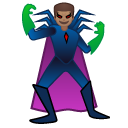
Appearance varies by platform and device. Google Noto, Twemoji, and OpenMoji are open-source.