💁🏿♂️
The Emoji
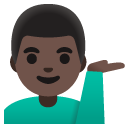
Man Tipping Hand: Dark Skin Tone
U+1F481 U+1F3FF U+200D U+2642 U+FE0F · :man_tipping_hand_dark_skin_tone:
Trend 72
Meaning layers
- interpretation
- Used to convey unbothered confidence, petty sass, or a sarcastic 'obviously' vibe — essentially saying 'I told you so' or 'not my problem' with maximum attitude.
- tiktok usage
- Appears in reaction videos and comment sections to signal a shady clapback, self-satisfaction, or 'I'm just saying' energy after a point is proven.
- irony level
- 8 / 10
Platform meanings
- meaning
- Signals unbothered sass, a mic-drop moment, or a 'here's the tea' reveal — often follows a punchline or a flex.
- trend usage
- Appears in comment sections to react to dramatic reversals, receipts being dropped, or someone being exposed.
- hashtags
- #sassy#unbothered#clapback#teazeit#iknewit
- virality score
- 74 / 100
Cultural meanings
🇺🇸
Western / Gen-Z
Core to Gen Z's digital sarcasm vocabulary — represents unbothered confidence and passive-aggressive shade without direct confrontation. Widely understood as a sass marker.
🇵🇰
Pakistan & India
Used in urban youth circles and Hinglish social media to signal sass or 'I know better' energy, especially in comment section debates.
🌍
Middle East
Gaining traction among Arab youth on Instagram and TikTok as a sign of confidence or dismissive attitude — carries similar Western connotations in digital spaces.
🌐
Global Neutral
Broadly readable as 'offering help' or 'here you go' gesture — the sarcastic layer requires cultural context that not all regions share equally.
🇧🇩
Bangladesh
Primarily used in urban social media circles to signal a know-it-all or confident persona, especially among younger, English-fluent users.
🇱🇰
Sri Lanka
Relatively niche; used by digitally connected youth to mirror Western sass culture on platforms like TikTok and Instagram.
🇨🇳
China
Less commonly used on domestic platforms (WeChat, Weibo) where local emoji sets dominate, but understood on international platforms as confident or sassy.
🇯🇵
Japan
The palm-out gesture has service-sector connotations in Japan; the sarcastic layer is largely lost, and it may be read as polite assistance.
🇰🇷
South Korea
Familiar through K-pop fandom culture online where sass and confidence emojis are celebrated — carries the Western 'attitude' interpretation among fans.
🇹🇼
Taiwan
Used among younger, Western-media-exposed users to signal cool confidence; less widespread in traditional communication contexts.
🇭🇰
Hong Kong
Relatively well understood due to strong English social media presence — carries the sass and confidence meaning familiar from Western usage.
🇵🇭
Philippines
Widely used and culturally resonant — Filipinos are heavy emoji users and this fits the playful, confident, sometimes shady online humor style.
🇮🇩
Indonesia
Popular among Indonesian Gen Z on TikTok and Twitter — understood as a sassy or 'I'm just saying' gesture in digital banter.
🇹🇭
Thailand
Used in Thai social media by younger users familiar with global emoji culture; primarily registers as confidence or mild shade.
🇻🇳
Vietnam
Emerging use among urban Vietnamese youth on TikTok — mirrors Western sass interpretation in meme-heavy contexts.
🇲🇾
Malaysia
Common in Malaysian social media humor — the multicultural, meme-savvy population uses it for clapbacks and confident self-expression.
🇸🇦
Saudi Arabia
Mainly used by younger, globally connected Saudis on Twitter and Snapchat — understood as confidence or dismissiveness in those circles.
🇦🇪
UAE
Dubai's multicultural, social-media-forward population uses it fluently in the Western sassy sense — common in youth and influencer culture.
🇪🇬
Egypt
Used by Egyptian youth on TikTok and Twitter — fits the Egyptian humor tradition of wit and pointed commentary with style.
🇹🇷
Turkey
Resonates with Turkish social media culture's love of dramatic, expressive communication — used to signal confidence or shade in group chats.
🇮🇷
Iran
Used on Instagram and Telegram by digitally active Iranians to project a confident, unbothered persona in an often-ironic online tone.
🇳🇬
Nigeria
Deeply culturally resonant — confidence, sass, and Black excellence themes align with Nigerian online culture; widely embraced in Afrobeats and Gen Z spaces.
🇿🇦
South Africa
Common in South African youth culture where digital sass and confidence are valued — pairs well with local slang and meme culture.
🇬🇧
UK & Ireland
Used widely for banter and shade — fits the British tradition of passive-aggressive wit and 'I'm just saying' commentary in group chats.
🇫🇷
France
Used among French youth influenced by American social media — the confident dismissiveness resonates but carries slightly less cultural weight than in Anglo spaces.
🇩🇪
Germany
Understood in ironic or sarcastic contexts by younger users, though German digital communication tends to be more direct and less emoji-heavy.
🇪🇸
Spain & Italy
Embraced in Southern European social media culture for expressive self-confidence — fits the animated, gesture-heavy communication style of both countries.
🇧🇷
Brazil
Very popular in Brazilian social media, especially among LGBTQ+ communities and drag-influenced culture where shade and confidence are art forms.
🇲🇽
Mexico
Used in Mexican social media to signal sass or 'I handled it' energy — fits into the playful but pointed humor style of Mexican online spaces.
🌎
Latin America
Broadly resonant across Latin America for representing a confident, self-aware persona — especially popular in LGBTQ+ and pop culture communities.
🇦🇺
Australia & NZ
Used in banter-heavy Australian and NZ digital culture to signal dry humor, mild shade, or casual confidence — common in group chats and Twitter/X.
How its meaning shifted
- 2010
Emoji did not exist yet — the base information desk person emoji was introduced in Unicode 6.0 in 2010, but gendered and skin-tone variants came later.
- 2015
Skin tone modifiers were introduced in Unicode 8.0 (2015); early usage was straightforward — representing a helpful person or information assistant.
- 2020
By 2020 the emoji had fully evolved into a sass and shade symbol, amplified by Black Twitter, drag culture, and TikTok meme formats.
- 2026
In 2026, the emoji is a stable, widely understood signal of confident unbotheredness, ironic helpfulness, and digital clapback culture — embedded in global Gen Z vocabulary.
See it on every platform
Adjacent emojis
- Often confused with
- person raising handwaving handopen hands
- Can replace
- nail polishcrownsmiling face with sunglasses
Share & embed
Frequently asked
01What does the 💁🏿♂️ Man Tipping Hand: Dark Skin Tone emoji mean?
A man with dark skin tone extending one hand outward in an information-desk or tipping gesture, often used to indicate helpfulness, sass, or a 'here you go' attitude.
02What does 💁🏿♂️ mean on TikTok?
Signals unbothered sass, a mic-drop moment, or a 'here's the tea' reveal — often follows a punchline or a flex.
03What does 💁🏿♂️ mean on WhatsApp?
Signals a sarcastic 'I'm just here to help' or a knowing smirk after being proven right in a group chat.
04What does 💁🏿♂️ mean in Gen-Z slang?
Used to convey unbothered confidence, petty sass, or a sarcastic 'obviously' vibe — essentially saying 'I told you so' or 'not my problem' with maximum attitude.
05Is the 💁🏿♂️ emoji safe to use?
A confident, sassy gesture used for humor, self-expression, and playful shade — generally harmless and positive in most contexts.
06What does 💁🏿♂️ mean in texting?
Psychologically signals a persona that is in control and unfazed — the raised hand posture mimics body language associated with authority, nonchalance, and social dominance.
07What is the shortcode for 💁🏿♂️?
The shortcode for Man Tipping Hand: Dark Skin Tone is :man_tipping_hand_dark_skin_tone:
08What does 💁🏿♂️ mean in dating?
Can be used flirtatiously to say 'I've got what you're looking for' with a wink-adjacent energy, especially in DMs where tone is playful.
Safety & usage
- Safe meaning
- A confident, sassy gesture used for humor, self-expression, and playful shade — generally harmless and positive in most contexts.
- Caution
- Can be used to mock, condescend, or pile on in cyberbullying contexts — the 'obviously, dummy' connotation can become mean-spirited when targeted.
Generally safe. When used repeatedly in targeted comments, it may function as a passive-aggressive bullying tool. The skin tone specificity also means misuse can carry racial undertones depending on who is deploying it.
How it looks across platforms
Appearance varies by platform and device. Google Noto, Twemoji, and OpenMoji are open-source.