🚶🏼♂️
The Emoji
Man Walking: Medium-light Skin Tone
U+1F6B6 U+1F3FC U+200D U+2642 U+FE0F · :man_walking_mediumlight_skin_tone:
Trend 58
Meaning layers
- interpretation
- Used to signal leaving a situation, unbothered energy, or quietly exiting drama without making a scene. The 'walking away' vibe is strong — communicates detachment or slow-burn confidence.
- tiktok usage
- Placed at the end of captions to signal unbothered departure from drama, bad vibes, or toxic situations. Often paired with 🚪 or 💨 for comedic exit effect.
- irony level
- 6 / 10
Platform meanings
- meaning
- Signals a dramatic or casual exit from a situation, often placed after a punchline or confession.
- trend usage
- Used in 'POV: me walking away from...' videos, satisfying montages, and self-improvement 'that girl' content.
- hashtags
- #walkingaway#unbothered#maincharacter#exitstrategy#selfcare
- virality score
- 62 / 100
Cultural meanings
🇺🇸
Western / Gen-Z
Universally understood as the 'walking away from drama' emoji — carries strong unbothered, self-preserving connotations in Gen Z digital communication.
🇵🇰
Pakistan & India
Used literally to indicate going for a walk or commuting on foot; less ironic usage compared to Western contexts, more practical signaling in casual chats.
🌍
Middle East
Primarily used in a literal sense — going for a walk, leaving home, or heading out. The ironic 'walking away from drama' layer exists among younger, digitally-native users.
🌐
Global Neutral
Universally readable as 'a person walking' — the literal interpretation is consistent across all cultures, making it a low-ambiguity emoji globally.
🇧🇩
Bangladesh
Used in everyday messaging to indicate movement, commuting, or going out on foot — skin tone representation is noted positively among lighter-skinned communities.
🇱🇰
Sri Lanka
Practical usage dominates — signals physical travel or walking as part of a daily update. Ironic digital usage is emerging among younger Sri Lankan social media users.
🇨🇳
China
Used casually to indicate movement or a casual stroll; on platforms like WeChat it signals departure or 'heading out' in group chats without much ironic weight.
🇯🇵
Japan
Interpreted quite literally as walking or commuting on foot — Japan's strong pedestrian culture makes this emoji relatable and frequently used without irony.
🇰🇷
South Korea
Used among younger Koreans to signal both literal walks and metaphorical 'unbothered' exits from cringe situations, influenced by global meme culture.
🇹🇼
Taiwan
Common in casual messaging to indicate going out or taking a walk; the meme layer of 'walking away from problems' is understood by younger, online-active users.
🇭🇰
Hong Kong
Frequently used to signal commuting on foot in a dense urban environment; also picked up ironic 'exit' usage from English-language social media influence.
🇵🇭
Philippines
Very commonly used in Filipino group chats to signal literally heading out or walking away; the dramatic departure meme is also well understood and used humorously.
🇮🇩
Indonesia
Used in everyday communication to indicate going out or walking; popular in fitness accountability groups for step challenges and outdoor activity logging.
🇹🇭
Thailand
Used casually to indicate leaving or going somewhere on foot; younger Thai users also use it in the ironic 'walking away from problems' meme context.
🇻🇳
Vietnam
Practical usage to signal going out or commuting; in younger digital spaces, the 'leaving drama' connotation has been adopted via global social media exposure.
🇲🇾
Malaysia
Used in multilingual group chats to indicate movement or departure — the skin tone specificity is sometimes noted in conversations about representation.
🇸🇦
Saudi Arabia
Primarily literal — indicating going out for a walk or leaving a location; used in fitness contexts among the growing Saudi health and wellness community.
🇦🇪
UAE
Used by the diverse expat and local population to signal going out, fitness walks, or literally heading somewhere — the ironic layer exists mostly among expat youth.
🇪🇬
Egypt
Used casually in Egyptian Arabic chat culture to signal leaving or heading out; younger Egyptians familiar with global meme culture use it for ironic exits.
🇹🇷
Turkey
Common in casual Turkish messaging to indicate heading out on foot; the 'walking away' meme is understood by younger, Twitter-active Turkish users.
🇮🇷
Iran
Used among younger Iranians on platforms like Instagram and Telegram to signal going out or departing; ironic usage follows global meme patterns.
🇳🇬
Nigeria
Popular in Nigerian Twitter (X) culture as a way to exit ridiculous arguments or discourse — the dramatic walk-away emoji fits perfectly into Naija internet humor.
🇿🇦
South Africa
Used in South African social media to indicate literal movement and also as a meme-layer exit from online drama — particularly active on Twitter.
🇬🇧
UK & Ireland
Heavily used in British and Irish internet culture with strong ironic and understated 'I'm done with this' energy — fits perfectly with British passive-aggressive digital communication.
🇫🇷
France
Used casually in French messaging; the skin tone representation is discussed in French conversations about digital diversity and emoji inclusivity.
🇩🇪
Germany
Practical usage is dominant — signaling going for a walk or leaving; the irony layer is understood by younger German users but not the primary interpretation.
🇪🇸
Spain & Italy
Used in the context of 'going for a passeggiata' or evening walk — deeply culturally resonant with Southern European walking culture and social strolling traditions.
🇧🇷
Brazil
Used humorously in Brazilian internet culture to signal exiting drama or ignoring nonsense — pairs well with Brazilian meme culture's flair for comedic detachment.
🇲🇽
Mexico
Used in Mexican group chats to signal heading out or walking away; the ironic 'leaving the drama' usage is popular among younger Mexican social media users.
🌎
Latin America
Broadly used across Latin America in both literal (going out) and ironic (walking away from chaos) contexts — the latter usage is popular on regional Twitter/X culture.
🇦🇺
Australia & NZ
Used with classic Australian/Kiwi dry humor to signal walking away from nonsense — fits the culturally understated 'can't be bothered' communication style.
How its meaning shifted
- 2010
Emoji did not exist in this form — basic walking figures existed in earlier Unicode but skin tone modifiers were not yet introduced.
- 2015
Introduced with skin tone modifier support in Unicode 8.0 — primarily used as a literal pedestrian or mobility symbol, no significant ironic layer yet.
- 2020
The 'walking away from drama' meme interpretation became mainstream — heavily used during lockdown social media culture to signal stepping back from overwhelming discourse.
- 2026
Fully embedded in digital communication as both a literal walking indicator and a nuanced 'unbothered departure' signifier — the specific medium-light skin tone version gains representation-conscious usage alongside meme applications.
See it on every platform
Adjacent emojis
- Often confused with
- man walking medium skin toneperson walkingman running medium light skin tone
- Can replace
- person walkingfootprintssneaker
Share & embed
Frequently asked
01What does the 🚶🏼♂️ Man Walking: Medium-light Skin Tone emoji mean?
A man walking, displayed with a medium-light skin tone modifier. Depicts a male figure in a walking pose facing left.
02What does 🚶🏼♂️ mean on TikTok?
Signals a dramatic or casual exit from a situation, often placed after a punchline or confession.
03What does 🚶🏼♂️ mean on WhatsApp?
Signals literally going for a walk or metaphorically stepping away from a conversation or situation.
04What does 🚶🏼♂️ mean in Gen-Z slang?
Used to signal leaving a situation, unbothered energy, or quietly exiting drama without making a scene. The 'walking away' vibe is strong — communicates detachment or slow-burn confidence.
05Is the 🚶🏼♂️ emoji safe to use?
A man in motion — walking, strolling, commuting, exercising, or departing a situation. Universally benign and practical.
06What does 🚶🏼♂️ mean in texting?
Walking symbolizes forward motion and autonomy. Psychologically this emoji conveys a quiet refusal to engage, emotional self-regulation, or deliberate distancing — less aggressive than running but more intentional than standing still.
07What is the shortcode for 🚶🏼♂️?
The shortcode for Man Walking: Medium-light Skin Tone is :man_walking_mediumlight_skin_tone:
08What does 🚶🏼♂️ mean in dating?
Rarely flirty on its own, but can be used playfully as 'coming over' or 'heading your way' in a light romantic context.
Safety & usage
- Safe meaning
- A man in motion — walking, strolling, commuting, exercising, or departing a situation. Universally benign and practical.
- Caution
- Very rarely weaponized; in extreme cases could be used passive-aggressively to signal ghosting or dismissing someone in a relationship context.
No significant toxic or NSFW usage patterns documented. Extremely low risk emoji. Skin tone modifier adds positive representation value.
How it looks across platforms
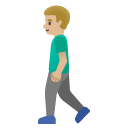
Appearance varies by platform and device. Google Noto, Twemoji, and OpenMoji are open-source.