👬🏿
The Emoji
Men Holding Hands: Dark Skin Tone
U+1F46C U+1F3FF · :men_holding_hands_dark_skin_tone:
Trend 58
Meaning layers
- interpretation
- Used to celebrate male friendship, Black queer love, brotherhood, and solidarity. Gen Z uses it authentically to represent LGBTQ+ relationships with racial pride, or ironically to hype up 'bromances' between male friends.
- tiktok usage
- Appears in videos celebrating Black LGBTQ+ love, Pride content, 'bestie' duos, and affectionate male friendship compilations. Often paired with empowerment captions.
- irony level
- 3 / 10
Platform meanings
- meaning
- Represents Black male love, queer Pride, and strong male friendship. Used in duets, couples' reveals, and 'day in my life' content by Black LGBTQ+ creators.
- trend usage
- Appears under Pride month content, Black joy compilations, and LGBTQ+ storytelling videos. Trend usage spikes significantly during June and around Black History Month.
- hashtags
- #BlackLove#BlackPride#LGBTQBlack#MenHoldingHands#BlackBoyJoy
- virality score
- 62 / 100
Cultural meanings
🇺🇸
Western / Gen-Z
Widely embraced as a symbol of Black queer love and intersectional Pride — used proudly and frequently by LGBTQ+ youth and their allies without irony or stigma.
🇵🇰
Pakistan & India
Largely misread as two close male friends, as open same-sex relationships remain heavily stigmatized; the romantic connotation is often invisible or deliberately ignored in these contexts.
🌍
Middle East
Generally interpreted as male friendship due to cultural norms around gender segregation and the criminalization of homosexuality in many countries; the LGBTQ+ reading is recognized but rarely acknowledged publicly.
🌐
Global Neutral
Broadly understood as representing male partnership — either romantic or deeply platonic — with the dark skin tone adding a layer of racial identity representation.
🇧🇩
Bangladesh
Almost exclusively read as close male friendship; same-sex romantic interpretation is culturally suppressed and rarely acknowledged in mainstream digital communication.
🇱🇰
Sri Lanka
Interpreted as brotherly or platonic male bonding in most contexts; awareness of LGBTQ+ meaning exists among urban youth but is not mainstream.
🇨🇳
China
Used primarily to indicate close male friendship ('good brothers'); LGBTQ+ reading is understood by younger netizens but censored on major platforms like WeChat and Weibo.
🇯🇵
Japan
Recognized both as close male friendship and as a BL (Boys' Love) or gay couple symbol by manga and anime-aware communities; skin tone specificity draws less cultural attention.
🇰🇷
South Korea
Associated with close 'bromance' culture and idol group friendships by mainstream users; LGBTQ+ communities use it to represent same-sex male couples with growing visibility.
🇹🇼
Taiwan
Used openly to represent same-sex male couples, reflecting Taiwan's status as the first Asian country to legalize same-sex marriage — the emoji is embraced with pride.
🇭🇰
Hong Kong
Used by LGBTQ+ communities and allies to represent gay male partnerships; visibility is higher than mainland China but faces increasing political sensitivity.
🇵🇭
Philippines
Understood across LGBTQ+ and ally communities as representing gay male relationships; the Philippines' relatively open attitude toward gender and sexuality makes this relatively normalized.
🇮🇩
Indonesia
Primarily read as male friendship; same-sex interpretation is known but sensitive given conservative religious norms and increasing anti-LGBTQ+ legislation.
🇹🇭
Thailand
Recognized by many as representing a gay male couple; Thailand's LGBTQ+ visibility and tourism culture mean the emoji reads naturally to a wide audience.
🇻🇳
Vietnam
Interpreted mostly as close male friends; LGBTQ+ awareness is growing in urban areas, and younger Vietnamese users increasingly understand the romantic connotation.
🇲🇾
Malaysia
Largely read as platonic male companionship; the LGBTQ+ interpretation is understood but rarely expressed openly due to legal and religious constraints.
🇸🇦
Saudi Arabia
Interpreted strictly as male friendship — any romantic or LGBTQ+ connotation is culturally and legally taboo; use in affirming LGBTQ+ contexts would be considered deeply inappropriate.
🇦🇪
UAE
Similar to Saudi Arabia — read as male camaraderie; the LGBTQ+ reading is understood but suppressed; international expat communities may use it more openly.
🇪🇬
Egypt
Viewed as male friendship; LGBTQ+ interpretation is known but highly stigmatized and potentially dangerous to express publicly given anti-gay laws and social climate.
🇹🇷
Turkey
Split interpretation — older and conservative users see male friendship, while younger urban LGBTQ+ communities use it to represent same-sex relationships with growing defiance.
🇮🇷
Iran
Interpreted as brotherly affection given the severe criminalization of homosexuality; any LGBTQ+ use would be covert and carry significant personal risk.
🇳🇬
Nigeria
Predominantly read as male friendship; LGBTQ+ interpretation is known in activist circles but expressing it openly is dangerous given anti-gay legislation and strong social stigma.
🇿🇦
South Africa
More openly used to represent gay male relationships given South Africa's progressive constitution protecting LGBTQ+ rights — Black gay communities embrace it with pride.
🇬🇧
UK & Ireland
Widely understood as representing a gay male couple or close friends, with the dark skin tone read as intentional racial representation; used comfortably in inclusive spaces.
🇫🇷
France
Interpreted as romantic male partnership or close friendship; French culture's relative openness toward LGBTQ+ expression and the country's visibility of Black queer communities make this readable in both contexts.
🇩🇪
Germany
Understood as representing a gay male couple or strong male friendship; Germany's LGBTQ+-affirming legal landscape means the emoji is used comfortably in public discourse.
🇪🇸
Spain & Italy
Spain reads it openly as representing gay partnership given progressive LGBTQ+ laws; Italy's more conservative regions may interpret it as close friendship, though urban LGBTQ+ communities use it proudly.
🇧🇷
Brazil
Used openly to celebrate Black gay love — Brazil's large Black LGBTQ+ community and vibrant Pride culture make this emoji a meaningful and frequently used symbol.
🇲🇽
Mexico
Understood as gay male partnership among LGBTQ+ communities and allies; machismo culture means older or conservative users may default to a 'close friends' interpretation.
🌎
Latin America
Varies by country — urban LGBTQ+ communities across Latin America use it to represent same-sex male love, while conservative communities interpret it as friendship; Black queer Latinx users find it especially meaningful.
🇦🇺
Australia & NZ
Widely recognized as representing gay male couple or close friends, with the dark skin tone appreciated as inclusive representation; used comfortably in LGBTQ+ and multicultural spaces.
How its meaning shifted
- 2010
This emoji did not exist in 2010 — the concept of skin tone modifiers and diverse couple emojis was years away from Unicode adoption.
- 2015
Skin tone modifiers were introduced in Unicode 8.0 (2015) but diverse couple emojis with matching skin tones were not yet available; the representation gap was actively noted by advocates.
- 2020
By 2020, the emoji was available and gaining traction among Black LGBTQ+ communities, particularly during Pride month and amid heightened racial justice conversations following the Black Lives Matter movement surge.
- 2026
Mainstream adoption across LGBTQ+ and ally communities globally, with frequent use in Pride content, representation discussions, and everyday affectionate messaging among Black gay couples and their friends.
See it on every platform
Adjacent emojis
- Often confused with
- people holding handshandshakeraised fist dark skin tone
- Can replace
- couple with heartrainbow flagtwo hearts
Share & embed
Frequently asked
01What does the 👬🏿 Men Holding Hands: Dark Skin Tone emoji mean?
Two men holding hands with dark skin tone modifier applied to both figures, representing male partnership, friendship, or romantic union between dark-skinned men.
02What does 👬🏿 mean on TikTok?
Represents Black male love, queer Pride, and strong male friendship. Used in duets, couples' reveals, and 'day in my life' content by Black LGBTQ+ creators.
03What does 👬🏿 mean on WhatsApp?
Signals a close male bond or romantic relationship between two dark-skinned men. Friends may use it playfully to describe an inseparable male duo.
04What does 👬🏿 mean in Gen-Z slang?
Used to celebrate male friendship, Black queer love, brotherhood, and solidarity. Gen Z uses it authentically to represent LGBTQ+ relationships with racial pride, or ironically to hype up 'bromances' between male friends.
05Is the 👬🏿 emoji safe to use?
Celebrating male friendship, Black queer love, LGBTQ+ Pride, and racial diversity in representation.
06What does 👬🏿 mean in texting?
This emoji carries significant emotional weight as a symbol of intersectional identity — combining racial and sexual identity affirmation. For many Black gay men, seeing this emoji feels validating and representational in a way older, default yellow emojis could not provide.
07What is the shortcode for 👬🏿?
The shortcode for Men Holding Hands: Dark Skin Tone is :men_holding_hands_dark_skin_tone:
08What does 👬🏿 mean in dating?
Used by gay or bisexual men of darker skin tones to signal romantic interest or to openly express their identity in dating conversations. Signals 'I'm proud, visible, and not hiding who I am.'
Safety & usage
- Safe meaning
- Celebrating male friendship, Black queer love, LGBTQ+ Pride, and racial diversity in representation.
- Caution
- Occasionally weaponized in homophobic commentary as a mocking tool, or used to taunt men perceived as 'too close'; can appear in anti-LGBTQ+ hate content.
While inherently neutral and representational, this emoji can attract homophobic responses in certain communities or online spaces. In regions where homosexuality is criminalized, using this emoji to represent a same-sex relationship publicly may carry personal risk.
How it looks across platforms
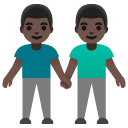


Appearance varies by platform and device. Google Noto, Twemoji, and OpenMoji are open-source.