👨🏿🤝👨🏼
The Emoji
Men Holding Hands: Dark Skin Tone, Medium-light Skin Tone
U+1F468 U+1F3FF U+200D U+1F91D U+200D U+1F468 U+1F3FC · :men_holding_hands_dark_skin_tone_mediumlight_skin_tone:
Trend 58
Meaning layers
- interpretation
- Used to signal allyship, interracial bromance, queer visibility, or wholesome male bonding without toxic masculinity. Often deployed ironically to celebrate two guys doing a 'bro thing' together.
- tiktok usage
- Appears in duets between creators of different backgrounds showing solidarity, used in 'found my person' content, or ironically captioning two male characters from shows/games being shipped.
- irony level
- 4 / 10
Platform meanings
- meaning
- Represents male solidarity across races, queer male couples, iconic bromances, or is used ironically when two male creators collab unexpectedly.
- trend usage
- Used in duet videos, 'meet my best friend' content, LGBTQ+ visibility posts, and shipping edits for fictional male characters.
- hashtags
- #BroCode#InterracialFriendship#QueerTikTok#MaleAllyship#UnlikelyDuo
- virality score
- 62 / 100
Cultural meanings
🇺🇸
Western / Gen-Z
Widely embraced as a symbol of queer visibility and interracial solidarity; used freely and positively across social media without much stigma among progressive youth.
🇵🇰
Pakistan & India
Largely interpreted as two male friends holding hands, a culturally common gesture of platonic closeness; the romantic or queer connotation is often not the primary read due to social norms.
🌍
Middle East
Platonic male hand-holding is culturally normal and the emoji may be read as friendship; the LGBTQ+ connotation is generally avoided or unrecognized due to social and legal restrictions.
🌐
Global Neutral
Understood broadly as male companionship or solidarity across racial lines; the specific romantic or queer meaning depends heavily on cultural context.
🇧🇩
Bangladesh
Similar to South Asian norms, male hand-holding is a sign of friendship and the emoji is typically read as platonic brotherhood rather than a romantic gesture.
🇱🇰
Sri Lanka
Interpreted primarily as close male friendship; the interracial aspect may be noted positively as a symbol of harmony, while queer connotations are less commonly recognized.
🇨🇳
China
Male platonic hand-holding is familiar culturally; the emoji is most often read as friendship or brotherhood, with LGBTQ+ interpretations existing mainly in urban progressive circles.
🇯🇵
Japan
Read in the context of close male friendship ('nakama' culture); queer readings exist in LGBTQ+ communities but the emoji is generally seen as wholesome male bonding.
🇰🇷
South Korea
Interpreted as close male friendship in mainstream culture; within K-pop fan communities it is often used to 'ship' male idols, adding a playful romantic layer.
🇹🇼
Taiwan
One of Asia's most LGBTQ+-affirming cultures; the emoji is used openly to represent both queer couples and interracial friendships with positive connotations.
🇭🇰
Hong Kong
Used in progressive circles to celebrate LGBTQ+ visibility and interracial bonds; mainstream interpretation leans toward close friendship.
🇵🇭
Philippines
Generally read as close male friendship; LGBTQ+ culture is vibrant and the queer reading is recognized, especially among younger urban users.
🇮🇩
Indonesia
Primarily interpreted as platonic male friendship; queer connotations are recognized in progressive communities but avoided in more conservative contexts.
🇹🇭
Thailand
In a culture with visible LGBTQ+ acceptance, the emoji is used to represent both queer couples and diverse male friendships without significant stigma.
🇻🇳
Vietnam
Mostly read as close platonic male friendship; younger, internet-savvy users are more aware of its queer meaning but it remains secondary in mainstream use.
🇲🇾
Malaysia
Typically read as friendship; LGBTQ+ connotations are largely suppressed due to social and legal norms, though recognized in discreet online communities.
🇸🇦
Saudi Arabia
Almost exclusively interpreted as platonic male friendship, as public expressions of queer identity are legally and socially restricted.
🇦🇪
UAE
Read as close male friendship in mainstream contexts; among expatriate communities and online, the LGBTQ+ meaning is more widely understood.
🇪🇬
Egypt
Primarily seen as friendship or brotherhood; the queer connotation is generally not acknowledged publicly due to social conservatism.
🇹🇷
Turkey
In urban progressive communities it signals LGBTQ+ allyship or queer relationships; mainstream interpretation leans toward male friendship.
🇮🇷
Iran
Strictly interpreted as platonic male friendship given legal and social restrictions on LGBTQ+ expression; the diversity aspect may be noted positively.
🇳🇬
Nigeria
Predominantly read as male friendship or brotherhood; the interracial aspect may carry positive connotations of unity, while queer readings are largely avoided.
🇿🇦
South Africa
In one of Africa's most progressive LGBTQ+ legal environments, the emoji is used openly to celebrate queer relationships and interracial friendships.
🇬🇧
UK & Ireland
Widely understood and used positively to represent queer male couples or diverse male friendships; very common during Pride Month.
🇫🇷
France
Used to celebrate male friendship across cultural lines and queer relationships; France's laïcité tradition means it is generally accepted in public discourse.
🇩🇪
Germany
Read positively as a symbol of diversity and queer visibility; frequently used in LGBTQ+ advocacy and multicultural contexts.
🇪🇸
Spain & Italy
In Spain widely used for queer positivity; in Italy mainstream use leans toward friendship, though LGBTQ+ communities embrace it fully.
🇧🇷
Brazil
Embraced enthusiastically in one of the world's largest LGBTQ+ communities; represents both queer love and interracial friendship in a racially diverse nation.
🇲🇽
Mexico
Used in progressive urban circles to celebrate queer relationships and interracial friendships; mainstream reading is often still platonic friendship.
🌎
Latin America
Interpretation varies by country; in progressive cities it signals queer visibility and interracial unity, while more conservative regions read it as friendship.
🇦🇺
Australia & NZ
Used freely and positively to celebrate LGBTQ+ relationships and diverse male friendships; common in Pride-related content and multicultural communities.
How its meaning shifted
- 2010
This specific multi-skin-tone emoji did not exist; predecessor emojis had no skin tone modifiers, and same-sex couple emojis were extremely limited or absent.
- 2015
Basic same-sex couple emojis began appearing; skin tone modifiers were introduced but multi-person skin tone combinations were not yet possible, limiting this specific combination.
- 2020
Mixed skin tone combinations became widely supported; used increasingly in LGBTQ+ visibility content, Black Lives Matter solidarity posts, and interracial friendship celebration.
- 2026
Normalized across progressive platforms as a symbol of both queer male partnership and interracial allyship; used casually in everyday digital communication without requiring explanation.
See it on every platform
Adjacent emojis
- Often confused with
- handshakepeople holding handsmen holding hands
- Can replace
- red hearttwo heartshandshake
Share & embed
Frequently asked
01What does the 👨🏿🤝👨🏼 Men Holding Hands: Dark Skin Tone, Medium-light Skin Tone emoji mean?
Two men holding hands, depicted with dark skin tone and medium-light skin tone, representing male companionship, friendship, solidarity, or romantic partnership across different skin tones.
02What does 👨🏿🤝👨🏼 mean on TikTok?
Represents male solidarity across races, queer male couples, iconic bromances, or is used ironically when two male creators collab unexpectedly.
03What does 👨🏿🤝👨🏼 mean on WhatsApp?
Sent between male friends of different backgrounds to express closeness or to acknowledge a shared moment; also used in queer group chats to celebrate relationships.
04What does 👨🏿🤝👨🏼 mean in Gen-Z slang?
Used to signal allyship, interracial bromance, queer visibility, or wholesome male bonding without toxic masculinity. Often deployed ironically to celebrate two guys doing a 'bro thing' together.
05Is the 👨🏿🤝👨🏼 emoji safe to use?
Represents male friendship, interracial solidarity, queer partnership, and inclusive love between men of different skin tones.
06What does 👨🏿🤝👨🏼 mean in texting?
The combination of two different skin tones amplifies the emotional resonance of unity across racial lines, triggering feelings of hope and social progress alongside the core emotional content of male affection and partnership.
07What is the shortcode for 👨🏿🤝👨🏼?
The shortcode for Men Holding Hands: Dark Skin Tone, Medium-light Skin Tone is :men_holding_hands_dark_skin_tone_mediumlight_skin_tone:
08What does 👨🏿🤝👨🏼 mean in dating?
Used between two men to signal romantic interest or to affirm a blossoming queer relationship; also used playfully between straight male friends to joke about closeness.
Safety & usage
- Safe meaning
- Represents male friendship, interracial solidarity, queer partnership, and inclusive love between men of different skin tones.
- Caution
- Rarely weaponized toxically; occasionally used mockingly to demean male friendliness or to troll LGBTQ+ spaces, but this is uncommon.
May be unwelcome or misunderstood in culturally or legally conservative contexts where LGBTQ+ expression is restricted. Use with awareness of audience.
How it looks across platforms
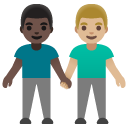


Appearance varies by platform and device. Google Noto, Twemoji, and OpenMoji are open-source.