👨🏾🤝👨🏼
The Emoji
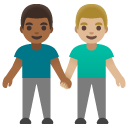
Men Holding Hands: Medium-dark Skin Tone, Medium-light Skin Tone
U+1F468 U+1F3FE U+200D U+1F91D U+200D U+1F468 U+1F3FC · :men_holding_hands_mediumdark_skin_tone_mediumlight_skin_tone:
Trend 58
Meaning layers
- interpretation
- Used to express brotherhood, male friendship, solidarity between guys of different backgrounds, or LGBTQ+ relationships. Gen Z uses it casually to celebrate interracial friendships or queer partnerships without making it a big deal.
- tiktok usage
- Appears in videos celebrating best-friend duos, interracial friendships, or queer couples showing off their relationship. Often used in 'found family' content.
- irony level
- 2 / 10
Platform meanings
- meaning
- Represents male friendship, brotherhood, or an interracial queer couple in video captions and comments.
- trend usage
- Used in friendship reveal videos, 'meet my best friend' content, and Pride-related posts celebrating diverse queer couples.
- hashtags
- #BrotherhoodGoals#InterracialFriendship#PrideTok#MaleAlliance#BestFriendVibes
- virality score
- 62 / 100
Cultural meanings
🇺🇸
Western / Gen-Z
Widely embraced as a symbol of both queer male romance and interracial male friendship, used freely and positively in everyday digital communication without stigma.
🇵🇰
Pakistan & India
Primarily read as a sign of close male friendship or brotherly bond; the romantic or queer interpretation is less commonly assumed and may be considered taboo in more conservative circles.
🌍
Middle East
Generally interpreted as male friendship or brotherhood in most conservative contexts; queer connotations are largely avoided or unacknowledged due to cultural and legal restrictions on LGBTQ+ expression.
🌐
Global Neutral
Broadly understood as a representation of male companionship, friendship, or partnership across different skin tones, with meaning varying by local cultural norms.
🇧🇩
Bangladesh
Seen as two male friends walking together; public display of male friendship is culturally normal, but the romantic interpretation is rarely considered and would be sensitive given local norms.
🇱🇰
Sri Lanka
Interpreted primarily as male camaraderie or brotherhood; the skin tone diversity aspect may be noted positively in multicultural contexts.
🇨🇳
China
Viewed as male friendship, with the interracial element occasionally sparking curiosity; LGBTQ+ connotations are muted due to platform censorship and cultural conservatism.
🇯🇵
Japan
May evoke the concept of close male bonds similar to 'nakama' (companions); queer interpretation exists in progressive urban circles but is not the default reading.
🇰🇷
South Korea
Interpreted as a tight male friendship or 'bromance,' a culturally significant concept; LGBTQ+ reading is growing among younger, progressive users but remains non-mainstream.
🇹🇼
Taiwan
Taiwan's progressive stance on LGBTQ+ rights means this emoji is openly used to represent queer male couples or proud friendships across racial lines.
🇭🇰
Hong Kong
Read as male friendship or a couple depending on the user's social circle; younger, progressive users are more likely to apply the queer interpretation.
🇵🇭
Philippines
Often seen as a sign of close male friendship; the LGBTQ+ interpretation is increasingly understood among younger Filipinos, who are generally more open-minded.
🇮🇩
Indonesia
Primarily understood as male friendship; the romantic or queer reading is sensitive given conservative Islamic values in many parts of the country.
🇹🇭
Thailand
In a culture known for relative openness to gender diversity, this emoji can represent male friendship or a queer couple, with both interpretations coexisting comfortably.
🇻🇳
Vietnam
Seen mainly as male friendship; LGBTQ+ awareness is growing among youth, but the romantic reading is not yet the default interpretation.
🇲🇾
Malaysia
Read cautiously due to religious and cultural conservatism; typically interpreted as male friendship, with the queer connotation largely avoided.
🇸🇦
Saudi Arabia
Strictly interpreted as male friendship or brotherhood in line with cultural and religious norms; any queer connotation would be considered inappropriate.
🇦🇪
UAE
Similar to Saudi Arabia, read as male friendship; in expat and cosmopolitan circles, the queer reading may be quietly understood but not publicly expressed.
🇪🇬
Egypt
Interpreted as a sign of close male friendship; Egypt's conservative social climate means the queer interpretation is largely suppressed or unknown in mainstream usage.
🇹🇷
Turkey
Seen as male friendship or camaraderie; younger, urban Turks may understand the LGBTQ+ connotation, but it remains sensitive in broader society.
🇮🇷
Iran
Understood as male friendship; any romantic or queer interpretation is culturally and legally sensitive and would not be expressed openly.
🇳🇬
Nigeria
Read as male friendship or solidarity across different skin tones; the queer interpretation is highly sensitive given Nigeria's legal and cultural environment.
🇿🇦
South Africa
With its constitutional protections for LGBTQ+ rights, South Africa's progressive urban communities read this as both queer partnership and interracial friendship, often celebrating both.
🇬🇧
UK & Ireland
Used comfortably to represent male friendship or a gay couple; the multi-skin-tone aspect is celebrated as a nod to multicultural British society.
🇫🇷
France
Seen as a sign of male friendship or romantic partnership; France's secular and relatively progressive culture allows both interpretations to coexist openly.
🇩🇪
Germany
Used to represent male friendship or a gay couple, with the skin tone diversity adding a layer of celebration of Germany's multicultural society.
🇪🇸
Spain & Italy
Interpreted as close male friendship or, among younger and LGBTQ+ communities, a romantic couple; warmly received in progressive circles.
🇧🇷
Brazil
In Brazil's vibrant LGBTQ+ culture, this emoji is embraced to represent queer male couples or diverse male friendships, often used enthusiastically during Pride events.
🇲🇽
Mexico
Younger Mexicans use it to represent male friendship or queer relationships; in more conservative or rural contexts, it is read solely as friendship.
🌎
Latin America
Across Latin America, primarily read as male camaraderie; in more progressive urban areas and among younger generations, the queer interpretation is increasingly recognized.
🇦🇺
Australia & NZ
Freely used to represent male friendship or a queer couple; the multicultural aspect resonates strongly in both countries' diverse societies.
How its meaning shifted
- 2010
Multi-skin-tone holding hands emojis did not yet exist; general couple or person emojis were used without skin tone or gender specificity.
- 2015
Basic same-sex couple emojis began emerging but with limited skin tone options; the concept of diverse hand-holding emojis was just beginning to develop.
- 2020
The emoji became available and was used primarily in LGBTQ+ contexts and to celebrate diversity; awareness of its dual (friendship and romantic) meaning spread.
- 2026
Widely normalized across platforms to represent both male friendship and queer romance; skin-tone combinations are celebrated as a marker of inclusivity rather than novelty.
See it on every platform
Compare with
Adjacent emojis
- Often confused with
- people holding handshandshakemen holding hands
- Can replace
- handshaketwo heartsrainbow flag
Share & embed
Frequently asked
01What does the 👨🏾🤝👨🏼 Men Holding Hands: Medium-dark Skin Tone, Medium-light Skin Tone emoji mean?
Two men holding hands, with the left figure having a medium-dark skin tone and the right figure having a medium-light skin tone, representing male partnership, friendship, or romance across different skin tones.
02What does 👨🏾🤝👨🏼 mean on TikTok?
Represents male friendship, brotherhood, or an interracial queer couple in video captions and comments.
03What does 👨🏾🤝👨🏼 mean on WhatsApp?
Sent between two male friends to signal camaraderie, hype each other up, or represent their friendship in a group chat.
04What does 👨🏾🤝👨🏼 mean in Gen-Z slang?
Used to express brotherhood, male friendship, solidarity between guys of different backgrounds, or LGBTQ+ relationships. Gen Z uses it casually to celebrate interracial friendships or queer partnerships without making it a big deal.
05Is the 👨🏾🤝👨🏼 emoji safe to use?
A positive representation of male friendship, brotherhood, solidarity, or a loving queer relationship across different skin tones.
06What does 👨🏾🤝👨🏼 mean in texting?
Symbolizes the human need for belonging and connection. The dual skin tones add an emotional layer of cross-cultural unity, suggesting that bonds transcend racial and social boundaries.
07What is the shortcode for 👨🏾🤝👨🏼?
The shortcode for Men Holding Hands: Medium-dark Skin Tone, Medium-light Skin Tone is :men_holding_hands_mediumdark_skin_tone_mediumlight_skin_tone:
08What does 👨🏾🤝👨🏼 mean in dating?
Used between two men in a romantic or flirtatious context to hint at interest or to publicly acknowledge a partner on social media.
Safety & usage
- Safe meaning
- A positive representation of male friendship, brotherhood, solidarity, or a loving queer relationship across different skin tones.
- Caution
- Rarely weaponized, but could theoretically be used mockingly in homophobic contexts to demean two men, though this is uncommon.
Generally safe and inclusive; may be culturally sensitive in regions with anti-LGBTQ+ laws or norms where even displaying the emoji could be considered provocative.
How it looks across platforms


Appearance varies by platform and device. Google Noto, Twemoji, and OpenMoji are open-source.