☦️
The Emoji
Orthodox Cross
U+2626 U+FE0F · :orthodox_cross:
Trend 18
Meaning layers
- interpretation
- Used primarily by Orthodox Christians to signal faith identity online; occasionally adopted aesthetically in 'dark academia' or 'byzantine core' aesthetics without deep religious conviction.
- tiktok usage
- Appears in Orthodox Christian content, Byzantine history TikToks, and aesthetic videos referencing Eastern European or Greek religious culture.
- irony level
- 2 / 10
Platform meanings
- meaning
- Marks Orthodox Christian faith identity or Byzantine/Eastern European historical content.
- trend usage
- Used in #OrthodoxChristian, #Byzantine, and Eastern European cultural content; appears in 'Byzantine Empire glazing' trend.
- hashtags
- #OrthodoxChristian#Byzantine#EasternOrthodox#ByzantineEmpire#OrthodoxFaith
- virality score
- 22 / 100
Cultural meanings
🇺🇸
Western / Gen-Z
Recognized by most as a religious symbol but less familiar than the Latin cross; adopted by some in aesthetic subcultures like 'Byzantine core' without deep religious meaning.
🇵🇰
Pakistan & India
Recognized mainly among Christian minority communities (Syriac Orthodox, Malankara Orthodox in India); carries strong religious significance for those groups.
🌍
Middle East
Deeply meaningful to Eastern Christian communities (Copts, Syriac Christians, Greek Orthodox in the Levant) as a marker of ancient Christian heritage and often minority identity.
🌐
Global Neutral
Understood broadly as a variant of the Christian cross; the specific Orthodox meaning is often only recognized by those with Eastern Christian cultural exposure.
🇧🇩
Bangladesh
Largely unfamiliar except among small Christian minority communities; distinguished from the Latin cross by those with religious education.
🇱🇰
Sri Lanka
Known among the small Orthodox Christian community; broader population may recognize it as a Christian symbol without knowing its specific Orthodox significance.
🇨🇳
China
Rarely used; those aware of it associate it with Russian or Eastern European Christianity rather than Chinese Christian practice.
🇯🇵
Japan
Primarily seen as a historical or aesthetic symbol; Orthodox Christianity has a small but historical presence in Japan (Russian Orthodox influence), where it holds genuine meaning for that community.
🇰🇷
South Korea
Recognized by scholars and historians; the large Korean Christian community is predominantly Protestant or Catholic, so Orthodox specificity is less culturally embedded.
🇹🇼
Taiwan
Known mainly in academic or historical contexts; small Orthodox Christian community uses it with genuine religious meaning.
🇭🇰
Hong Kong
Recognized as a Christian symbol; Orthodox Christianity is a niche community, so the specific iconography is known mainly to enthusiasts of religious history.
🇵🇭
Philippines
Predominantly Catholic country; the Orthodox Cross is distinguished from the Latin cross mainly by the religiously educated, though it signals Christianity broadly.
🇮🇩
Indonesia
Among the small Christian minority, recognized as a Christian symbol; the Orthodox specificity is known mainly to those with Eastern Christian heritage.
🇹🇭
Thailand
Recognized as a religious symbol by the small Christian community; broader association with Russian culture due to Russian Orthodox church presence in tourist areas.
🇻🇳
Vietnam
Known mainly to the small Catholic and Orthodox Christian communities; generally seen as a variant of the Christian cross.
🇲🇾
Malaysia
Recognized by the Christian minority as a Christian symbol; Orthodox distinction is less commonly understood in the broader population.
🇸🇦
Saudi Arabia
Religious symbols of non-Islamic faiths are sensitive; the Orthodox Cross is understood as a Christian symbol and its display may be culturally restricted or avoided.
🇦🇪
UAE
Known among the diverse expat Christian community; Eastern Orthodox expats (Russian, Serbian, Romanian, Greek) use it openly as a faith marker.
🇪🇬
Egypt
Highly significant for Coptic Orthodox Christians, though the Coptic Cross differs; the Byzantine Orthodox Cross is recognized and respected by Egypt's substantial Christian minority.
🇹🇷
Turkey
Carries deep historical resonance connected to Byzantine and Greek Orthodox heritage; recognized as a symbol of the Ecumenical Patriarchate of Constantinople located in Istanbul.
🇮🇷
Iran
Known to the Armenian and Assyrian Orthodox Christian minorities who use it as a sacred identity marker; broader population recognizes it as a Christian symbol.
🇳🇬
Nigeria
Used by the small but growing Orthodox Christian community in Nigeria; broader population may conflate it with other Christian crosses.
🇿🇦
South Africa
Recognized within the small Eastern Orthodox community; broader Christian population may not differentiate it from the Latin cross.
🇬🇧
UK & Ireland
Known among Greek, Russian, Romanian, and Serbian Orthodox diaspora communities; increasingly recognized in academic and aesthetic circles.
🇫🇷
France
Recognized among Eastern European Orthodox diaspora; associated with Russian and Greek Orthodox communities that have historic presence in Paris.
🇩🇪
Germany
Known among Eastern European Orthodox diaspora (Russian, Serbian, Romanian); associated with Eastern European immigration and Orthodox cultural identity.
🇪🇸
Spain & Italy
Primarily Catholic countries; the Orthodox Cross is recognized by the educated as a variant of the Christian cross, associated with Eastern European immigration communities.
🇧🇷
Brazil
Known among Eastern European and Middle Eastern Orthodox Christian immigrants; some cultural overlap with the large Greek and Russian communities in São Paulo.
🇲🇽
Mexico
Predominantly Catholic; the Orthodox Cross is recognized by the religiously literate as a Christian variant, with a small but present Orthodox community.
🌎
Latin America
Recognized mainly among Eastern European and Middle Eastern diaspora Orthodox communities; broader population may identify it as a Christian symbol without Orthodox specificity.
🇦🇺
Australia & NZ
Well recognized among the large Greek, Serbian, and Russian Orthodox diaspora communities; used openly as a faith and cultural identity marker.
How its meaning shifted
- 2010
Used almost exclusively by Orthodox Christians in religious digital contexts; very limited mainstream digital awareness.
- 2015
Adoption grew among Eastern European and Orthodox diaspora communities on social media; beginning to appear in bios and holiday posts.
- 2020
Increased visibility due to Byzantine and Eastern European history content online; adopted in aesthetic subcultures; pandemic-era spiritual reflection boosted religious emoji usage broadly.
- 2026
Established as a recognized faith marker in Orthodox online communities; also adopted in 'Byzantine core' and 'medieval aesthetic' subcultures; used in geopolitical discourse around Orthodox nations.
See it on every platform
Compare with
Adjacent emojis
- Opposite
- no entryprohibitedskull
- Often confused with
- latin crosscross markdagger
- Can replace
- latin crossstar of davidsparkles
Share & embed
Frequently asked
01What does the ☦️ Orthodox Cross emoji mean?
The Orthodox Cross (☦️) represents the cross used in Eastern Orthodox Christianity, featuring a main horizontal crossbar, a smaller bar above for the inscription plate (INRI), and a diagonal bar below representing the footrest.
02What does ☦️ mean on TikTok?
Marks Orthodox Christian faith identity or Byzantine/Eastern European historical content.
03What does ☦️ mean on WhatsApp?
Signals religious greeting or blessing, often sent by Orthodox Christians during Easter (Pascha) or Christmas.
04What does ☦️ mean in Gen-Z slang?
Used primarily by Orthodox Christians to signal faith identity online; occasionally adopted aesthetically in 'dark academia' or 'byzantine core' aesthetics without deep religious conviction.
05Is the ☦️ emoji safe to use?
A sacred religious symbol representing Eastern Orthodox Christianity; used respectfully to express faith, cultural identity, and religious heritage.
06What does ☦️ mean in texting?
Carries deep sacred meaning for adherents; evoking spiritual belonging, ancestral continuity, and faith. For non-Orthodox users it may signal curiosity about or admiration for the aesthetic of Eastern Christianity.
07What is the shortcode for ☦️?
The shortcode for Orthodox Cross is :orthodox_cross:
08What does ☦️ mean in dating?
Rarely used in flirting; signals strong religious identity that may indicate conservative values and expectations in a relationship.
Safety & usage
- Safe meaning
- A sacred religious symbol representing Eastern Orthodox Christianity; used respectfully to express faith, cultural identity, and religious heritage.
- Caution
- Can be weaponized in nationalist or extremist contexts (e.g., as a symbol in Russian or Serbian ultranationalist rhetoric); occasionally co-opted by far-right groups using Orthodox identity politically.
While the symbol itself is sacred and benign, context matters — in some geopolitical discussions it may be used to signal ethno-religious nationalism. Users should be aware of this potential connotation in political contexts.
How it looks across platforms
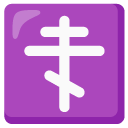


Appearance varies by platform and device. Google Noto, Twemoji, and OpenMoji are open-source.