🤲🏾
The Emoji
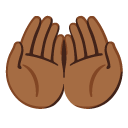
Palms Up Together: Medium-dark Skin Tone
U+1F932 U+1F3FE · :palms_up_together_mediumdark_skin_tone:
Trend 65
Meaning layers
- interpretation
- Used to ask for something, beg, plead, or express desperate need — often humorous or exaggerated. Also used in spiritual or manifestation contexts among younger audiences.
- tiktok usage
- Appears in 'please give me this energy' or 'I am manifesting this' captions. Also used when asking followers for something like likes or shares in a self-aware way.
- irony level
- 4 / 10
Platform meanings
- meaning
- Pleading, manifesting, or expressing spiritual openness. Often paired with affirmations or desperate requests for engagement.
- trend usage
- Used in 'POV: the universe is listening 🤲🏾' trends and 'I'm manifesting this for everyone' comment sections.
- hashtags
- #manifest#prayeremoji#pleasegivemethis#spiritualtiktok#gratitude
- virality score
- 68 / 100
Cultural meanings
🇺🇸
Western / Gen-Z
Primarily used as a humorous begging gesture or in manifestation/spiritual aesthetic contexts with low religious specificity.
🇵🇰
Pakistan & India
Strongly associated with Islamic du'a prayer; used sincerely in religious contexts, WhatsApp prayer forwards, and expressions of supplication to God.
🌍
Middle East
Deep religious significance representing du'a (supplication in Islam); used widely during Ramadan, Eid, and in daily religious communication.
🌐
Global Neutral
Universally readable as 'open hands offering or receiving' — interpreted as prayer, gratitude, or a request depending on cultural background.
🇧🇩
Bangladesh
Primarily carries Islamic prayer connotation; used heavily in religious messaging, condolence texts, and calls for collective du'a.
🇱🇰
Sri Lanka
Used across Muslim communities for prayer; also used broadly to signal humility or a sincere request regardless of religion.
🇨🇳
China
Less common; may be interpreted as offering or receiving a gift, or as a Buddhist-adjacent prayer gesture in spiritual contexts.
🇯🇵
Japan
Occasionally confused with offering or receiving gestures in temple/shrine etiquette; not widely used natively but understood as prayer.
🇰🇷
South Korea
Used in spiritual or K-pop fan contexts to express longing or pleading, often in fan messages to idols.
🇹🇼
Taiwan
Interpreted as a gesture of respectful offering or prayer; used in spiritual social media content and wellness communities.
🇭🇰
Hong Kong
Used in religious and wellness contexts; younger users adopt it for the international 'begging/pleading' meme usage.
🇵🇭
Philippines
Used in Catholic prayer contexts as a general 'praying for you' gesture; also used humorously for pleading in casual chats.
🇮🇩
Indonesia
Heavily used in Islamic contexts for du'a; among the most recognizable prayer emojis in Indonesian Muslim social media communities.
🇹🇭
Thailand
Occasionally associated with Buddhist offering gestures; used spiritually but less frequently than folded hands alternatives.
🇻🇳
Vietnam
Used in spiritual and ancestral veneration contexts as a general offering or prayer symbol; adopted in meme formats by younger users.
🇲🇾
Malaysia
Strong Islamic du'a association; widely used in Malay Muslim communities on WhatsApp and Instagram for prayers and blessings.
🇸🇦
Saudi Arabia
One of the most meaningful emojis in the cultural context — directly represents du'a; used with great sincerity in religious communication.
🇦🇪
UAE
Used sincerely in Islamic religious contexts and also adopted by multicultural expat communities in the broader pleading/gratitude sense.
🇪🇬
Egypt
Widely used for Islamic du'a expressions; also common in everyday pleading or requesting contexts in colloquial Arabic digital communication.
🇹🇷
Turkey
Used in both religious (Islamic du'a) and secular contexts; younger Turkish users also use it in the international meme/begging sense.
🇮🇷
Iran
Represents sincere prayer or supplication in Persian digital culture; used in both religious and emotional pleading contexts.
🇳🇬
Nigeria
Used in both Muslim Northern Nigerian communities for du'a and broadly by Nigerian Christians as a general prayer or blessing gesture.
🇿🇦
South Africa
Used across Muslim communities (especially Cape Malay) for prayer; also adopted broadly for gratitude and spiritual expression.
🇬🇧
UK & Ireland
Used by South Asian and Middle Eastern diaspora communities for prayer; also used widely in the ironic 'begging' meme format by Gen Z.
🇫🇷
France
Adopted by North African (Maghrebi) diaspora for Islamic prayer contexts; also used in mainstream French internet culture as a pleading gesture.
🇩🇪
Germany
Used by Turkish and Arab diaspora communities for prayer; mainstream German internet users employ it in the pleading/begging meme context.
🇪🇸
Spain & Italy
Less culturally specific; used generally for prayer or pleading with some influence from North African diaspora communities.
🇧🇷
Brazil
Used in spiritual contexts across religions including Candomblé-adjacent aesthetics and evangelical prayer; also common in pleading meme formats.
🇲🇽
Mexico
Employed in prayer and religious expression contexts; younger Mexican users use it in 'I am begging' internet humor formats.
🌎
Latin America
Broadly used for prayer and supplication across Latin American digital spaces; spiritual communities and meme culture both actively use it.
🇦🇺
Australia & NZ
Used by South Asian and Middle Eastern diaspora for prayer; mainstream Gen Z usage follows international 'begging/manifesting' meme conventions.
How its meaning shifted
- 2010
Emoji did not exist yet; prayer and offering gestures were represented by folded hands or text-based equivalents like '(hands up)' in Islamic digital spaces.
- 2015
Still pre-release; anticipation in Muslim online communities for a du'a-specific emoji distinct from the folded-hands emoji.
- 2020
Widely adopted in Muslim communities globally for du'a; beginning to cross over into Gen Z pleading and manifestation meme culture.
- 2026
Dual identity firmly established: sincere religious and spiritual symbol in Islamic and global faith communities, AND mainstream ironic 'I am begging you' meme staple across all platforms.
See it on every platform
Adjacent emojis
- Often confused with
- folded handsopen handsperson gesturing ok
- Can replace
- folded handspleading faceraised hands
Share & embed
Frequently asked
01What does the 🤲🏾 Palms Up Together: Medium-dark Skin Tone emoji mean?
Two open hands held together with palms facing upward, displayed with a medium-dark skin tone modifier. Used to represent offering, receiving, prayer, or supplication.
02What does 🤲🏾 mean on TikTok?
Pleading, manifesting, or expressing spiritual openness. Often paired with affirmations or desperate requests for engagement.
03What does 🤲🏾 mean on WhatsApp?
Strong religious or prayer connotation, especially in Muslim-majority communities for du'a. Also used to ask for help or favors.
04What does 🤲🏾 mean in Gen-Z slang?
Used to ask for something, beg, plead, or express desperate need — often humorous or exaggerated. Also used in spiritual or manifestation contexts among younger audiences.
05Is the 🤲🏾 emoji safe to use?
Prayer, supplication, offering, gratitude, humility, pleading for help — overwhelmingly used in sincere, positive, or humorous contexts.
06What does 🤲🏾 mean in texting?
Open upward palms are a universal gesture of non-threat and openness, psychologically signaling vulnerability, sincerity, and a request for trust or assistance. Associated with deep emotional honesty.
07What is the shortcode for 🤲🏾?
The shortcode for Palms Up Together: Medium-dark Skin Tone is :palms_up_together_mediumdark_skin_tone:
08What does 🤲🏾 mean in dating?
Used to beg a crush to reply, go on a date, or give attention — often playfully. Can signal emotional neediness if overused.
Safety & usage
- Safe meaning
- Prayer, supplication, offering, gratitude, humility, pleading for help — overwhelmingly used in sincere, positive, or humorous contexts.
- Caution
- Rarely weaponized; occasionally used sarcastically to mock someone perceived as begging or desperate in an unkind way.
Generally safe. In some contexts, excessive use directed at a person could come across as pressuring or guilt-tripping. No significant NSFW associations.
How it looks across platforms


Appearance varies by platform and device. Google Noto, Twemoji, and OpenMoji are open-source.