🧑🏽🤝🧑🏾
The Emoji
People Holding Hands: Medium Skin Tone, Medium-dark Skin Tone
U+1F9D1 U+1F3FD U+200D U+1F91D U+200D U+1F9D1 U+1F3FE · :people_holding_hands_medium_skin_tone_mediumdark_skin_tone:
Trend 58
Meaning layers
- interpretation
- Used to show solidarity, friendship goals, or romantic coupling especially celebrating diversity and mixed-race relationships. Often dropped in captions to signal wholesome bonding or 'we're together' energy.
- tiktok usage
- Appears in videos celebrating interracial friendships, diversity content, couple reveals, and 'found family' moments. Frequently paired with heartfelt or aesthetic montages.
- irony level
- 1 / 10
Platform meanings
- meaning
- Symbolizes diverse friendship, couple reveals, or solidarity moments in short-form video captions and comments.
- trend usage
- Paired with couple POV videos, interracial relationship content, friend group appreciation posts, and diversity celebration trends.
- hashtags
- #friendshipgoals#couplesofdifferentcolors#diverselove#holdinghandsvibes#unitycheck
- virality score
- 62 / 100
Cultural meanings
🇺🇸
Western / Gen-Z
Widely embraced as a symbol of interracial friendship and romantic love, often celebrated as progressive and positive representation of diversity.
🇵🇰
Pakistan & India
Primarily read as a friendship symbol; the skin tone combination may draw attention in contexts referencing cross-community bonds, which can carry social weight.
🌍
Middle East
Generally interpreted as a friendship or familial bond symbol; romantic interpretations may be downplayed in conservative contexts, though the diverse tones are noted positively.
🌐
Global Neutral
Universally understood as two people holding hands in solidarity or affection, with the skin tone pairing signaling inclusive diversity.
🇧🇩
Bangladesh
Read mainly as a friendship gesture; the mix of skin tones is increasingly appreciated by younger, globally connected users as a symbol of unity.
🇱🇰
Sri Lanka
Interpreted as friendship or togetherness; younger generations familiar with global emoji culture appreciate the multicultural skin tone aspect.
🇨🇳
China
Used to represent friendship or partnership; the nuanced skin tone diversity may be less culturally emphasized, with the holding-hands gesture being the primary focus.
🇯🇵
Japan
Seen as a symbol of close friendship or a couple; the mixed skin tones are acknowledged but the gesture of hand-holding carries the primary emotional weight.
🇰🇷
South Korea
Appreciated for its representation of couple or friendship bonds; the diverse skin tones resonate with younger Koreans engaged in global culture.
🇹🇼
Taiwan
Used to express close bonds between friends or partners; the inclusive skin tone combination is positively received in Taiwan's relatively open cultural climate.
🇭🇰
Hong Kong
Interpreted as friendship or romantic pairing; the multicultural tone combination resonates in Hong Kong's diverse, cosmopolitan environment.
🇵🇭
Philippines
Warmly received as a symbol of friendship or partnership; Filipinos, known for their close social bonds, use it to express genuine affection across diverse communities.
🇮🇩
Indonesia
Read as a friendship or solidarity gesture; in a diverse archipelago nation, the mixed skin tones can reflect the country's own multicultural identity.
🇹🇭
Thailand
Primarily seen as a friendship or couple symbol; the skin tone diversity is a secondary consideration, with the gesture itself conveying warmth.
🇻🇳
Vietnam
Used to represent friendship or togetherness; younger, globally connected Vietnamese users appreciate the diversity aspect more than older generations.
🇲🇾
Malaysia
Resonates strongly in Malaysia's multicultural context — can symbolize cross-ethnic friendship between Malay, Chinese, Indian, and other communities.
🇸🇦
Saudi Arabia
Interpreted cautiously in romantic contexts due to conservative social norms; more comfortably used to express friendship or professional solidarity.
🇦🇪
UAE
Very relevant in the UAE's hyper-diverse expat environment; used to celebrate multicultural friendships and partnerships common in the Emirates.
🇪🇬
Egypt
Seen as a friendship symbol primarily; the mixed skin tones may be used to comment on cross-cultural bonds, though romantic interpretations stay subdued.
🇹🇷
Turkey
Used to express friendship or partnership; younger Turks with global exposure appreciate the diversity message, while traditional audiences focus on the gesture.
🇮🇷
Iran
Primarily read as a friendship gesture; younger Iranians with internet access use it to express solidarity and cross-cultural connection in digital spaces.
🇳🇬
Nigeria
Used to express diverse friendships and cross-ethnic or cross-tribal bonds, which holds particular resonance in Nigeria's multi-ethnic society.
🇿🇦
South Africa
Carries powerful symbolic weight in post-apartheid South Africa — the mixed skin tones can represent the Rainbow Nation ideal of cross-racial unity and friendship.
🇬🇧
UK & Ireland
Widely embraced as a symbol of multicultural friendship and interracial relationships, reflecting the UK's diverse urban demographics.
🇫🇷
France
Appreciated as a symbol of republican universalism and diverse friendship, though French cultural norms around colorblindness may de-emphasize the skin tone aspect.
🇩🇪
Germany
Used to represent diverse friendships and inclusive values; resonates in multicultural urban centers like Berlin and Frankfurt.
🇪🇸
Spain & Italy
Interpreted as friendship or romantic partnership; the skin tone diversity is received positively by younger, cosmopolitan users in major cities.
🇧🇷
Brazil
Highly resonant in Brazil's mixed-race society; used to celebrate the country's diverse heritage and cross-racial friendships or romantic bonds.
🇲🇽
Mexico
Used to express friendship and partnership; the skin tone diversity reflects Mexico's own mestizo and multicultural identity, appreciated particularly by younger users.
🌎
Latin America
Broadly positive across Latin America as a symbol of diverse love and friendship, reflecting the region's rich multicultural and mixed-race social fabric.
🇦🇺
Australia & NZ
Embraced as a symbol of multicultural friendship and partnership, fitting naturally into Australia and New Zealand's increasingly diverse and inclusive social values.
How its meaning shifted
- 2010
Emoji with skin tone modifiers did not yet exist in 2010; basic yellow holding-hands representations were just beginning to appear in early emoji sets.
- 2015
Skin tone variants were introduced with Unicode 8.0 in 2015, enabling some diversity in emoji; multi-person skin tone combinations were still being developed.
- 2020
The emoji gained traction as interracial relationship and diversity visibility increased online, particularly during the social justice movements of 2020 amplifying diverse representation.
- 2026
Widely normalized as a go-to emoji for expressing diverse friendships, interracial couples, and multicultural solidarity, embedded naturally into everyday digital communication.
See it on every platform
Adjacent emojis
- Often confused with
- handshakefolded handspeople wrestling
- Can replace
- red hearttwo heartspeople hugging
Share & embed
Frequently asked
01What does the 🧑🏽🤝🧑🏾 People Holding Hands: Medium Skin Tone, Medium-dark Skin Tone emoji mean?
Two people holding hands with medium skin tone and medium-dark skin tone, representing friendship, partnership, or romantic connection between individuals of different skin tones.
02What does 🧑🏽🤝🧑🏾 mean on TikTok?
Symbolizes diverse friendship, couple reveals, or solidarity moments in short-form video captions and comments.
03What does 🧑🏽🤝🧑🏾 mean on WhatsApp?
Sent between close friends or partners to convey togetherness or 'we're a team' energy in personal chats.
04What does 🧑🏽🤝🧑🏾 mean in Gen-Z slang?
Used to show solidarity, friendship goals, or romantic coupling especially celebrating diversity and mixed-race relationships. Often dropped in captions to signal wholesome bonding or 'we're together' energy.
05Is the 🧑🏽🤝🧑🏾 emoji safe to use?
Represents friendship, partnership, solidarity, and inclusive human connection between people of different skin tones.
06What does 🧑🏽🤝🧑🏾 mean in texting?
Holding hands is a universal symbol of safety, trust, and emotional closeness. The dual skin tones add a layer of cross-cultural acceptance and psychological openness to difference.
07What is the shortcode for 🧑🏽🤝🧑🏾?
The shortcode for People Holding Hands: Medium Skin Tone, Medium-dark Skin Tone is :people_holding_hands_medium_skin_tone_mediumdark_skin_tone:
08What does 🧑🏽🤝🧑🏾 mean in dating?
Sent to hint at wanting to hold someone's hand or express budding romantic interest in a soft, non-aggressive way. Very wholesome flirt territory.
Safety & usage
- Safe meaning
- Represents friendship, partnership, solidarity, and inclusive human connection between people of different skin tones.
- Caution
- Occasionally co-opted sarcastically in commentary about performative diversity or tokenism, though the emoji itself is not inherently toxic.
Extremely low risk emoji. Rarely misused. In highly polarized political contexts, any diversity-signaling emoji could attract negative engagement, but this is context-dependent rather than inherent to the emoji.
How it looks across platforms
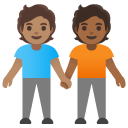


Appearance varies by platform and device. Google Noto, Twemoji, and OpenMoji are open-source.