👯
The Emoji
People With Bunny Ears
U+1F46F · :people_with_bunny_ears:
Trend 68
Meaning layers
- interpretation
- Used to represent best friends doing everything together, matching energy, squad goals, or a night out with your ride-or-die. Also used to hype up dancing, twinning outfits, or party vibes.
- tiktok usage
- Appears in 'bestie' content, matching outfit reveals, synchronized dance challenges, and 'we're the same person' duo trends.
- irony level
- 3 / 10
Platform meanings
- meaning
- Represents best friend duo energy, matching vibes, synchronized dancing, or a girls' night out. Often placed in bios or captions of duo content.
- trend usage
- Featured in bestie reveal videos, 'POV: you and your best friend' trends, matching outfit TikToks, and synchronized dance challenges.
- hashtags
- #bestievibes#twinning#squadgoals#girlsnight#duoenergy
- virality score
- 72 / 100
Cultural meanings
🇺🇸
Western / Gen-Z
Universally understood as 'bestie emoji' — represents matching energy, squad vibes, and the ultimate best friend dynamic. Extremely common in Gen Z digital communication.
🇵🇰
Pakistan & India
Used to represent close female friendships, matching salwar-kameez or lehenga moments, and girls' celebrations like Diwali or Eid preparations. Carries a fun, festive undertone.
🌍
Middle East
Used carefully — the bunny ear/showgirl association can feel culturally inappropriate in conservative contexts, but among younger urban women it signals close friendship and fun.
🌐
Global Neutral
Broadly interpreted as two friends who are inseparable and in sync, making it one of the more universally positive duo emojis across cultures.
🇧🇩
Bangladesh
Used among younger urban women to celebrate close friendships, matching outfits during Eid or Puja, and girls' group photos. Less common in rural or conservative digital spaces.
🇱🇰
Sri Lanka
Represents close female friendships and synchronized fun. Popular during festival seasons when matching outfits and group photos are common.
🇨🇳
China
Associated with 'best friend' (闺蜜, guīmì) culture, popular among young women on Weibo and Douyin to represent inseparable female friendships and matching couple-style outfits.
🇯🇵
Japan
Heavily resonant with idol culture, especially AKB48-style synchronized performance groups. Used to represent 'oshi' pairs, matching coordinations, and close female bonds in kawaii contexts.
🇰🇷
South Korea
Deeply tied to K-pop duo and group culture — used to celebrate bestie pairs within idol groups, matching fan outfits (twin looks), and 'we are the same' energy between friends.
🇹🇼
Taiwan
Used in the context of close female friendships and 'couple outfit' (情侶裝) culture extended to best friends. Popular in LINE chats and Instagram among younger demographics.
🇭🇰
Hong Kong
Used in WhatsApp and Instagram among young women to celebrate close friendships and synchronized moments. Associated with the local nightlife and party girl aesthetic.
🇵🇭
Philippines
Very popular for expressing 'best friend goals' — used heavily in group chat contexts, matching outfit posts, and 'ride or die bestie' captions on Facebook and TikTok.
🇮🇩
Indonesia
Used among young women on TikTok and Instagram to celebrate BFF culture. The bunny ears connotation is generally seen as fun rather than provocative in urban digital spaces.
🇹🇭
Thailand
Associated with Thai BL culture's concept of close bonds and also with synchronized Thai dancing traditions. Used to celebrate same-energy friendships on TikTok and Instagram.
🇻🇳
Vietnam
Used by younger Vietnamese women on TikTok and Zalo to represent close friendships, matching outfits, and 'bạn thân' (best friend) moments.
🇲🇾
Malaysia
Used among young urban women on Instagram and TikTok to represent BFF culture and matching outfit moments. Viewed as fun and playful rather than suggestive.
🇸🇦
Saudi Arabia
Limited use due to the revealing connotation of bunny costumes, but among younger, more liberal women it can represent close friendships in private digital spaces.
🇦🇪
UAE
More openly used than in other GCC countries due to Dubai's cosmopolitan culture — represents party girl aesthetics, close female friendships, and nightlife vibes among expat and younger local communities.
🇪🇬
Egypt
Used mostly among younger urban women to represent close friendships and matching moments. The performance/showgirl connotation may be interpreted as too bold in conservative circles.
🇹🇷
Turkey
Popular among young Turkish women on Instagram and Twitter to represent 'en iyi arkadaş' (best friend) dynamics and synchronized fun moments.
🇮🇷
Iran
Used discreetly among younger women in private chats on Telegram and Instagram to represent close female friendships, often stripped of the costume connotation.
🇳🇬
Nigeria
Used to celebrate 'squad goals' and female friendship energy — popular in Lagos-based social media circles and among Nigerian Gen Z women on TikTok and Instagram.
🇿🇦
South Africa
Used among young South African women to represent best friend duos and matching outfit moments — common in Cape Town and Johannesburg social media aesthetics.
🇬🇧
UK & Ireland
Very popular for 'girls on tour,' hen parties, and night out captions. Strongly associated with matched-costume nights out and pre-drink selfie captions.
🇫🇷
France
Used to represent close female friendships and Parisian cabaret/showgirl aesthetics. Appears in nightlife, fashion, and bestie content with a chic undertone.
🇩🇪
Germany
Used straightforwardly among younger women to represent synchronized friendship and matching moments — less loaded with showgirl connotation, more about duo energy.
🇪🇸
Spain & Italy
Popular in the context of girls' nights out, matching summer outfits, and Mediterranean party culture. Used enthusiastically in Instagram captions and WhatsApp groups.
🇧🇷
Brazil
Extremely popular — used to represent 'amiga da alma' (soulmate friend) energy, synchronized carnival vibes, and matching looks. High usage in TikTok and Instagram caption culture.
🇲🇽
Mexico
Used to celebrate 'mejor amiga' (best friend) moments, matching quinceañera preparations, and girls' nights — warm, enthusiastic deployment in Instagram and WhatsApp culture.
🌎
Latin America
Broadly represents the inseparable best friend bond across Latin American cultures. Tied to festive, synchronized, and celebratory female friendship moments.
🇦🇺
Australia & NZ
Used for girls' nights out, hen's parties, matching festival outfits, and bestie goals content. Very common on Instagram and TikTok among younger Aussie and Kiwi women.
How its meaning shifted
- 2010
Rarely used — emoji was new and primarily interpreted literally as two women in bunny costumes, often associated with Halloween or Playboy-adjacent imagery.
- 2015
Gained traction as a 'best friend' and 'squad goals' emoji during the height of the squad era, used by celebrities and fans to signal matching energy with their clique.
- 2020
Fully adopted as the definitive 'best friend duo' emoji — used across TikTok, Instagram, and Twitter to represent synchronized friendship, matching outfits, and ride-or-die energy.
- 2026
A stable staple of digital communication for friendship content — enhanced by Y2K revival aesthetics and K-pop duo culture. Also increasingly used gender-neutrally for any best friend pair.
See it on every platform
Emoji combinations
Adjacent emojis
- Often confused with
- rabbit faceearswoman with bunny ears partying
- Can replace
- two heartswoman dancingsparkling heart
Share & embed
Frequently asked
01What does the 👯 People With Bunny Ears emoji mean?
Two people wearing bunny ears, typically depicted as women in leotards doing a synchronized dance pose, often referencing Playboy Bunny costumes or party/showgirl aesthetics.
02What does 👯 mean on TikTok?
Represents best friend duo energy, matching vibes, synchronized dancing, or a girls' night out. Often placed in bios or captions of duo content.
03What does 👯 mean on WhatsApp?
Sent between friends to say 'we're doing this together' or 'we're the same,' often before a night out or a fun event.
04What does 👯 mean in Gen-Z slang?
Used to represent best friends doing everything together, matching energy, squad goals, or a night out with your ride-or-die. Also used to hype up dancing, twinning outfits, or party vibes.
05Is the 👯 emoji safe to use?
A fun, celebratory emoji representing best friends, synchronized dancing, matching outfits, and party energy — widely used in positive, inclusive contexts.
06What does 👯 mean in texting?
This emoji taps into the psychological comfort of belonging and mirroring — the desire to have a partner who matches your energy. It evokes feelings of fun, freedom, and being part of a duo that 'just gets it.'
07What is the shortcode for 👯?
The shortcode for People With Bunny Ears is :people_with_bunny_ears:
08What does 👯 mean in dating?
Can be used flirtatiously to suggest matching energy with someone or hint at playful, flirty nightlife scenarios. Sometimes used to invite a partner to dress up or go out together.
Safety & usage
- Safe meaning
- A fun, celebratory emoji representing best friends, synchronized dancing, matching outfits, and party energy — widely used in positive, inclusive contexts.
- Caution
- Can be weaponized in clique-exclusion contexts ('it's just us two 👯') or used alongside objectifying commentary referencing Playboy Bunny aesthetics.
The Playboy Bunny costume association means this emoji can carry adult or sexualized connotations in certain contexts, particularly on adult platforms or in suggestive conversations. Generally safe in mainstream social media but context-dependent.
How it looks across platforms
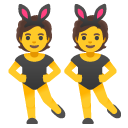


Appearance varies by platform and device. Google Noto, Twemoji, and OpenMoji are open-source.