🙍🏾
The Emoji
Person Frowning: Medium-dark Skin Tone
U+1F64D U+1F3FE · :person_frowning_mediumdark_skin_tone:
Trend 38
Meaning layers
- interpretation
- Used to express mild to moderate disappointment, frustration, or being upset about something. Often deployed when something didn't go as planned or when seeking sympathy. Can also be used ironically to overdramatize minor inconveniences.
- tiktok usage
- Appears in comment sections when creators share relatable disappointment content, or as a reaction to 'main character' suffering moments. Sometimes used sarcastically when something is only slightly annoying.
- irony level
- 5 / 10
Platform meanings
- meaning
- Reaction emoji for relatable sadness, minor suffering, or exaggerated disappointment in comment sections and video captions.
- trend usage
- Commonly appears under 'things that ruin your day' content, disappointment storytimes, and 'POV you're me' videos where creators share struggles.
- hashtags
- #relatable#disappointed#thatfeelwhen#sadvibes#notokay
- virality score
- 52 / 100
Cultural meanings
🇺🇸
Western / Gen-Z
Used freely and often ironically to signal everything from genuine sadness to performative suffering over minor inconveniences. The skin tone variation is appreciated for inclusive representation.
🇵🇰
Pakistan & India
Used sincerely to express sadness, disappointment, or being hurt in personal or family contexts. Less common in ironic usage; more likely to carry genuine emotional weight in messages.
🌍
Middle East
Conveys sadness or disappointment in personal communication; used among friends and family to signal emotional distress. The skin tone is noted positively for its closer match to regional complexions.
🌐
Global Neutral
Universally understood as expressing sadness or displeasure. The medium-dark skin tone is appreciated in diverse communities as a step toward more representative emoji use.
🇧🇩
Bangladesh
Deployed in messaging apps like WhatsApp and Facebook to show genuine sadness or frustration, particularly in personal relationships and family group chats.
🇱🇰
Sri Lanka
Used to express disappointment or being upset in casual digital communication; appreciated for its skin tone diversity among younger, socially aware users.
🇨🇳
China
Less commonly used compared to locally popular Chinese emoji platforms; when used, it straightforwardly signals sadness or displeasure. Skin tone nuance is less culturally prominent.
🇯🇵
Japan
Used occasionally on international platforms; Japanese users more commonly rely on platform-specific emoji or kaomoji for emotional expression, but this emoji is understood as sadness.
🇰🇷
South Korea
Recognized as a sadness emoji among younger Koreans on global platforms; skin tone diversity is more actively discussed here given South Korea's growing multicultural conversations.
🇹🇼
Taiwan
Used straightforwardly to signal disappointment or being down; younger, globally connected users are more aware of its skin tone diversity significance.
🇭🇰
Hong Kong
Common in expressive digital communication to convey disappointment or frustration; more internationally exposed users appreciate the skin tone inclusivity.
🇵🇭
Philippines
Frequently used in casual chat to express being hurt, sad, or disappointed — Filipinos tend to use emoji expressively and this one fits naturally in emotional conversations.
🇮🇩
Indonesia
Used in messaging apps to signal sadness or disappointment among friends; medium-dark skin tone resonates more closely with many Indonesian users' self-identification.
🇹🇭
Thailand
Appears in casual digital communication to show being upset or disappointed; Thai users on global platforms recognize its emotional meaning within standard sad emoji conventions.
🇻🇳
Vietnam
Used among younger Vietnamese social media users to express disappointment; the skin tone diversity aspect is increasingly appreciated in Vietnam's growing digital culture.
🇲🇾
Malaysia
Widely used across Malaysia's multicultural population to signal sadness or displeasure; the medium-dark skin tone has broad resonance across Malay, Indian, and mixed communities.
🇸🇦
Saudi Arabia
Used in personal messaging to express sadness or disappointment; skin tone diversity in emoji is increasingly valued among younger Saudi social media users.
🇦🇪
UAE
Appreciated in the UAE's highly diverse population — the medium-dark skin tone makes it relatable across multiple communities. Used sincerely to express emotional distress.
🇪🇬
Egypt
Used in casual messaging to show sadness or disappointment; Egyptians are expressive digital communicators and this emoji fits naturally into emotional conversations.
🇹🇷
Turkey
Deployed to signal being upset or disappointed in personal chats; younger Turkish users on global platforms use it similarly to Western conventions.
🇮🇷
Iran
Used on platforms accessible in Iran (often via VPN) to express sadness or frustration; straightforward emotional communication without significant ironic layering.
🇳🇬
Nigeria
The medium-dark skin tone is particularly resonant for many Nigerian users, making this a preferred choice for expressing sadness or disappointment over lighter-toned alternatives.
🇿🇦
South Africa
Appreciated for skin tone inclusivity across South Africa's diverse population; used to express genuine sadness or frustration in everyday digital communication.
🇬🇧
UK & Ireland
Used similarly to American Gen Z conventions — both sincerely and ironically — to express disappointment or perform relatable suffering over trivial things.
🇫🇷
France
Used in casual digital communication to express sadness or disappointment; French users are generally expressive with emoji and this fits naturally in emotional messaging.
🇩🇪
Germany
More likely to be used sincerely than ironically; German digital communication tends to be more direct, so this emoji signals genuine emotional dissatisfaction.
🇪🇸
Spain & Italy
Used expressively to convey sadness or disappointment in emotionally open digital cultures; southern European users integrate this naturally into expressive personal messaging.
🇧🇷
Brazil
Brazilians use emoji very expressively — this one appears in sad or disappointed contexts, and the skin tone diversity is appreciated in Brazil's highly racially diverse society.
🇲🇽
Mexico
Used to express sadness, disappointment, or hurt feelings in personal communication; Mexicans are emotionally expressive digitally and this emoji fits authentic sad moments.
🌎
Latin America
Broadly used across Latin America to signal emotional distress or disappointment; the medium-dark skin tone resonates well across the region's diverse population.
🇦🇺
Australia & NZ
Used similarly to other English-speaking Western markets — both sincerely and with light irony — to communicate disappointment or a bad day.
How its meaning shifted
- 2010
This specific skin tone variant did not exist in 2010; only the default yellow frowning person emoji was available, with no diversity options in Unicode at that time.
- 2015
Unicode 8.0 introduced skin tone modifiers in 2015, making this variant newly available. Early adoption was driven by users celebrating emoji diversity, though usage was limited overall.
- 2020
By 2020, skin-toned emoji were normalized and widely used. This variant saw increased use as conversations around representation in digital media grew more mainstream, especially post-2020 racial justice movements.
- 2026
In 2026, skin-toned emoji are standard practice with users routinely selecting tones matching their own identity. This variant is used naturally across platforms for expressing disappointment, frustration, and emotional relatability.
See it on every platform
Adjacent emojis
Share & embed
Frequently asked
01What does the 🙍🏾 Person Frowning: Medium-dark Skin Tone emoji mean?
A person with a frowning or displeased facial expression, depicted with medium-dark skin tone. The figure typically shows a downturned mouth and sometimes hunched posture indicating sadness, disappointment, or displeasure.
02What does 🙍🏾 mean on TikTok?
Reaction emoji for relatable sadness, minor suffering, or exaggerated disappointment in comment sections and video captions.
03What does 🙍🏾 mean on WhatsApp?
Sent to express being upset, sad, or disappointed in a conversation — often following bad news or a letdown from someone.
04What does 🙍🏾 mean in Gen-Z slang?
Used to express mild to moderate disappointment, frustration, or being upset about something. Often deployed when something didn't go as planned or when seeking sympathy. Can also be used ironically to overdramatize minor inconveniences.
05Is the 🙍🏾 emoji safe to use?
Expressing sadness, disappointment, or frustration in a non-harmful way. Commonly used for emotional communication and seeking empathy or support.
06What does 🙍🏾 mean in texting?
Represents mid-range negative affect — not full despair but a visible emotional downturn. Psychologically signals a need for acknowledgment or validation, often used to communicate distress nonverbally in digital spaces.
07What is the shortcode for 🙍🏾?
The shortcode for Person Frowning: Medium-dark Skin Tone is :person_frowning_mediumdark_skin_tone:
08What does 🙍🏾 mean in dating?
Sent to a crush to hint that something they said or did was disappointing, often as a playful guilt-trip. Can be used to fish for reassurance or apologies in a flirty, low-stakes way.
Safety & usage
- Safe meaning
- Expressing sadness, disappointment, or frustration in a non-harmful way. Commonly used for emotional communication and seeking empathy or support.
- Caution
- Can be weaponized in passive-aggressive communication to guilt-trip others or as emotional manipulation — sending it repeatedly to make someone feel responsible for one's emotions.
Generally safe; very low risk of misuse. In rare cases it may be used in harassment contexts to mock someone's sadness, but this is uncommon. Not associated with NSFW usage.
How it looks across platforms
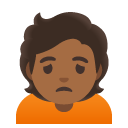


Appearance varies by platform and device. Google Noto, Twemoji, and OpenMoji are open-source.