💇🏿
The Emoji
Person Getting Haircut: Dark Skin Tone
U+1F487 U+1F3FF · :person_getting_haircut_dark_skin_tone:
Trend 52
Meaning layers
- interpretation
- Used to signal a glow-up in progress, a fresh start, or treating yourself to some self-care. Often paired with transformation content.
- tiktok usage
- Appears in 'before and after' haircut reveal videos, self-care days, and 'new me' transformation content.
- irony level
- 2 / 10
Platform meanings
- meaning
- Represents a glow-up, transformation, or self-care day, especially in beauty and lifestyle content.
- trend usage
- Featured heavily in haircut reveal videos, barber shop POV content, and 'new year new me' transformation trends.
- hashtags
- #haircuttransformation#glowup#selfcareday#freshcut#newlook
- virality score
- 58 / 100
Cultural meanings
🇺🇸
Western / Gen-Z
Widely used as a glow-up and self-care signal, celebrated especially in Black American communities as a symbol of cultural grooming pride and identity.
🇵🇰
Pakistan & India
Understood straightforwardly as a barbershop or salon visit; dark skin tone modifier is noted but emoji is used broadly across communities for grooming appointments.
🌍
Middle East
Represents a barber or salon visit, common in the region's strong barbershop culture; dark skin tone is acknowledged as a representation choice.
🌐
Global Neutral
Universally understood as someone getting a haircut or grooming service; dark skin tone adds representation value globally.
🇧🇩
Bangladesh
Used casually to indicate a trip to the barbershop or salon; seen as a straightforward grooming emoji.
🇱🇰
Sri Lanka
Interpreted as a salon or barber visit; used in personal messaging to indicate grooming appointments.
🇨🇳
China
Understood as a haircut or barbershop visit; skin tone modifiers are less culturally emphasized but the emoji function is clear.
🇯🇵
Japan
Used in beauty and grooming contexts; hair care culture in Japan is strong and this emoji fits neatly into beauty service messaging.
🇰🇷
South Korea
Resonates strongly given Korea's prominent beauty and grooming culture; used in salon and self-care content frequently.
🇹🇼
Taiwan
Casually used for salon or barbershop check-ins; appreciated in the context of Taiwan's strong personal grooming culture.
🇭🇰
Hong Kong
Common in grooming and beauty service contexts; dark skin tone version is recognized as an inclusive representation choice.
🇵🇭
Philippines
Used freely across skin tones for barbershop and salon content; Filipinos often use the emoji that best represents them or simply the most expressive version.
🇮🇩
Indonesia
Understood as a barbershop or salon visit; the dark skin tone is appreciated in a country with diverse skin representations.
🇹🇭
Thailand
Used in beauty and grooming contexts; Thailand's thriving salon industry means this emoji appears frequently in beauty-related messaging.
🇻🇳
Vietnam
Interpreted as a haircut appointment or salon visit; used casually in personal and business grooming contexts.
🇲🇾
Malaysia
Used across multicultural communities for barbershop and salon messaging; dark skin tone is embraced by Tamil Malaysian and other darker-skinned communities.
🇸🇦
Saudi Arabia
Represents a barbershop or salon visit; barbershop culture is significant for men in Saudi Arabia and this emoji fits naturally.
🇦🇪
UAE
Used in the cosmopolitan UAE context for grooming appointments; resonates particularly with South Asian and African communities in the region.
🇪🇬
Egypt
Common for barber or salon visit messaging; barbershop culture is culturally significant in Egypt and this emoji is well understood.
🇹🇷
Turkey
Used for haircut and grooming appointments; Turkey has a strong barber culture and this emoji maps naturally onto it.
🇮🇷
Iran
Interpreted as a salon or barber visit; used in personal messaging about grooming without significant cultural subtext.
🇳🇬
Nigeria
Particularly meaningful in Nigeria where barbershop culture is deeply embedded in community life; the dark skin tone is celebrated as representative.
🇿🇦
South Africa
Used broadly across communities for haircut and grooming content; the dark skin tone resonates strongly with the majority population.
🇬🇧
UK & Ireland
Used for salon and barber appointments; within UK Black communities specifically, the dark skin tone version is a point of positive representation.
🇫🇷
France
Used in beauty and grooming contexts; France's diverse multicultural population means this skin tone is relatable to many.
🇩🇪
Germany
Interpreted straightforwardly as a haircut or salon visit; German users appreciate the diversity representation in skin tone options.
🇪🇸
Spain & Italy
Used for salon and barbershop visits; the darker skin tone is relatable to Mediterranean and Afro-European communities in these countries.
🇧🇷
Brazil
Widely embraced in Brazil's diverse beauty culture; the dark skin tone resonates with Afro-Brazilian communities and broader grooming culture.
🇲🇽
Mexico
Used for barbershop and salon visits; recognized across communities as a grooming emoji with the skin tone noted as a diversity marker.
🌎
Latin America
Broadly used across Latin America for grooming and salon content; particularly resonant in countries with significant Afro-Latino populations.
🇦🇺
Australia & NZ
Used for salon and barber visits; embraced across Australia and NZ's multicultural communities as an inclusive representation.
How its meaning shifted
- 2010
Emoji didn't exist yet; basic haircut emojis without skin tone modifiers were not yet part of mainstream Unicode.
- 2015
Introduced with Unicode 8.0 skin tone modifiers; used primarily for literal haircut appointment messaging with growing appreciation for representation.
- 2020
Gained stronger cultural resonance during the self-care movement boom; increasingly used in glow-up and transformation content, especially in Black digital spaces.
- 2026
Firmly established in self-care, glow-up, and transformation content; celebrated as a representation milestone and used fluidly across beauty, wellness, and personal reinvention contexts.
See it on every platform
Compare with
Adjacent emojis
- Often confused with
- person getting massage dark skin tonebarber polebust in silhouette
- Can replace
- sparklesnail polishcrown
Share & embed
Frequently asked
01What does the 💇🏿 Person Getting Haircut: Dark Skin Tone emoji mean?
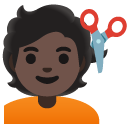
A person receiving a haircut with dark skin tone modifier applied, depicted seated while a stylist cuts their hair.
02What does 💇🏿 mean on TikTok?
Represents a glow-up, transformation, or self-care day, especially in beauty and lifestyle content.
03What does 💇🏿 mean on WhatsApp?
Telling someone you're at the salon or barbershop, or that you're getting a fresh look.
04What does 💇🏿 mean in Gen-Z slang?
Used to signal a glow-up in progress, a fresh start, or treating yourself to some self-care. Often paired with transformation content.
05Is the 💇🏿 emoji safe to use?
Represents getting a haircut or salon service; entirely benign and positive in standard use.
06What does 💇🏿 mean in texting?
Haircuts are psychologically associated with fresh starts and identity reinvention, making this emoji carry a subtle but meaningful emotional weight around change and self-investment.
07What is the shortcode for 💇🏿?
The shortcode for Person Getting Haircut: Dark Skin Tone is :person_getting_haircut_dark_skin_tone:
08What does 💇🏿 mean in dating?
Low flirt potential; occasionally used to say 'I'm getting cleaned up for you' or signal effort being put into appearance before a date.
Safety & usage
- Safe meaning
- Represents getting a haircut or salon service; entirely benign and positive in standard use.
- Caution
- Extremely rare toxic use; could theoretically be used in targeted harassment suggesting someone needs to 'fix themselves', but this is uncommon.
No significant safety concerns. The dark skin tone modifier is a positive representation feature and should not be misappropriated or used mockingly in cross-cultural contexts.
How it looks across platforms


Appearance varies by platform and device. Google Noto, Twemoji, and OpenMoji are open-source.