💆🏼
The Emoji
Person Getting Massage: Medium-light Skin Tone
U+1F486 U+1F3FC · :person_getting_massage_mediumlight_skin_tone:
Trend 38
Meaning layers
- interpretation
- Used to express being overwhelmed, needing a mental break, or treating yourself to self-care. Often signals burnout, stress, or the fantasy of escaping responsibilities.
- tiktok usage
- Appears in 'treat yourself' or 'self-care day' content, POV skits about being exhausted, and wellness aesthetic videos.
- irony level
- 5 / 10
Platform meanings
- meaning
- Represents self-care, rest, and the desire to escape hustle culture. Often used in wellness, spa, or 'treat yourself' TikToks.
- trend usage
- Featured in 'soft life' trends, 'reset routines', GRWM spa days, and 'things I'm doing for myself this week' content.
- hashtags
- #selfcare#spaday#softlife#treatyourself#relaxationmode
- virality score
- 42 / 100
Cultural meanings
🇺🇸
Western / Gen-Z
Heavily tied to 'soft life' culture and the anti-hustle movement — signals burnout recovery and guilt-free self-indulgence, often used ironically.
🇵🇰
Pakistan & India
Associated with traditional head massage (champi) culture — used genuinely for spa posts but also humorously after stressful family events or work situations.
🌍
Middle East
Linked to hammam and spa culture which is traditional and respected — used in lifestyle content and as a sign of wealth and leisure.
🌐
Global Neutral
Universally understood as relaxation, spa, and self-care without strong cultural baggage — safe and broadly interpretable.
🇧🇩
Bangladesh
Used in urban social media contexts to signal modern self-care habits and aspirational lifestyle content.
🇱🇰
Sri Lanka
Connected to Ayurvedic wellness traditions — used in spa promotion content and shared during conversations about stress relief.
🇨🇳
China
Massage culture is deeply ingrained — used sincerely in lifestyle and wellness WeChat posts, and on Weibo to signal taking care of one's health (养生 culture).
🇯🇵
Japan
Relates to the robust Japanese spa (onsen) and massage culture — used earnestly in wellness content and as a symbol of therapeutic rest.
🇰🇷
South Korea
Tied to the prominent K-beauty and wellness culture — frequently used in skincare routines, spa content, and 'me time' messaging.
🇹🇼
Taiwan
Used in the context of local massage parlors and spa culture, which are very popular — often tied to after-work relaxation content.
🇭🇰
Hong Kong
Appears in lifestyle posts about high-end spas and wellness retreats, reflecting the city's luxury wellness market.
🇵🇭
Philippines
Used in self-care content, particularly around affordable local spa culture (hilot), and as a humorous sign of needing a break after a long week.
🇮🇩
Indonesia
Associated with traditional Javanese massage and spa culture — used in wellness content and travel posts about local wellness experiences.
🇹🇭
Thailand
Strongly connected to world-famous Thai massage culture — used genuinely in tourism, wellness, and lifestyle content.
🇻🇳
Vietnam
Appears in self-care and wellness posts, increasingly popular among younger urban users who embrace modern spa culture.
🇲🇾
Malaysia
Used in lifestyle and wellness content, connected to affordable and accessible local spa culture popular across demographics.
🇸🇦
Saudi Arabia
Associated with high-end spa experiences available in luxury hotels — used in affluent lifestyle content, mainly by women in private contexts.
🇦🇪
UAE
Tied to the luxury wellness and spa industry prominent in Dubai and Abu Dhabi — appears in influencer and lifestyle content signaling indulgence.
🇪🇬
Egypt
Connected to hammam culture and increasingly popular modern spas — used in lifestyle and self-care content by urban users.
🇹🇷
Turkey
Deeply linked to the iconic Turkish hamam (hammam) tradition — used with cultural pride in wellness content and travel posts.
🇮🇷
Iran
Traditional public bath (hammam) culture gives this emoji cultural relevance — used in wellness and humor contexts, especially by younger Iranians online.
🇳🇬
Nigeria
Used in aspirational lifestyle content to signal wealth, luxury, and self-reward — popular in 'level up' and 'soft life' online culture.
🇿🇦
South Africa
Appears in wellness and lifestyle content, often tied to luxury spa experiences and signaling upward mobility or self-care routines.
🇬🇧
UK & Ireland
Used humorously after stressful situations ('after this week, I deserve a spa day 💆🏼') and genuinely in wellness and self-care posts.
🇫🇷
France
Associated with high beauty and wellness standards — used in sophisticated lifestyle content, skincare routines, and spa day posts.
🇩🇪
Germany
Tied to the culture of wellness (Wellness-Wochenende) and spa vacations — used sincerely in health and relaxation content.
🇪🇸
Spain & Italy
Linked to relaxed Mediterranean lifestyle values — used in lifestyle and leisure content, and as a symbol of much-deserved rest.
🇧🇷
Brazil
Used in beauty and wellness content tied to Brazil's thriving spa and beauty industry — also humorously in 'I need this after that drama' contexts.
🇲🇽
Mexico
Appears in self-care and beauty content, increasingly popular among younger users adopting wellness aesthetics on social media.
🌎
Latin America
Broadly used across Latin America in wellness, beauty, and 'me time' content, signaling modern self-care culture.
🇦🇺
Australia & NZ
Used casually in self-care and lifestyle posts — common in 'treat yourself' content, post-surf or outdoor activity recovery, and wellness humor.
How its meaning shifted
- 2010
Emoji was not yet available or widely used — massage and spa activities were not commonly represented with dedicated emoji in early smartphone culture.
- 2015
Appeared primarily in literal contexts — spa days, massage appointments, and wellness posts without much cultural layering or ironic usage.
- 2020
Gained new layers with the rise of self-care culture and burnout discourse during the pandemic — used widely for 'I need a break' and mental health messaging.
- 2026
Fully embedded in 'soft life', anti-hustle, and wellness aesthetics — used ironically and sincerely, with skin tone variants normalized as standard personalization.
See it on every platform
Adjacent emojis
- Often confused with
- person bowingperson gesturing okface holding back tears
Share & embed
Frequently asked
01What does the 💆🏼 Person Getting Massage: Medium-light Skin Tone emoji mean?
A person receiving a head or face massage, depicted with a medium-light skin tone modifier. The figure is typically shown with hands pressing on the sides of the head.
02What does 💆🏼 mean on TikTok?
Represents self-care, rest, and the desire to escape hustle culture. Often used in wellness, spa, or 'treat yourself' TikToks.
03What does 💆🏼 mean on WhatsApp?
Signals needing rest, a spa day, or being extremely stressed and wanting relief. Often sent after venting.
04What does 💆🏼 mean in Gen-Z slang?
Used to express being overwhelmed, needing a mental break, or treating yourself to self-care. Often signals burnout, stress, or the fantasy of escaping responsibilities.
05Is the 💆🏼 emoji safe to use?
Represents relaxation, spa treatments, self-care, and stress relief — entirely positive and wholesome in standard usage.
06What does 💆🏼 mean in texting?
Evokes the dual psychology of deserved rest and escapism. Often signals the user is either genuinely relaxing or fantasizing about it as a coping mechanism for stress.
07What is the shortcode for 💆🏼?
The shortcode for Person Getting Massage: Medium-light Skin Tone is :person_getting_massage_mediumlight_skin_tone:
08What does 💆🏼 mean in dating?
Can be used flirtatiously as a hint that you want or are offering a massage, creating a soft, sensual but non-explicit suggestion.
Safety & usage
- Safe meaning
- Represents relaxation, spa treatments, self-care, and stress relief — entirely positive and wholesome in standard usage.
- Caution
- Rarely used in harmful contexts; could occasionally be used sarcastically in a dismissive way, e.g., implying someone needs to 'calm down' when minimizing real concerns.
Low risk emoji overall. In rare private messaging contexts, it could carry a subtle suggestive undertone related to massage and physical touch, but this is not a common or primary usage.
How it looks across platforms
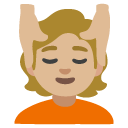


Appearance varies by platform and device. Google Noto, Twemoji, and OpenMoji are open-source.