🛌🏿
The Emoji
Person In Bed: Dark Skin Tone
U+1F6CC U+1F3FF · :person_in_bed_dark_skin_tone:
Trend 65
Meaning layers
- interpretation
- Used to express exhaustion, laziness, the desire to stay in bed all day, or the 'I'm not getting up' energy. Often used ironically to signal mental fatigue or refusing to engage with responsibilities.
- tiktok usage
- Appears in 'bed rotting' trend content, self-care videos, and mental health check-ins. Often paired with captions like 'my entire personality' or 'current mood forever'.
- irony level
- 5 / 10
Platform meanings
- meaning
- Represents the 'bed rot' lifestyle, extreme tiredness, or refusing to leave bed. Frequently used in mental health, self-care, and humor content.
- trend usage
- Featured heavily in 'bed rotting' trend videos, 'day in my life doing nothing' content, and soft life aesthetic videos. Also appears in 'it's giving lazy Sunday' edits.
- hashtags
- #bedrotting#softlife#cozyszn#dontgetup#restday
- virality score
- 72 / 100
Cultural meanings
🇺🇸
Western / Gen-Z
Closely tied to 'bed rotting' culture and the rejection of hustle culture — a badge of honor for choosing rest over productivity. Used constantly in ironic self-deprecating humor.
🇵🇰
Pakistan & India
Primarily used literally to indicate sleep or rest. Also common in group chats as a goodnight sign-off. The dark skin tone variant feels more representative and is widely embraced.
🌍
Middle East
Used straightforwardly for sleep and rest. In younger demographics it aligns with Gulf 'soft life' aspirations. The skin tone is seen as inclusive and reflective of the region's diversity.
🌐
Global Neutral
Universally understood as a symbol of sleep, rest, or going to bed. The dark skin tone is recognized as a diversity modifier and does not change the core interpretation globally.
🇧🇩
Bangladesh
Used in casual messaging to indicate tiredness or bedtime. Commonly sent in family and friend group chats as a goodnight message. The skin tone modifier is appreciated for representation.
🇱🇰
Sri Lanka
Primarily literal — used to indicate rest or sleep. Younger users align it with cozy or lazy day content on social platforms.
🇨🇳
China
Used to convey extreme tiredness or the desire to sleep, especially in the context of overwork culture ('996' grind). Ironic use is growing among younger Weibo and Douyin users.
🇯🇵
Japan
Associated with rest, exhaustion from overwork, or futon culture. Used earnestly in messaging apps. May appear in posts about 'neet' or hikikomori discourse, sometimes ironically.
🇰🇷
South Korea
Used by younger Koreans to reject the intense study/work culture — 'I'd rather stay in bed.' Aligns with the growing 'Shibata' (lying flat) movement among Korean youth.
🇹🇼
Taiwan
Used casually for sleep and rest. Among younger users, it ties into chill lifestyle content and rejection of grind culture.
🇭🇰
Hong Kong
Used to express tiredness from busy city life. Appears frequently in posts about needing a break from Hong Kong's fast-paced environment.
🇵🇭
Philippines
Very common as a goodnight emoji in group chats. Also used humorously to express laziness or skipping plans — 'diko kaya, 🛌🏿.'
🇮🇩
Indonesia
Used as a goodnight or rest indicator. Among Gen Z it connects to 'rebahan' (lying down) culture — a local version of bed-rotting that has its own cultural resonance.
🇹🇭
Thailand
Used to signal rest or sleep. In Thai social media contexts, it also appears in posts about self-care and taking breaks from demanding routines.
🇻🇳
Vietnam
Primarily a literal sleep or rest emoji. Younger users incorporate it into content about lazy days or avoiding social obligations.
🇲🇾
Malaysia
Very common for goodnight messages. The 'lepak' (chill/relax) culture in Malaysia makes this emoji resonate strongly — it embodies the art of doing nothing.
🇸🇦
Saudi Arabia
Used straightforwardly for rest and sleep. In youth culture it can signal afternoon nap (qailula) culture which is culturally embedded in Saudi daily life.
🇦🇪
UAE
Common in casual messaging for rest and sleep. Among younger, cosmopolitan UAE users, it connects to luxury rest aesthetics and 'soft life' aspirations.
🇪🇬
Egypt
Used for rest and sleep — the concept of afternoon rest (قيلولة) gives this extra cultural relevance. Also used humorously when someone is done with a stressful situation.
🇹🇷
Turkey
Commonly used for sleep or to express being completely worn out. Younger Turkish users on social media use it in the same ironic 'I'm done, I'm going to bed' context as Western Gen Z.
🇮🇷
Iran
Used for sleep and rest. In younger Iranian social media communities (Instagram and Telegram), it appears in content about escaping daily stressors.
🇳🇬
Nigeria
Used casually to indicate sleep or tiredness. Among Nigerian Gen Z on Twitter/X and TikTok, it is used humorously to signal exhaustion from life's hustle or bad news.
🇿🇦
South Africa
The dark skin tone variant is particularly resonant in South Africa for representation. Used for sleep, rest, and in meme contexts to signal giving up on a chaotic situation.
🇬🇧
UK & Ireland
Used as a goodnight or 'I'm exhausted' emoji. Among younger British and Irish users, it connects to 'can't be bothered' humor and the cultural pride in laziness on weekends.
🇫🇷
France
Used for sleep or rest. French users may also tie it to the culturally valued concept of leisure (les loisirs) and the importance of not overworking.
🇩🇪
Germany
Primarily literal — used to indicate sleep or tiredness. German work culture irony means it also appears in posts about finally taking a much-needed rest.
🇪🇸
Spain & Italy
Connected to siesta culture — the afternoon nap is a cultural institution, making this emoji particularly resonant. Used warmly and frequently in casual messaging.
🇧🇷
Brazil
Used for sleep and rest in casual messaging. Among Brazilian youth it is also tied to 'preguiça' (laziness) humor — a self-deprecating but affectionate cultural trait.
🇲🇽
Mexico
Used for sleep or rest. In Mexican youth culture it pairs with humor about avoiding responsibilities or the classic 'hueva' (extreme laziness) lifestyle.
🌎
Latin America
Broadly used for rest and sleep across Latin America. Often tied to siesta culture and a cultural appreciation for taking life at a slower pace.
🇦🇺
Australia & NZ
Used casually for goodnight or rest. Among younger Australians and Kiwis it fits the laid-back cultural identity — 'can't be bothered getting up' energy is highly relatable.
How its meaning shifted
- 2010
Emoji did not yet exist in this form. The base sleeping person emoji was not widely available and skin tone modifiers had not been introduced to Unicode.
- 2015
Skin tone modifiers were introduced in Unicode 8.0 (2015). Initial usage was primarily literal — indicating sleep, rest, or illness. Diversity representation was the main talking point.
- 2020
Usage expanded with growing mental health conversation online. Began appearing in burnout, self-care, and quarantine content during COVID-19, when staying in bed became a global shared experience.
- 2026
Deeply embedded in 'bed rot' culture, anti-hustle discourse, and soft life aesthetics. The dark skin tone variant is used without comment as natural representation. Ironic and sincere uses coexist fluidly.
See it on every platform
Adjacent emojis
- Opposite
- person runningalarm clocksunrise
- Often confused with
- person in lotus positioncoffinperson lying down
- Can replace
- sleeping facezzzcrescent moon
Share & embed
Frequently asked
01What does the 🛌🏿 Person In Bed: Dark Skin Tone emoji mean?
A person lying in bed, depicted with dark skin tone. Represents sleeping, resting, bedtime, or being ill in bed.
02What does 🛌🏿 mean on TikTok?
Represents the 'bed rot' lifestyle, extreme tiredness, or refusing to leave bed. Frequently used in mental health, self-care, and humor content.
03What does 🛌🏿 mean on WhatsApp?
Commonly used to say goodnight, signal going to sleep, or indicate that someone is too tired to continue a conversation.
04What does 🛌🏿 mean in Gen-Z slang?
Used to express exhaustion, laziness, the desire to stay in bed all day, or the 'I'm not getting up' energy. Often used ironically to signal mental fatigue or refusing to engage with responsibilities.
05Is the 🛌🏿 emoji safe to use?
Represents sleep, rest, tiredness, illness recovery, cozy time, or going to bed. Completely safe in the vast majority of contexts.
06What does 🛌🏿 mean in texting?
This emoji taps into the deeply human need for rest and withdrawal. It can signal burnout or emotional depletion when used in personal contexts, but also genuine contentment and self-care when used in cozy or positive framing.
07What is the shortcode for 🛌🏿?
The shortcode for Person In Bed: Dark Skin Tone is :person_in_bed_dark_skin_tone:
08What does 🛌🏿 mean in dating?
Can carry suggestive undertones when sent in a flirtatious conversation, subtly hinting at an invitation or implying thinking about someone in an intimate setting.
Safety & usage
- Safe meaning
- Represents sleep, rest, tiredness, illness recovery, cozy time, or going to bed. Completely safe in the vast majority of contexts.
- Caution
- Can occasionally be used with suggestive intent in flirtatious or explicitly sexual conversations as an invitation. Context-dependent.
Low risk emoji overall. In romantic or flirtatious DM contexts it may carry an implicit suggestive subtext depending on the conversation. The dark skin tone modifier itself carries no additional risk.
How it looks across platforms
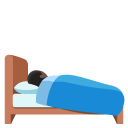


Appearance varies by platform and device. Google Noto, Twemoji, and OpenMoji are open-source.