🧘🏽
The Emoji
Person In Lotus Position: Medium Skin Tone
U+1F9D8 U+1F3FD · :person_in_lotus_position_medium_skin_tone:
Trend 68
Meaning layers
- interpretation
- Used to signal a 'healing era', unbothered energy, or self-care mode. Often ironic — posted right after chaotic or stressful content to pretend everything is fine.
- tiktok usage
- Appears in 'soft life' and 'that girl' aesthetic videos, morning routine content, or sarcastically after venting about drama to signal 'I'm so at peace'.
- irony level
- 6 / 10
Platform meanings
- meaning
- Represents 'that girl' aesthetic, morning routines, hot girl walks, and wellness culture; also used ironically to signal unbothered energy.
- trend usage
- Paired with morning routine videos, journaling content, 'healing era' audios, and 'main character' life content.
- hashtags
- #thatgirl#morningroutine#healingera#mindfulness#softlife
- virality score
- 72 / 100
Cultural meanings
🇺🇸
Western / Gen-Z
Heavily associated with the 'that girl' aesthetic and ironic 'I'm so unbothered' energy; used both sincerely in wellness culture and sarcastically after chaos.
🇵🇰
Pakistan & India
Carries deep cultural and spiritual resonance given the subcontinental origins of yoga and meditation; used sincerely for yoga, spirituality, and Ayurveda content.
🌍
Middle East
Gaining traction in UAE and Gulf wellness scenes; associated with modern self-care and mindfulness trends rather than traditional spiritual connotations.
🌐
Global Neutral
Universally understood as meditation or yoga; one of the least ambiguous wellness emojis across cultures.
🇧🇩
Bangladesh
Used in wellness and self-care contexts, increasingly popular among urban youth influenced by global wellness trends.
🇱🇰
Sri Lanka
Connected to Buddhist meditation traditions; used sincerely for mindfulness and spiritual practice content.
🇨🇳
China
Associated with yoga culture which is popular in urban Chinese cities; used in fitness and wellness contexts, less spiritual connotation.
🇯🇵
Japan
Connected to mindfulness (マインドフルネス) and wellness culture; popular in stress relief and work-life balance conversations.
🇰🇷
South Korea
Used in wellness, mental health, and self-care content which is a growing trend; connected to 'healing' culture (힐링).
🇹🇼
Taiwan
Used in yoga and wellness contexts, particularly popular in urban wellness communities and mental health advocacy.
🇭🇰
Hong Kong
Associated with the growing mindfulness movement as a response to high-stress urban life; used in self-care and mental health content.
🇵🇭
Philippines
Used in wellness and fitness content; growing trend especially among younger urban demographics influenced by Western wellness culture.
🇮🇩
Indonesia
Used in wellness contexts; given Indonesia's large Muslim population, more associated with general wellness than Hindu/Buddhist spiritual connotation.
🇹🇭
Thailand
Closely tied to Buddhist meditation traditions; used sincerely for both secular wellness and spiritual practice.
🇻🇳
Vietnam
Used in fitness and wellness contexts; growing popularity among urban youth interested in mindfulness and yoga.
🇲🇾
Malaysia
Used in wellness and self-care contexts; interpreted more secularly as fitness/yoga given diverse religious landscape.
🇸🇦
Saudi Arabia
Gaining use in wellness and fitness contexts particularly among younger generations; spiritual connotations are downplayed.
🇦🇪
UAE
Widely used in the cosmopolitan UAE wellness scene; associated with luxury wellness, yoga retreats, and mindfulness culture.
🇪🇬
Egypt
Emerging use in urban wellness and fitness contexts; primarily secular interpretation focusing on yoga and self-care.
🇹🇷
Turkey
Used in wellness and yoga contexts; growing mindfulness culture in urban centers like Istanbul drives usage.
🇮🇷
Iran
Used among younger demographics in fitness and wellness contexts; spiritual Hindu/Buddhist connotations are not prominent.
🇳🇬
Nigeria
Used in wellness and self-care content, often associated with the global wellness aesthetic trend popular among Nigerian youth.
🇿🇦
South Africa
Used in wellness and yoga contexts; part of the growing wellness culture across urban South African communities.
🇬🇧
UK & Ireland
Used in wellness and self-care contexts; common in ironic British humor as the 'unbothered' emoji after complaining.
🇫🇷
France
Associated with wellness, yoga, and bien-être culture; also used ironically in the French tradition of understated humor.
🇩🇪
Germany
Used in wellness, yoga, and Achtsamkeit (mindfulness) contexts; taken relatively sincerely with less irony than Anglo cultures.
🇪🇸
Spain & Italy
Used in wellness and yoga contexts; also adopted into the 'bella vita' / 'dolce far niente' aesthetic of peaceful living.
🇧🇷
Brazil
Popular in wellness and self-care content; connected to Brazil's growing yoga and mindfulness culture in urban centers.
🇲🇽
Mexico
Used in wellness contexts; growing yoga and mindfulness scene in Mexican cities drives increasing usage.
🌎
Latin America
Generally associated with wellness and yoga culture influenced by global trends; also used in self-care and mental health advocacy.
🇦🇺
Australia & NZ
Very popular in the active wellness and yoga culture; used sincerely for self-care and also ironically in the laconic Aussie/NZ humor style.
How its meaning shifted
- 2010
Emoji did not exist yet; meditation and yoga were represented awkwardly with generic figures or text.
- 2015
Emoji introduced nearby this era; used almost exclusively for literal yoga and meditation content by early wellness adopters.
- 2020
Exploded in usage during COVID-19 pandemic lockdowns as meditation, mindfulness, and self-care became mainstream coping mechanisms.
- 2026
Dual usage firmly established — sincere wellness signaling AND ironic 'unbothered/choosing peace' emoji; core part of Gen Z digital vocabulary.
See it on every platform
Adjacent emojis
- Often confused with
- person sittingperson gesturing okperson bowing
- Can replace
- leaf fluttering in windherbdove
Share & embed
Frequently asked
01What does the 🧘🏽 Person In Lotus Position: Medium Skin Tone emoji mean?
A person sitting in the lotus position (cross-legged meditation pose) with medium skin tone, used to represent meditation, yoga, mindfulness, and spiritual practice.
02What does 🧘🏽 mean on TikTok?
Represents 'that girl' aesthetic, morning routines, hot girl walks, and wellness culture; also used ironically to signal unbothered energy.
03What does 🧘🏽 mean on WhatsApp?
Sent to signal calmness, that you're doing yoga or meditating, or as a response meaning 'I'm at peace / not engaging with this drama'.
04What does 🧘🏽 mean in Gen-Z slang?
Used to signal a 'healing era', unbothered energy, or self-care mode. Often ironic — posted right after chaotic or stressful content to pretend everything is fine.
05Is the 🧘🏽 emoji safe to use?
Meditation, yoga, mindfulness, self-care, inner peace, wellness, spiritual practice.
06What does 🧘🏽 mean in texting?
Signals a desire for stillness and inner peace; psychologically linked to mindfulness culture and the modern wellness movement as a coping mechanism for anxiety.
07What is the shortcode for 🧘🏽?
The shortcode for Person In Lotus Position: Medium Skin Tone is :person_in_lotus_position_medium_skin_tone:
08What does 🧘🏽 mean in dating?
Used to seem emotionally mature, calm, and spiritually aligned — a subtle flex of self-awareness on dating apps.
Safety & usage
- Safe meaning
- Meditation, yoga, mindfulness, self-care, inner peace, wellness, spiritual practice.
- Caution
- Can be used passive-aggressively to dismiss others' concerns or gaslight by pretending to be unbothered; occasionally mocked as performative wellness.
Generally very safe emoji. Rarely misused. Occasionally used to mock wellness culture or spiritual bypassing. No NSFW associations.
How it looks across platforms
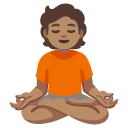


Appearance varies by platform and device. Google Noto, Twemoji, and OpenMoji are open-source.