🤷🏾
The Emoji
Person Shrugging: Medium-dark Skin Tone
U+1F937 U+1F3FE · :person_shrugging_mediumdark_skin_tone:
Trend 74
Meaning layers
- interpretation
- A vibe check fail or ultimate 'not my problem' energy. Used when you genuinely have no answers, can't be bothered to explain yourself, or are completely unbothered by drama. Also deployed as subtle sass when someone asks a question you refuse to dignify.
- tiktok usage
- Captioning chaotic life moments, replying to comment drama, or as a reaction to absurd situations. Often used in 'POV: when asked why I did that' style videos.
- irony level
- 7 / 10
Platform meanings
- meaning
- Reaction emoji for unbothered, chaotic, or dismissive moments. Signals 'I did that and I'd do it again' or 'I have no explanation and I'm at peace with that.'
- trend usage
- Used in comment wars to shut down arguments, in 'storytime' captions, and as a standalone reply to overwhelmingly negative or invasive comments.
- hashtags
- #unbothered#idk#notmyproblem#shrug#idgaf
- virality score
- 78 / 100
Cultural meanings
🇺🇸
Western / Gen-Z
Core emoji in the Gen Z communication toolkit — signals unbothered energy, plausible deniability, and ironic self-awareness simultaneously. The medium-dark skin tone is widely used across racial backgrounds as a representation choice.
🇵🇰
Pakistan & India
Used casually in urban youth digital communication to express helplessness, lack of information, or dismissal of an annoying question. Carries similar meaning to the Urdu/Hindi expression 'pata nahi' (I don't know).
🌍
Middle East
Common in youth-driven social media to express resignation or confusion, often responding to unpredictable social situations or systemic frustrations. Skin tone resonance is meaningful to Arab and South Asian communities in the region.
🌐
Global Neutral
Universally understood as 'I don't know' or 'whatever' — one of the most cross-culturally transferable emojis due to the shrug gesture's global recognition.
🇧🇩
Bangladesh
Used by young, digitally active users to signal uncertainty or a carefree attitude in informal chats. The medium-dark skin tone has notable representation value in Bangladeshi online spaces.
🇱🇰
Sri Lanka
Popular among urban youth on platforms like WhatsApp and Instagram to deflect questions or express genuine uncertainty. The gesture translates naturally to local communication norms.
🇨🇳
China
Less commonly used than platform-native emoticons on WeChat or Weibo, but recognized on international platforms. Shrug gesture may read as more confrontational than intended without contextual framing.
🇯🇵
Japan
Used with some caution as the shrug gesture can read as rude or dismissive in Japanese communication culture where indirectness is preferred. Younger, globally-connected users deploy it ironically online.
🇰🇷
South Korea
Common among younger Koreans on Twitter/X and Instagram as an import of Western internet culture. Often used in K-drama fan communities to react to plot twists or idol news.
🇹🇼
Taiwan
Frequently used in casual digital communication among youth, particularly in reaction to political or social absurdities. Fits naturally into Taiwan's internet-savvy meme culture.
🇭🇰
Hong Kong
Used actively in protest-adjacent and youth culture digital spaces to signal resignation about political or social situations. Also a standard casual reaction emoji in everyday messaging.
🇵🇭
Philippines
Very popular in Filipino digital culture — used humorously to respond to chaos, life struggles, or inexplicable situations with signature Filipino humor and resilience.
🇮🇩
Indonesia
Common in WhatsApp groups and Instagram to express 'who knows!' or gentle dismissal. Fits into the Indonesian concept of 'santai' (chill/relaxed) communication style.
🇹🇭
Thailand
Used casually among younger Thai social media users, often in response to confusing news or social situations. May be combined with laughing emojis to soften the dismissive tone.
🇻🇳
Vietnam
Popular on Facebook and TikTok among Vietnamese youth to express genuine uncertainty or playful indifference. Fits with informal Vietnamese digital communication patterns.
🇲🇾
Malaysia
Frequently used across Malaysia's multilingual digital spaces — fits naturally in Bahasa Malaysia, English, and Chinese language chats as a universal nonverbal cue.
🇸🇦
Saudi Arabia
Growing usage among Saudi youth on Snapchat and Twitter/X, particularly to respond to social norms questions or express unconcerned attitudes in an increasingly open youth culture.
🇦🇪
UAE
Common in Dubai and Abu Dhabi's cosmopolitan digital spaces, used by youth across nationalities. The medium-dark skin tone resonates with the region's South Asian diaspora communities.
🇪🇬
Egypt
Popular on Egyptian social media to express collective frustration with everyday chaos or systemic issues — 'what can you do' energy. Heavy usage in humor pages and meme accounts.
🇹🇷
Turkey
Used by Turkish youth online to deflect political topics or signal laid-back attitudes. Fits into the 'ne yapalım' (what can we do) cultural sentiment.
🇮🇷
Iran
Used among younger Iranians on Telegram and Instagram to express resignation about everyday situations. The shrug carries particular weight as an expression of navigating constraints.
🇳🇬
Nigeria
Highly popular — the shrug resonates deeply with Nigerian online humor culture and the 'e go be' (it will sort itself out) philosophy. The medium-dark skin tone has strong representational significance.
🇿🇦
South Africa
Common in South African digital spaces across communities as a reaction to load-shedding jokes, political chaos memes, or everyday unpredictability. Relatable and widely used.
🇬🇧
UK & Ireland
Used with classic British/Irish understatement energy — the emoji version of 'couldn't tell ya, mate.' Very common in informal digital communication across age groups.
🇫🇷
France
Resonates strongly as the digital equivalent of the iconic French shrug — a gesture deeply embedded in French cultural identity. Used to express philosophical indifference or existential detachment.
🇩🇪
Germany
Used more literally than ironically in German digital spaces — often genuinely means 'I don't know the answer.' Ironic usage is growing among younger, internet-native Germans.
🇪🇸
Spain & Italy
Extremely relatable — maps onto the expressive Southern European shrug gesture used in everyday life. Used liberally in casual digital communication with high cultural authenticity.
🇧🇷
Brazil
Widely used across Brazilian social media to express 'sei lá' (beats me) energy. Fits naturally into Brazilian internet culture's humor, warmth, and expressiveness.
🇲🇽
Mexico
Common reaction to everyday chaos, bureaucratic frustration, or absurd situations. Carries 'ni modo' (what can you do) energy — resignedly accepting the uncontrollable.
🌎
Latin America
Broadly used across Latin American digital spaces as a universal 'no sé' reaction. Resonates across countries as a shared gesture of bemused resignation.
🇦🇺
Australia & NZ
Very common in casual Aussie and Kiwi digital communication — equivalent to 'dunno, mate.' Used with laid-back humor and minimal ironic overlay compared to US usage.
How its meaning shifted
- 2010
Skin tone modifier emojis did not yet exist in 2010. The base shrug emoji hadn't been standardized, and shrug text emoticons like '¯\_(ツ)_/¯' dominated this expression online.
- 2015
The shrug person emoji was introduced in Unicode 9.0 (approved 2016), so 2015 saw the tail end of text shrug dominance. Skin tone modifiers were introduced in 2015 Unicode 8.0, setting the stage.
- 2020
🤷🏾 became widely adopted as skin tone representation gained cultural importance. Heavy usage during COVID-19 for expressing collective uncertainty, plan changes, and existential vibes.
- 2026
A staple emoji across all major platforms with entrenched ironic and sincere usage patterns. The medium-dark variant specifically benefits from increased representation awareness and is used broadly across demographics.
See it on every platform
Adjacent emojis
- Often confused with
- person gesturing noface with open mouthconfused face
Share & embed
Frequently asked
01What does the 🤷🏾 Person Shrugging: Medium-dark Skin Tone emoji mean?
A person with medium-dark skin tone raising both hands in a shrug gesture, indicating uncertainty, indifference, or lack of knowledge. The emoji combines the neutral shrugging posture with the 🏾 Fitzpatrick scale modifier.
02What does 🤷🏾 mean on TikTok?
Reaction emoji for unbothered, chaotic, or dismissive moments. Signals 'I did that and I'd do it again' or 'I have no explanation and I'm at peace with that.'
03What does 🤷🏾 mean on WhatsApp?
Signals 'I don't know' in casual group chats or one-on-ones. Often used to dodge questions about plans, responsibilities, or opinions.
04What does 🤷🏾 mean in Gen-Z slang?
A vibe check fail or ultimate 'not my problem' energy. Used when you genuinely have no answers, can't be bothered to explain yourself, or are completely unbothered by drama. Also deployed as subtle sass when someone asks a question you refuse to dignify.
05Is the 🤷🏾 emoji safe to use?
Expresses uncertainty, indifference, or casual dismissal. Universally understood as benign in most digital contexts.
06What does 🤷🏾 mean in texting?
Psychologically, the shrug gesture signals cognitive disengagement and social boundary-setting. It can reflect genuine ignorance, emotional self-protection, or deliberate dismissiveness. In digital contexts it often serves as a low-stakes emotional shield.
07What is the shortcode for 🤷🏾?
The shortcode for Person Shrugging: Medium-dark Skin Tone is :person_shrugging_mediumdark_skin_tone:
08What does 🤷🏾 mean in dating?
Used playfully to seem mysterious or unbothered — 'Maybe I like you, maybe I don't 🤷🏾' — as a casual, low-commitment flirt signal that keeps the other person guessing.
Safety & usage
- Safe meaning
- Expresses uncertainty, indifference, or casual dismissal. Universally understood as benign in most digital contexts.
- Caution
- Can be weaponized as passive-aggressive dismissal in conflict situations, gaslighting interactions, or to minimize someone's concerns by appearing unbothered by harm caused.
In arguments or sensitive conversations, repeated use can signal contempt or emotional stonewalling. In online harassment contexts, it can be used to mock or trivialize victims. Generally low-risk but context-dependent.
How it looks across platforms
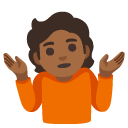


Appearance varies by platform and device. Google Noto, Twemoji, and OpenMoji are open-source.