🏊🏿
The Emoji
Person Swimming: Dark Skin Tone
U+1F3CA U+1F3FF · :person_swimming_dark_skin_tone:
Trend 48
Meaning layers
- interpretation
- Used to flex swimming skills, represent staying in your lane, or metaphorically swimming through life's chaos. Also used to signal being in the zone or grinding through something.
- tiktok usage
- Appears in fitness content, swim team videos, 'day in my life' vlogs, and as a metaphor for staying afloat during stressful times.
- irony level
- 2 / 10
Platform meanings
- meaning
- Represents athletic grind, summer vibes, swim life, and metaphorical endurance through tough times.
- trend usage
- Used in swim team trend videos, Black athlete appreciation posts, summer body transformation content, and 'how I stay sane' mental health content.
- hashtags
- #SwimLife#BlackSwimmers#SummerVibes#AthleteTok#StayAfloat
- virality score
- 52 / 100
Cultural meanings
🇺🇸
Western / Gen-Z
Used genuinely for swim content and metaphorically for pushing through challenges; embraced as part of Black athlete representation.
🇵🇰
Pakistan & India
Primarily used literally for swimming activities; carries connotations of leisure at resorts or competitive swimming, which is less mainstream but growing.
🌍
Middle East
Used in context of resort and hotel pool culture, competitive swimming in Gulf states, and leisure activities; the dark skin tone is generally unremarkable.
🌐
Global Neutral
Universally understood as a swimming person; the dark skin tone modifier signals inclusivity without altering the core meaning.
🇧🇩
Bangladesh
Primarily literal usage for swimming activities; water association is strong culturally given geography, though emoji use is casual.
🇱🇰
Sri Lanka
Associated with beach culture and leisure swimming; used in travel and vacation contexts given the island's coastal lifestyle.
🇨🇳
China
Used literally for swimming sports, especially around Olympic seasons; skin tone modifiers are less culturally emphasized.
🇯🇵
Japan
Applied in sports and summer contexts; Japanese emoji culture tends toward literal use, so this signals swimming activity or competitive sports.
🇰🇷
South Korea
Used in fitness, sports, and summer content; aligned with K-wellness trends and athletic aesthetics popular on Korean social media.
🇹🇼
Taiwan
Literal use for pool and beach activities; occasionally appears in fitness content and summer holiday posts.
🇭🇰
Hong Kong
Used in leisure and sports contexts, especially around competitive swimming events or summer beach culture.
🇵🇭
Philippines
Strongly associated with beach culture given the archipelago's geography; used frequently in summer and vacation content.
🇮🇩
Indonesia
Connected to coastal and beach lifestyle; used in travel content and increasingly in competitive swimming communities.
🇹🇭
Thailand
Tied to beach tourism, resort culture, and water sports; widely used in travel and leisure content.
🇻🇳
Vietnam
Used for swimming activities and beach culture; the coastal geography makes water-related emojis common in casual conversation.
🇲🇾
Malaysia
Applied in beach, pool, and water sports contexts; used in leisure and fitness content across social media platforms.
🇸🇦
Saudi Arabia
Used in context of sports activities and pool culture; swimming is popular among youth and in private leisure settings.
🇦🇪
UAE
Strongly associated with luxury pool and resort culture; widely used in travel and lifestyle content given the region's affluence.
🇪🇬
Egypt
Connected to Mediterranean and Red Sea beach culture; used in vacation and leisure contexts with literal meaning.
🇹🇷
Turkey
Associated with Aegean and Mediterranean beach culture; used in summer travel and leisure content across platforms.
🇮🇷
Iran
Primarily literal usage for swimming sports; competitive swimming culture is present and the emoji appears in sports contexts.
🇳🇬
Nigeria
Used in aspirational content about learning to swim, luxury travel, and increasingly as a symbol of Black excellence in aquatics.
🇿🇦
South Africa
Associated with beach culture and competitive swimming; also carries connotations of racial representation in historically white-dominated aquatic sports.
🇬🇧
UK & Ireland
Used for summer swimming content, competitive sports, and metaphorically for 'keeping afloat'; British humor sometimes uses it ironically for rainy weather swimming.
🇫🇷
France
Associated with French beach culture, competitive swimming, and leisure at the piscine; used literally and in summer lifestyle content.
🇩🇪
Germany
Used in sports and fitness contexts; Germans appreciate the literal meaning and use it in swim club or Freibad (outdoor pool) references.
🇪🇸
Spain & Italy
Strongly tied to Mediterranean beach and pool culture; used prolifically in summer content, beach holiday posts, and sports coverage.
🇧🇷
Brazil
Deeply connected to beach culture and competitive swimming; used in summer content, sports posts, and coastal lifestyle aesthetics.
🇲🇽
Mexico
Associated with beach vacation culture, pool parties, and water activities; used in leisure and travel content.
🌎
Latin America
Broadly used for beach and pool culture across Latin America; connected to summer, sports, and leisure lifestyle.
🇦🇺
Australia & NZ
Strongly associated with beach culture, competitive swimming, and lifeguard culture; used frequently and positively in sports and outdoor lifestyle content.
How its meaning shifted
- 2010
Skin tone modifiers did not yet exist; base swimming emoji was used generically without racial representation consideration.
- 2015
Unicode 8.0 introduced skin tone modifiers; this variant began appearing but with limited awareness and slow adoption.
- 2020
Usage surged alongside heightened racial representation conversations; embraced by Black swimmers, athletes, and allies celebrating diversity in aquatic sports.
- 2026
Normalized as a standard part of diverse emoji vocabulary; used fluidly in athletic, summer, and metaphorical contexts with no special novelty attached to the skin tone.
See it on every platform
Compare with
Adjacent emojis
Share & embed
Frequently asked
01What does the 🏊🏿 Person Swimming: Dark Skin Tone emoji mean?
A person swimming with dark skin tone modifier applied, depicting a human figure performing a swimming stroke in water.
02What does 🏊🏿 mean on TikTok?
Represents athletic grind, summer vibes, swim life, and metaphorical endurance through tough times.
03What does 🏊🏿 mean on WhatsApp?
Casually indicates going for a swim, visiting a pool or beach, or staying active.
04What does 🏊🏿 mean in Gen-Z slang?
Used to flex swimming skills, represent staying in your lane, or metaphorically swimming through life's chaos. Also used to signal being in the zone or grinding through something.
05Is the 🏊🏿 emoji safe to use?
Represents swimming, athletic activity, summer recreation, and fitness — entirely benign in nearly all contexts.
06What does 🏊🏿 mean in texting?
Swimming is psychologically linked to mental clarity, endurance, and escape from stress. Using this emoji can signal someone processing emotions through physical activity or seeking a sense of freedom.
07What is the shortcode for 🏊🏿?
The shortcode for Person Swimming: Dark Skin Tone is :person_swimming_dark_skin_tone:
08What does 🏊🏿 mean in dating?
Could be used to suggest a pool date, hint at a beach outing, or compliment someone's athletic physique in a playful way.
Safety & usage
- Safe meaning
- Represents swimming, athletic activity, summer recreation, and fitness — entirely benign in nearly all contexts.
- Caution
- Extremely rare misuse; could theoretically be used in contexts mocking swimming ability stereotypes, but this is uncommon.
No significant safety concerns. The dark skin tone modifier is a positive representation tool. Misuse in negative racial stereotyping contexts is theoretically possible but not a documented pattern.
How it looks across platforms
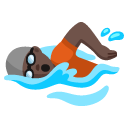


Appearance varies by platform and device. Google Noto, Twemoji, and OpenMoji are open-source.