🚶🏼
The Emoji
Person Walking: Medium-light Skin Tone
U+1F6B6 U+1F3FC · :person_walking_mediumlight_skin_tone:
Trend 58
Meaning layers
- interpretation
- Used to signal leaving a situation, ghosting someone, or unbothered energy — 'I'm walking away and not looking back.' Also used for a casual 'I'm out' vibe.
- tiktok usage
- Placed at the end of captions when someone is done with drama, a toxic situation, or just unbothered — e.g., 'They said what? 🚶🏼'
- irony level
- 6 / 10
Platform meanings
- meaning
- Signals unbothered energy, leaving drama, or a casual 'I'm out' moment. Often used ironically after saying something wild.
- trend usage
- Appears in POV videos, 'walking away from toxic situations' trends, and self-care walk content especially on wellness and mental health TikTok.
- hashtags
- #walkingaway#unbothered#selfcare#notmyproblem#walkingtok
- virality score
- 62 / 100
Cultural meanings
🇺🇸
Western / Gen-Z
Symbolizes unbothered energy and walking away from drama — one of the quintessential Gen Z 'I'm done' emojis used ironically and sincerely.
🇵🇰
Pakistan & India
Used literally to indicate going for a walk (common evening 'sair' culture) or metaphorically to signal leaving an awkward situation in group chats.
🌍
Middle East
Associated with evening walks ('tamesha' culture in Gulf countries) and also used to signal politely stepping away from a conversation.
🌐
Global Neutral
Universally understood as a person walking — interpreted as movement, departure, or forward progress across all cultures.
🇧🇩
Bangladesh
Used in everyday chat to mean going out for a walk or indicating someone is leaving a place; less used for meme purposes.
🇱🇰
Sri Lanka
Commonly used in WhatsApp to signal heading out, especially for evening walks which are a popular daily activity.
🇨🇳
China
Used on WeChat and Weibo to indicate going for a walk or stepping away; also part of health challenge posts about daily step counts.
🇯🇵
Japan
Associated with walking culture and urban commuting; used on LINE to indicate heading out or taking a stroll, very matter-of-fact usage.
🇰🇷
South Korea
Used on KakaoTalk and Instagram to represent walking dates, evening strolls in Han River parks, or 'taking a breather' moments.
🇹🇼
Taiwan
Frequently used in fitness and wellness contexts — Taiwan has strong walking culture around parks and night markets.
🇭🇰
Hong Kong
Used to indicate commuting on foot or taking a walk break; also used playfully to signal leaving a tense situation.
🇵🇭
Philippines
Used in group chats to signal heading out or leaving; Filipino culture of 'lakad' (walking around) makes this relatable and literal.
🇮🇩
Indonesia
Used on WhatsApp and Instagram to mean heading out or going for a walk; less ironic usage, more literal communication.
🇹🇭
Thailand
Associated with leisurely evening walks and temple visits; used straightforwardly to indicate movement or stepping away.
🇻🇳
Vietnam
Common in messaging to indicate going out for a walk or leaving; morning walk culture in Vietnam gives it a positive, healthy association.
🇲🇾
Malaysia
Used in casual chats to mean heading out, stepping away, or going for a walk; occasionally used humorously to signal disengagement.
🇸🇦
Saudi Arabia
Used in the context of evening walks ('mashiy') which are culturally significant social activities, especially in cooler months.
🇦🇪
UAE
Associated with corniche and boardwalk culture in Dubai and Abu Dhabi; used to signal outdoor walks or leisurely strolls.
🇪🇬
Egypt
Used to indicate heading out for a walk or leaving a situation; the Nile corniche walking culture makes this emoji culturally relevant.
🇹🇷
Turkey
Connected to the strong Turkish promenade ('kordon') walking culture; used to indicate heading out or stepping away from drama.
🇮🇷
Iran
Used casually in messaging to indicate going for a walk or stepping outside; park walking culture is strong in Iranian cities.
🇳🇬
Nigeria
Used straightforwardly to mean leaving or heading out; can also be used humorously to signal someone is 'waka-ing' (leaving).
🇿🇦
South Africa
Used in casual messaging and social media to indicate taking a walk or stepping away; also linked to outdoor and nature culture.
🇬🇧
UK & Ireland
Used to signal going for a walk (hugely popular post-COVID habit) or to exit a drama — both literal and ironic interpretations are common.
🇫🇷
France
Associated with the French promenade culture; used to indicate going for a leisurely walk ('se promener') or stepping away calmly.
🇩🇪
Germany
Used in the context of structured outdoor walks ('Spaziergang' culture); also used in professional contexts to signal stepping away.
🇪🇸
Spain & Italy
Connected to the 'passeggiata' evening stroll culture; used to indicate going out for an evening walk or leaving a gathering.
🇧🇷
Brazil
Used to signal heading out or going for a walk in parks and beachfronts; also used in the ironic 'I'm out' Gen Z sense online.
🇲🇽
Mexico
Used casually to indicate leaving or heading out; also appears in fitness and wellness content on Instagram and TikTok.
🌎
Latin America
Generally used to indicate movement, leaving, or heading out; the ironic 'walking away from drama' usage is gaining traction among younger users.
🇦🇺
Australia & NZ
Used to signal heading out for a walk — outdoor and bush walking culture makes this literal usage very common and positive.
How its meaning shifted
- 2010
Emoji was not yet widely available; walking human figures were rare in early emoji sets and had no skin tone variations.
- 2015
Skin tone variants introduced via Unicode 8.0; used primarily literally to indicate walking or physical activity.
- 2020
Gained ironic and meme usage during the pandemic as 'going for a walk' became a major coping mechanism and cultural moment; also began being used to signal unbothered exit energy.
- 2026
Firmly established as both a literal walking emoji and a Gen Z signal for disengagement, quiet quitting energy, and moving on — used across all major platforms with moderate irony.
See it on every platform
Compare with
Adjacent emojis
- Often confused with
- person runningperson standingperson gesturing ok
- Can replace
- footprintsperson runningperson hiking
Share & embed
Frequently asked
01What does the 🚶🏼 Person Walking: Medium-light Skin Tone emoji mean?
A person walking depicted with a medium-light skin tone, showing a human figure in mid-stride with one foot forward.
02What does 🚶🏼 mean on TikTok?
Signals unbothered energy, leaving drama, or a casual 'I'm out' moment. Often used ironically after saying something wild.
03What does 🚶🏼 mean on WhatsApp?
Used to literally say 'going for a walk' or metaphorically to say 'I'm done with this conversation / situation.'
04What does 🚶🏼 mean in Gen-Z slang?
Used to signal leaving a situation, ghosting someone, or unbothered energy — 'I'm walking away and not looking back.' Also used for a casual 'I'm out' vibe.
05Is the 🚶🏼 emoji safe to use?
Person walking — represents physical activity, movement, departure, or self-care through walking.
06What does 🚶🏼 mean in texting?
Walking often symbolizes forward momentum and autonomy. This emoji taps into themes of independence, disengagement from stressors, and personal agency — a quiet but powerful emotional statement.
07What is the shortcode for 🚶🏼?
The shortcode for Person Walking: Medium-light Skin Tone is :person_walking_mediumlight_skin_tone:
08What does 🚶🏼 mean in dating?
Rarely used to flirt; more likely used when someone is giving the other person a subtle 'I could leave at any moment' energy or playfully threatening to walk away mid-argument.
Safety & usage
- Safe meaning
- Person walking — represents physical activity, movement, departure, or self-care through walking.
- Caution
- Occasionally used passive-aggressively to shut down conversations without explanation, which can feel dismissive in heated arguments.
Generally a very safe emoji with no offensive connotations. Skin tone variant may occasionally be co-opted in racially charged meme contexts, but this is rare and not inherent to the emoji.
How it looks across platforms
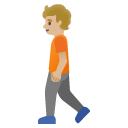


Appearance varies by platform and device. Google Noto, Twemoji, and OpenMoji are open-source.