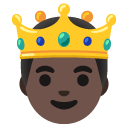
🤴🏿
The Emoji
Prince: Dark Skin Tone
U+1F934 U+1F3FF · :prince_dark_skin_tone:
Trend 62
Meaning layers
- interpretation
- Used to hype up a friend or crush who is acting confident, charming, or effortlessly cool. Often self-applied to flex or ironically crown oneself royalty.
- tiktok usage
- Appears in 'main character' energy videos, Black excellence content, and hype comment sections where someone is praised for their drip or charisma.
- irony level
- 3 / 10
Platform meanings
- meaning
- Represents Black excellence, royalty energy, or hyping up a confident Black male creator or character.
- trend usage
- Used in duets and stitch comments to crown someone who did something impressive; also in 'you're that girl/guy' affirmation trends.
- hashtags
- #BlackRoyalty#BlackExcellence#KingVibes#PrinceEnergy#MainCharacter
- virality score
- 68 / 100
Cultural meanings
🇺🇸
Western / Gen-Z
Widely used as a hype emoji to celebrate Black men and affirm Black identity; central to 'Black kings' discourse and mainstream Gen Z celebration of diversity.
🇵🇰
Pakistan & India
Less culturally specific; may be used to call a close friend or partner a prince as a term of endearment, though the dark skin tone may occasionally carry colorism-influenced interpretations.
🌍
Middle East
Used to denote royalty or nobility in a region with strong prince/sheikh cultural archetypes; the dark skin tone is less commonly self-identified with but used respectfully.
🌐
Global Neutral
Universally recognized as a symbol of royalty, admiration, and masculine elegance regardless of cultural context.
🇧🇩
Bangladesh
Primarily used as a romantic or affectionate term calling someone a prince; skin tone modifier often overlooked in usage.
🇱🇰
Sri Lanka
Used similarly to a general compliment emoji meaning 'handsome' or 'noble'; not strongly tied to racial identity discourse.
🇨🇳
China
Interpreted as a fairy-tale or fantasy prince figure; the dark skin tone may be less relatable to mainstream users but used in diverse-appreciation contexts.
🇯🇵
Japan
Associated with Disney-style prince characters or anime royalty archetypes; used in fan content or to compliment someone's elegant style.
🇰🇷
South Korea
Used in K-pop fan communities to crown idols or in general pop culture contexts to call someone royalty-level handsome.
🇹🇼
Taiwan
Similar to South Korea — used in fan communities and general compliment contexts; the skin tone diversity is appreciated in progressive circles.
🇭🇰
Hong Kong
Used to call someone charming or distinguished; progressive youth communities use it to celebrate diversity and representation.
🇵🇭
Philippines
Commonly used to hype up handsome men or in fan comment sections; Filipinos with African heritage or allies may use it with cultural pride.
🇮🇩
Indonesia
Used as a romantic or playful compliment; the dark skin tone modifier is present but often not the focus of the emoji's usage.
🇹🇭
Thailand
Interpreted as royalty or prestige; Thais have deep reverence for royalty, so this emoji carries genuine weight in celebratory contexts.
🇻🇳
Vietnam
Used in romantic and complimentary contexts; younger Vietnamese users on TikTok may use it in line with global Gen Z trends.
🇲🇾
Malaysia
Used in multicultural social media spaces to celebrate Black male celebrities or as a compliment; resonates in Afrocentric interest communities.
🇸🇦
Saudi Arabia
Associated with regional royalty culture; the dark skin tone connects with the diverse population of the Arabian Peninsula and is used respectfully.
🇦🇪
UAE
In a highly diverse country, this emoji resonates across African expatriate communities and is used to celebrate Black excellence and identity.
🇪🇬
Egypt
Used to call someone handsome or noble; Egyptian social media users may use it in contexts celebrating Black African heritage or pan-African identity.
🇹🇷
Turkey
Used as a general royal/charming compliment; less tied to racial identity discourse and more to the idea of someone being distinguished.
🇮🇷
Iran
Relatively rare in specific cultural usage; when used, it signals royalty or prestige rather than racial identity affirmation.
🇳🇬
Nigeria
Deeply resonant — used widely to celebrate Black royalty, African heritage, and male excellence; one of the most culturally affirming uses of this emoji globally.
🇿🇦
South Africa
Strongly associated with Black pride, Ubuntu philosophy, and celebration of Black male achievement; used in both casual and political cultural contexts.
🇬🇧
UK & Ireland
Used in Black British communities as a pride symbol; mainstream Gen Z also uses it to hype Black male celebrities like athletes and musicians.
🇫🇷
France
Used in Afro-French communities to celebrate Black identity; also appears in general compliment contexts in a country with a large African diaspora.
🇩🇪
Germany
Used in Afro-German communities and among diverse youth; signals respect and celebration of Black male identity in progressive circles.
🇪🇸
Spain & Italy
Used to call someone charming or royal; African diaspora communities in both countries use it as a cultural pride marker.
🇧🇷
Brazil
Strongly embraced in Afro-Brazilian communities celebrating Blackness and heritage; used in contexts of resistance, pride, and celebration of Black masculinity.
🇲🇽
Mexico
Used in Afro-Mexican communities and by general users as a compliment; growing awareness of Afro-Latino identity gives this emoji additional resonance.
🌎
Latin America
Across Latin America, used to celebrate Black Latin men and Afro-Latino identity; increasingly visible in social justice and cultural pride movements.
🇦🇺
Australia & NZ
Used in Aboriginal and Black community spaces as an affirmation; mainstream users also deploy it to hype Black athletes and entertainers.
How its meaning shifted
- 2010
Emoji with skin tone modifiers did not yet exist; the base prince emoji was not released until 2016, so usage in this period is non-applicable.
- 2015
Skin tone modifiers were just being introduced to Unicode; early adoption was minimal and the prince emoji itself was still pending release.
- 2020
Gained significant traction during the Black Lives Matter movement as a symbol of Black excellence and pride; used widely on social media to affirm Black identity.
- 2026
Mainstream and well-established in Black cultural digital spaces; routinely used across platforms for Black male affirmation, celebrity hype, and cultural pride content.
See it on every platform
Adjacent emojis
- Often confused with
- princeman in tuxedo dark skin toneguard dark skin tone
- Can replace
- crownman dark skin toneprince
Share & embed
Frequently asked
01What does the 🤴🏿 Prince: Dark Skin Tone emoji mean?
A prince figure with dark skin tone modifier applied, representing royalty, nobility, and masculine regal status.
02What does 🤴🏿 mean on TikTok?
Represents Black excellence, royalty energy, or hyping up a confident Black male creator or character.
03What does 🤴🏿 mean on WhatsApp?
Calling someone a prince as a term of endearment or compliment in private chats.
04What does 🤴🏿 mean in Gen-Z slang?
Used to hype up a friend or crush who is acting confident, charming, or effortlessly cool. Often self-applied to flex or ironically crown oneself royalty.
05Is the 🤴🏿 emoji safe to use?
A positive, celebratory emoji representing Black male royalty, excellence, and identity pride; used for compliments and affirmation.
06What does 🤴🏿 mean in texting?
The dark skin tone modifier carries added emotional weight as a symbol of representation and cultural pride, activating feelings of belonging and positive self-identity for Black users and their allies.
07What is the shortcode for 🤴🏿?
The shortcode for Prince: Dark Skin Tone is :prince_dark_skin_tone:
08What does 🤴🏿 mean in dating?
Sent to a guy to signal he's being treated like royalty or to flirt by implying he's 'prince charming' material, especially directed at Black men as a compliment.
Safety & usage
- Safe meaning
- A positive, celebratory emoji representing Black male royalty, excellence, and identity pride; used for compliments and affirmation.
- Caution
- Rarely weaponized negatively, but could appear sarcastically to mock entitlement; extremely unlikely to be used in genuinely harmful contexts.
Essentially safe for all audiences; the skin tone modifier exists to promote representation and is not typically used in hateful ways. Be aware of sarcastic overuse that could feel dismissive.
How it looks across platforms


Appearance varies by platform and device. Google Noto, Twemoji, and OpenMoji are open-source.