🫸🏻
The Emoji
Rightwards Pushing Hand: Light Skin Tone
U+1FAF8 U+1F3FB · :rightwards_pushing_hand_light_skin_tone:
Trend 58
Meaning layers
- interpretation
- Used to signal 'back off,' create distance, set a boundary, or playfully push something or someone away in conversation. Also used as a directional cue pointing right.
- tiktok usage
- Appears in duets or reply videos where someone is symbolically 'pushing' an idea, person, or concept away. Often paired with 🫷🏻 to simulate a push-pull tension.
- irony level
- 4 / 10
Platform meanings
- meaning
- Symbolizes pushing something away, setting a boundary, or directing attention to the right. Used in video comments to 'push' content or trends.
- trend usage
- Used in duet-style trends where creators 'push' a concept back and forth. Common in POV skits and reaction videos.
- hashtags
- #boundaries#pushinghands#fyp#nope#genzhumor
- virality score
- 62 / 100
Cultural meanings
🇺🇸
Western / Gen-Z
Widely understood as a boundary-setting or playful rejection emoji, often paired with 🫷🏻 for comedic or dramatic effect in memes and social media.
🇵🇰
Pakistan & India
Used informally to signal 'stay away' or 'not now' in casual chats; the light skin tone is noted but the gesture itself reads as a stop or push-away sign.
🌍
Middle East
The open-palm gesture can culturally align with a 'stop' or 'wait' signal which is widely recognized; skin tone customization is appreciated for self-representation.
🌐
Global Neutral
Universally readable as a hand pushing or directing to the right, making it one of the more cross-culturally intuitive directional hand emojis.
🇧🇩
Bangladesh
Used casually among younger users as a 'keep away' or 'not interested' signal, especially in group chats influenced by Indian social media trends.
🇱🇰
Sri Lanka
Primarily used among youth to signal rejection or to playfully push away someone in messaging apps like WhatsApp.
🇨🇳
China
The gesture is understood as directional or a stop signal; paired usage with 🫷🏻 has gained traction in youth-oriented platforms like Weibo.
🇯🇵
Japan
The open palm pushing gesture aligns with some traditional 'oshite' (push) gestures in communication; used in casual digital contexts to denote spacing or rejection.
🇰🇷
South Korea
Popular among K-pop fan communities to signal pushing away antis or negativity; also used in idol stan culture to 'push' content and artists.
🇹🇼
Taiwan
Used similarly to South Korea and Japan — casual rejection or directional cue, often in youth social media contexts.
🇭🇰
Hong Kong
Understood as a stop or push-away gesture in mixed Cantonese-English digital communication, especially in satirical or protest-related contexts.
🇵🇭
Philippines
Used in casual messaging to express 'huwag na' (stop it) or playfully pushing friends away in group chats.
🇮🇩
Indonesia
Commonly used among youth to signal 'jangan' (don't) or to push away undesirable content, ideas, or drama.
🇹🇭
Thailand
The gesture resonates as a soft rejection or boundary signal; Thai youth use it humorously in Line and TikTok interactions.
🇻🇳
Vietnam
Used in Zalo and Facebook chats to indicate pushing something away or directing attention, with younger generations using it in meme contexts.
🇲🇾
Malaysia
Used across Malay, Chinese-Malaysian, and Indian-Malaysian communities as a general push-away or stop gesture in casual digital conversation.
🇸🇦
Saudi Arabia
The open palm is a recognized stop/wait gesture; used digitally to signal boundaries or to redirect conversations, particularly on Snapchat and Twitter.
🇦🇪
UAE
In multicultural UAE digital spaces, it reads as a universal boundary-setting or directional emoji, used across expat and local communities.
🇪🇬
Egypt
Used in Arabic-language chats on WhatsApp and Facebook to signal rejection or to 'push away' unwanted suggestions, with a light-hearted tone among youth.
🇹🇷
Turkey
Used among younger Turkish users on Twitter and Instagram to signal 'dur' (stop) or to push away negativity, often in humorous contexts.
🇮🇷
Iran
On Instagram and Telegram — primary platforms — it is used to signal boundary-setting or to push away unwanted commentary, valued for its non-verbal clarity.
🇳🇬
Nigeria
Popular in Lagos youth culture on Twitter (X) and WhatsApp to signal 'abeg comot' (please leave) or to playfully push away someone's bad idea.
🇿🇦
South Africa
Used across Zulu, Xhosa, Afrikaans, and English-speaking communities as a casual rejection or boundary-setting emoji in WhatsApp and TikTok.
🇬🇧
UK & Ireland
Deployed with dry humor to signal 'get away' or 'not today,' fitting into British and Irish culture's tendency toward understated rejection.
🇫🇷
France
Used casually to push away drama or signal disinterest, fitting French cultural norms of direct but polite boundary-setting in digital spaces.
🇩🇪
Germany
Appreciated for its clear, direct meaning — pushing something away or signaling stop — aligns with German communication preferences for clarity.
🇪🇸
Spain & Italy
Used expressively and often humorously to push away drama, bad energy, or unwanted plans, fitting Southern European expressive digital culture.
🇧🇷
Brazil
Hugely popular in Brazilian WhatsApp and TikTok culture, used to push away negativity or as part of comedic meme duos with 🫷🏻.
🇲🇽
Mexico
Used in casual Mexican Spanish digital conversation to signal 'ya no' (no more) or to humorously push away something cringe-worthy.
🌎
Latin America
Across Latin America, used to signal rejection, boundary-setting, or playful pushing-away in vibrant meme and social media cultures.
🇦🇺
Australia & NZ
Used with casual Aussie/Kiwi humor to push away bad ideas, cringe content, or to direct someone elsewhere in a laid-back tone.
How its meaning shifted
- 2010
This emoji did not exist in 2010; Unicode had not yet introduced pushing hand gestures, so users relied on 🖐️ or ✋ for similar stop/push expressions.
- 2015
Still non-existent; users approximated the concept with ✋, 🙅, or text-based expressions like 'back off' or 'stop.'
- 2020
Introduced in Unicode 14.0 (approved 2021, released in late 2021); early adoption began in 2021-2022 with tech-savvy users exploring new emoji sets.
- 2026
Firmly established in digital vocabulary, especially among Gen Z; commonly paired with 🫷🏻 in memes, used for boundary-setting narratives, and embedded in platform-specific sticker packs.
See it on every platform
Adjacent emojis
- Often confused with
- raised handbackhand index pointing rightpalm up hand
Share & embed
Frequently asked
01What does the 🫸🏻 Rightwards Pushing Hand: Light Skin Tone emoji mean?
A right-facing hand with palm open and fingers together, appearing to push something away or to the right, rendered in a light skin tone.
02What does 🫸🏻 mean on TikTok?
Symbolizes pushing something away, setting a boundary, or directing attention to the right. Used in video comments to 'push' content or trends.
03What does 🫸🏻 mean on WhatsApp?
Signals 'back off,' 'not right now,' or a playful shove in casual conversation.
04What does 🫸🏻 mean in Gen-Z slang?
Used to signal 'back off,' create distance, set a boundary, or playfully push something or someone away in conversation. Also used as a directional cue pointing right.
05Is the 🫸🏻 emoji safe to use?
A neutral-to-positive gesture representing boundary-setting, playful rejection, directional cuing, or pushing away negativity.
06What does 🫸🏻 mean in texting?
Represents a non-verbal boundary-setting gesture digitally. Psychologically linked to personal space assertion and the fight-flight-freeze response's 'push away' variant.
07What is the shortcode for 🫸🏻?
The shortcode for Rightwards Pushing Hand: Light Skin Tone is :rightwards_pushing_hand_light_skin_tone:
08What does 🫸🏻 mean in dating?
Can be used flirtatiously to 'push back' on someone's advances while still engaging — the digital equivalent of a playful shove.
Safety & usage
- Safe meaning
- A neutral-to-positive gesture representing boundary-setting, playful rejection, directional cuing, or pushing away negativity.
- Caution
- Could be used to harass or dismiss someone's valid concerns by repeatedly 'pushing away' their messages, or to coordinate group exclusion.
Generally safe; in rare cases, its use in pile-on replies may contribute to targeted dismissal of individuals. Not inherently offensive.
How it looks across platforms
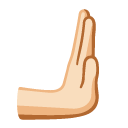

Appearance varies by platform and device. Google Noto, Twemoji, and OpenMoji are open-source.