🫸🏼
The Emoji
Rightwards Pushing Hand: Medium-light Skin Tone
U+1FAF8 U+1F3FC · :rightwards_pushing_hand_mediumlight_skin_tone:
Trend 58
Meaning layers
- interpretation
- Used to signal 'back off', 'not right now', 'I'm pushing this away', or humorously shoving away unwanted energy, people, or situations. Also used as a playful 'stay in your lane' gesture.
- tiktok usage
- Appears in reaction videos to cringe content, awkward situations, or unsolicited opinions — visually 'pushing' the vibe away. Also used in 'push vs pull' trend duets.
- irony level
- 5 / 10
Platform meanings
- meaning
- Reaction emoji used to push away cringe, bad takes, or unwanted energy in comments and video captions
- trend usage
- Used in 'push it away' trend where creators physically mime pushing something off screen paired with this emoji; also in duet reaction videos
- hashtags
- #pushingaway#nottoday#badvibesonly#boundarysetting#emojitrend
- virality score
- 62 / 100
Cultural meanings
🇺🇸
Western / Gen-Z
Widely used as a boundary-setting or dismissal emoji; understood as 'back off' or pushing away bad vibes with humor and assertiveness.
🇵🇰
Pakistan & India
Used to signal 'ruk ja' (stop/wait) in Hindi/Urdu digital slang; also used to comically push away relatives' unsolicited life advice in meme culture.
🌍
Middle East
Interpreted as a stop or 'stay back' gesture; used in WhatsApp family groups to humorously push away nosy questions or gossip.
🌐
Global Neutral
Universally understood as a pushing or stopping gesture; cross-cultural readability is high due to the intuitive nature of the hand motion.
🇧🇩
Bangladesh
Used in casual chats to signal stopping or pushing away; often appears in reaction to dramatic social media posts or unwanted commentary.
🇱🇰
Sri Lanka
Deployed in WhatsApp and Facebook chats to signal disapproval or to push away gossip; also used humorously between friends.
🇨🇳
China
Used on WeChat and Weibo to signal refusing or pushing away requests; can carry a polite refusal connotation in digital etiquette.
🇯🇵
Japan
Interpreted cautiously — pushing gestures can be considered rude in Japanese physical culture, so digital use tends to be limited to very casual or comedic contexts.
🇰🇷
South Korea
Popular on KakaoTalk and Twitter/X among younger users to push away cringe K-pop takes or online drama; fits into the 'no I don't think so' digital slang.
🇹🇼
Taiwan
Used casually on PTT and Instagram to signal rejection or pushing away unwanted situations; often paired with humorous captions.
🇭🇰
Hong Kong
Appears in Cantonese meme culture to push away 'aunties' (busybodies) or to signal refusing drama; fits Cantonese humor style well.
🇵🇭
Philippines
Frequently used on Facebook and TikTok to push away 'chabong' (cringe) content or to react to overdramatic posts with humor.
🇮🇩
Indonesia
Used across WhatsApp and TikTok to signal 'udah deh' (enough already) — pushing away drama or tired topics in casual conversation.
🇹🇭
Thailand
Appears in LINE and Twitter/X chats to signal polite but firm refusal; Thai users often soften it with additional friendly emojis.
🇻🇳
Vietnam
Used on Zalo and Facebook to signal stopping or pushing away uncomfortable topics; younger users pair it with slang for comedic dismissal.
🇲🇾
Malaysia
Common in Malaysian meme culture on Twitter/X and TikTok for pushing away 'mafan' (troublesome) situations or people.
🇸🇦
Saudi Arabia
Used on Snapchat and Twitter/X to push away unwanted content or signal disapproval; fits into Gulf Millennial/Gen Z digital humor.
🇦🇪
UAE
Popular in multicultural UAE social media to signal boundary-setting; used by both Emirati and expat communities in casual digital communication.
🇪🇬
Egypt
Used on Facebook and TikTok to push away 'mesh da3wetek' (not your business) situations; fits Egyptian digital humor around minding one's business.
🇹🇷
Turkey
Deployed on Twitter/X and Instagram in casual dismissal contexts; Turkish Gen Z uses it alongside 'dur ya' (stop it) energy in meme culture.
🇮🇷
Iran
Used on Instagram and Telegram (major platforms in Iran) to signal pushing away negativity or unwanted commentary in creative communities.
🇳🇬
Nigeria
Used on Twitter/X and WhatsApp to push away bad vibes, 'razz' behavior, or unsolicited opinions; fits Nigerian Gen Z internet slang culture well.
🇿🇦
South Africa
Common across South African social media for pushing away drama or cringe; often paired with local slang for comedic boundary-setting.
🇬🇧
UK & Ireland
Used with dry British/Irish humor to push away overly enthusiastic or cringe content; often low-key sarcastic in tone.
🇫🇷
France
Deployed to signal 'non merci' (no thank you) energy in casual digital contexts; French users appreciate its directness without overt aggression.
🇩🇪
Germany
Used straightforwardly to signal stopping, refusing, or pushing back — Germans appreciate its direct communicative function without ambiguity.
🇪🇸
Spain & Italy
Used expressively in chats and social media to push away drama or signal 'basta' (enough) — fits the expressive Mediterranean communication style.
🇧🇷
Brazil
Popular on TikTok and WhatsApp for pushing away 'fuxico' (gossip) or cringe behavior; Brazilian Gen Z uses it in playful confrontational meme formats.
🇲🇽
Mexico
Used on TikTok and Twitter/X to push away 'chisme' (drama) or signal 'ya para' (stop already) in casual Gen Z digital language.
🌎
Latin America
Broadly used across Latin America to signal pushing back against drama, gatekeeping, or unsolicited opinions in social media comment sections.
🇦🇺
Australia & NZ
Used casually to push away bad vibes or cringe content; Australians often deploy it with dry humor in comment sections and group chats.
How its meaning shifted
- 2010
Did not exist — Unicode 15.0 was not released until 2022; no usage in this period.
- 2015
Did not exist — still pre-Unicode 15.0; pushing gestures were approximated with 🤚 or ✋ during this era.
- 2020
Did not exist yet, but the communicative need it fills was being served by 🤚, ✋, and 🖐 in boundary-setting and stop-gesture contexts.
- 2026
Established as a go-to boundary and dismissal emoji for Gen Z; increasingly used in self-care, mental health, and assertiveness content across all major platforms.
See it on every platform
Adjacent emojis
- Often confused with
- raised handwaving handbackhand index pointing right
- Can replace
- raised handstop signno entry
Share & embed
Frequently asked
01What does the 🫸🏼 Rightwards Pushing Hand: Medium-light Skin Tone emoji mean?
A hand with palm facing right, pushing outward, shown with a medium-light skin tone. Represents pushing, stopping, blocking, or directing someone/something to the right.
02What does 🫸🏼 mean on TikTok?
Reaction emoji used to push away cringe, bad takes, or unwanted energy in comments and video captions
03What does 🫸🏼 mean on WhatsApp?
Tells someone to back off, stop, or give space — often in a lighthearted way between friends
04What does 🫸🏼 mean in Gen-Z slang?
Used to signal 'back off', 'not right now', 'I'm pushing this away', or humorously shoving away unwanted energy, people, or situations. Also used as a playful 'stay in your lane' gesture.
05Is the 🫸🏼 emoji safe to use?
Boundary-setting, pushing away negativity, playful dismissal, directional guidance, stopping someone from proceeding
06What does 🫸🏼 mean in texting?
The pushing gesture is a classic physical metaphor for psychological distancing. It communicates a need for space or rejection without verbal confrontation, making it emotionally safer to deploy in digital communication.
07What is the shortcode for 🫸🏼?
The shortcode for Rightwards Pushing Hand: Medium-light Skin Tone is :rightwards_pushing_hand_mediumlight_skin_tone:
08What does 🫸🏼 mean in dating?
Playfully used to 'push away' a flirty comment while actually enjoying the attention — a digital version of coy rejection. Can mean 'stop it you're making me blush'.
Safety & usage
- Safe meaning
- Boundary-setting, pushing away negativity, playful dismissal, directional guidance, stopping someone from proceeding
- Caution
- Can be used to aggressively dismiss, silence, or symbolically push out marginalized voices in heated online debates
Generally safe emoji; low risk of misuse. In rare cases it can be used to intimidate or aggressively shut down conversation, but this is uncommon.
How it looks across platforms
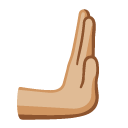

Appearance varies by platform and device. Google Noto, Twemoji, and OpenMoji are open-source.