🫸🏽
The Emoji
Rightwards Pushing Hand: Medium Skin Tone
U+1FAF8 U+1F3FD · :rightwards_pushing_hand_medium_skin_tone:
Trend 58
Meaning layers
- interpretation
- Used to push away negativity, set boundaries, or signal 'stay back' or 'not now' energy. Also used playfully to hype someone forward or pass energy to the next person.
- tiktok usage
- Appears in 'pushing' trends where users pass a vibe, emotion, or meme to the next person in duets or comment chains.
- irony level
- 4 / 10
Platform meanings
- meaning
- Represents pushing something away, passing a vibe or challenge to the next person, or setting a boundary in short-form video content.
- trend usage
- Used heavily in duet chains where creators 'pass' a trend, emotion, or curse to the right. Also used in boundary-setting storytimes.
- hashtags
- #pushinghands#passthevibe#boundarycheck#noentry#handemoji
- virality score
- 62 / 100
Cultural meanings
🇺🇸
Western / Gen-Z
Primarily used to set digital boundaries, pass meme energy, or signal assertive dismissal. Very common in TikTok and Twitter Gen Z discourse.
🇵🇰
Pakistan & India
Used in casual chats to say 'move aside', 'go away', or teasingly push someone in conversations. The skin tone medium representation resonates well here.
🌍
Middle East
Used to signal stopping, blocking, or redirecting — culturally aligns with the open-palm stop gesture common in the region.
🌐
Global Neutral
Broadly understood as a stop, push, or redirect gesture across cultures with minimal ambiguity.
🇧🇩
Bangladesh
Used colloquially to dismiss bad news or push away unwanted topics in chat conversations.
🇱🇰
Sri Lanka
Used similarly to a 'move along' or 'keep going' gesture in social media contexts.
🇨🇳
China
The rightward push can align with concepts of deflection or redirection; more commonly used in gaming and forwarding contexts than emotional ones.
🇯🇵
Japan
Associated with polite but firm refusal — the open palm is a culturally recognized stop gesture. Used in formal and informal digital contexts.
🇰🇷
South Korea
Frequently used in fan culture to 'push' idols or content forward, and also in meme formats involving rejection or boundary humor.
🇹🇼
Taiwan
Used in LINE and social media chats to signal blocking or pushing away drama, especially among younger users.
🇭🇰
Hong Kong
Common in WhatsApp and Telegram to tell someone to back off or redirect a conversation.
🇵🇭
Philippines
Used playfully in group chats to tease someone or push them into action, very common in casual Filipino internet humor.
🇮🇩
Indonesia
Used to signal dismissal or to push an idea forward in group chats, often paired with laughing emojis in humorous contexts.
🇹🇭
Thailand
Used on LINE messaging to signal 'not now' or to pass a conversation forward, often in friendly group chats.
🇻🇳
Vietnam
Appears in Zalo and Facebook conversations to signal pushing someone to act or dismissing a topic.
🇲🇾
Malaysia
Used in casual Malay internet slang contexts to say 'go away' or 'your turn', often with playful intent.
🇸🇦
Saudi Arabia
The open palm rightward push aligns with local gestures of dismissal or redirection; used digitally to signal 'stop' or 'move on'.
🇦🇪
UAE
Used in cosmopolitan social media contexts to signal boundary-setting or directing — common among youth in mixed cultural digital spaces.
🇪🇬
Egypt
Used on Facebook and WhatsApp to push back on opinions or direct someone away from a topic.
🇹🇷
Turkey
Used in Twitter and Instagram discourse to dismiss arguments or push back on trending bad takes.
🇮🇷
Iran
Primarily used on Instagram and Telegram to signal rejection, boundary-setting, or playful dismissal.
🇳🇬
Nigeria
Very common in playful banter — used to tell someone to 'shift' or move out of the way, with significant cultural resonance for the gesture.
🇿🇦
South Africa
Used across WhatsApp groups to signal dismissal, boundary-setting, or pushing someone to take action.
🇬🇧
UK & Ireland
Used with dry humor to dismiss people or ideas, fitting into British passive-aggressive digital communication styles.
🇫🇷
France
Used to signal intellectual dismissal or push back on ideas, sometimes with a sarcastic tone in online debates.
🇩🇪
Germany
Used straightforwardly to signal boundaries or direct action — German digital communication tends to use it more literally.
🇪🇸
Spain & Italy
Used in expressive, often humorous contexts to push away drama or tell someone to go ahead with something.
🇧🇷
Brazil
Heavily used in meme and humor contexts, often in chains and reaction content on Twitter and Instagram to push bad energy away.
🇲🇽
Mexico
Used in playful and meme-heavy contexts — common in group chats to tease or push someone to do something funny.
🌎
Latin America
Broadly used across Latin America to signal dismissal, playful redirection, or passing energy to someone else in digital conversations.
🇦🇺
Australia & NZ
Used casually with humor to tell someone to 'rack off' or push forward — fits into casual, self-deprecating Aussie digital humor.
How its meaning shifted
- 2010
Emoji of this type did not exist yet. Hand gesture emojis were extremely limited in this era.
- 2015
Basic hand emojis existed but pushing-specific gestures were not yet available. General hand wave emojis were used as proxies.
- 2020
Unicode added directional pushing hands around this time; adoption was gradual and usage was mostly literal (stop, push, direct).
- 2026
Now widely adopted in Gen Z communication for boundary-setting, meme chains, duet culture, and assertive digital expression. Skin tone variants are standard practice.
See it on every platform
Compare with
Adjacent emojis
- Often confused with
- waving handraised back of handopen hands
Share & embed
Frequently asked
01What does the 🫸🏽 Rightwards Pushing Hand: Medium Skin Tone emoji mean?
A hand with medium skin tone pushing or gesturing to the right, palm facing outward in a pushing motion.
02What does 🫸🏽 mean on TikTok?
Represents pushing something away, passing a vibe or challenge to the next person, or setting a boundary in short-form video content.
03What does 🫸🏽 mean on WhatsApp?
Stop, back off, or hold on — used to pause a conversation or push back on an idea.
04What does 🫸🏽 mean in Gen-Z slang?
Used to push away negativity, set boundaries, or signal 'stay back' or 'not now' energy. Also used playfully to hype someone forward or pass energy to the next person.
05Is the 🫸🏽 emoji safe to use?
Boundary-setting, stop gesture, pushing forward, redirecting, passing something on.
06What does 🫸🏽 mean in texting?
The pushing hand gesture is psychologically linked to self-protection and personal space enforcement. It can signal emotional distancing or active rejection without verbal confrontation.
07What is the shortcode for 🫸🏽?
The shortcode for Rightwards Pushing Hand: Medium Skin Tone is :rightwards_pushing_hand_medium_skin_tone:
08What does 🫸🏽 mean in dating?
Used playfully to 'push' a crush into making a move, like teasing 'your turn 🫸🏽'. Can also signify a flirty nudge.
Safety & usage
- Safe meaning
- Boundary-setting, stop gesture, pushing forward, redirecting, passing something on.
- Caution
- Can be used aggressively to dismiss or dehumanize someone by repeatedly pushing them away in arguments.
Generally safe. In certain contexts it can come across as dismissive or aggressive if used repeatedly in conflict situations. No known use in hate speech patterns.
How it looks across platforms
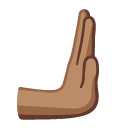

Appearance varies by platform and device. Google Noto, Twemoji, and OpenMoji are open-source.