🧑🎤
The Emoji
Singer
U+1F9D1 U+200D U+1F3A4 · :singer:
Trend 68
Meaning layers
- interpretation
- Used to express being in your main character era, feeling iconic, living dramatically, or channeling a rockstar attitude. Often signals a vibe shift or confidence moment.
- tiktok usage
- Dropped at the end of captions when someone is doing something bold or dramatic — 'quit my job and booked a solo trip 🧑🎤' — signals unbothered main character energy.
- irony level
- 5 / 10
Platform meanings
- meaning
- Symbol of main character energy, rockstar era announcements, bold life decisions, and artistic identity flex.
- trend usage
- Appears in transformation videos, 'new era' announcements, bold outfit reveals, and 'I did something chaotic' captions.
- hashtags
- #rockstarera#maincharacter#singervibe#newera#artsy
- virality score
- 72 / 100
Cultural meanings
🇺🇸
Western / Gen-Z
Heavily ironic and self-aware usage — signals 'I'm in my rockstar era' for any life situation. Core to main character and villain arc meme formats.
🇵🇰
Pakistan & India
Used literally to reference Bollywood playback singers, local musicians, and reality singing show contestants. Also used to hype friends who sing well.
🌍
Middle East
Primarily used to reference pop or nasheed artists, used in music fan communities and to celebrate talented vocalists.
🌐
Global Neutral
Universally understood as representing a singer or performer, used straightforwardly in music-related conversations.
🇧🇩
Bangladesh
Associated with folk, classical, and Bangla pop musicians. Used to tag music-related content and celebrate local vocal talent.
🇱🇰
Sri Lanka
Used to reference local pop and baila music artists, or to cheer on friends performing at school or community events.
🇨🇳
China
Used in fan communities (饭圈) for idol groups and solo singers, often paired with concert and album release announcements.
🇯🇵
Japan
Associated with J-pop, visual kei, and idol culture. Used by fan accounts and in concert anticipation posts with high sincerity.
🇰🇷
South Korea
Heavily used in K-pop fan communities to represent idol singers and performers. Often part of fan account branding and concert posts.
🇹🇼
Taiwan
Used to celebrate Mandopop artists and local music talent, particularly among younger fans engaged in artist fandom culture.
🇭🇰
Hong Kong
Associated with Cantopop legacy artists and new-wave local musicians. Used in both nostalgic and contemporary music fan contexts.
🇵🇭
Philippines
Used to celebrate OPM (Original Pilipino Music) artists and reality singing competition contestants, often with enthusiastic fan energy.
🇮🇩
Indonesia
Used in reference to dangdut, pop Indonesia, and indie music artists. Common in fan group chats and concert promotion posts.
🇹🇭
Thailand
Associated with Thai pop (T-pop) and indie music scenes. Used to celebrate artists and signal a cool, artistic identity online.
🇻🇳
Vietnam
Used to represent V-pop artists and local talent, often in fan pages and music competition reaction posts.
🇲🇾
Malaysia
Used for local pop and indie music references, often tied to Malay pop culture and regional music award discussions.
🇸🇦
Saudi Arabia
Carefully used — music culture is evolving rapidly post-2017 liberalization. Used in contexts of concerts and entertainment events by youth.
🇦🇪
UAE
Used in cosmopolitan contexts around Dubai concerts, international music events, and by the young multicultural population for music content.
🇪🇬
Egypt
Associated with iconic Egyptian pop tradition and modern Arabic pop artists. Used to celebrate singers like Amr Diab's legacy and new stars.
🇹🇷
Turkey
Used for Turkish pop (Türk pop) and arabesk music fans, as well as to signal theatrical or dramatic personality online.
🇮🇷
Iran
Used carefully in private messaging contexts for music discussions, as public music performance has restrictions, but underground music culture is vibrant.
🇳🇬
Nigeria
Used to celebrate Afrobeats, Afropop, and highlife artists, often dropped in fan discussions about artists like Burna Boy or Wizkid.
🇿🇦
South Africa
Associated with amapiano, kwaito, and South African pop artists. Used in music fan spaces and to hype local performers.
🇬🇧
UK & Ireland
Used to reference British pop, indie, grime, and alternative music artists. Also used ironically in the classic British deadpan style.
🇫🇷
France
Used for French pop (variété française) and electronic music artist references, with a slightly sophisticated or artsy connotation.
🇩🇪
Germany
Used straightforwardly for music references and Schlager or pop artist content, occasionally in ironic contexts in internet culture.
🇪🇸
Spain & Italy
Associated with passionate vocal performance culture — used to celebrate flamenco, opera-adjacent, and Latin/Italian pop artists.
🇧🇷
Brazil
Used in sertanejo, funk, and axé music fan communities, often with high energy to celebrate performers and concert moments.
🇲🇽
Mexico
Associated with mariachi, regional Mexican music, and pop artists. Used to celebrate local musical heritage and contemporary stars.
🌎
Latin America
Broadly used across Latin America to celebrate diverse regional music traditions and modern reggaeton/Latin pop artists.
🇦🇺
Australia & NZ
Used in a mix of sincere music fan contexts and ironic 'I'm the main character' humor. Common at music festival season online.
How its meaning shifted
- 2010
This emoji did not exist in 2010. Music performer concepts were represented with 🎤 or 🎸 alone.
- 2015
Still not introduced. Musician representation in emoji was limited to gendered options and instrument emojis.
- 2020
Newly introduced and gaining traction primarily in literal music contexts — fans using it for artist posts, singer bios, and concert content.
- 2026
Evolved into a versatile cultural signal used for main character energy, rockstar era announcements, dramatic irony, and artistic identity flex across all platforms.
See it on every platform
Emoji combinations
Adjacent emojis
- Often confused with
- dancerperforming artsclapper board
- Can replace
- microphonemusical notesparkles
Share & embed
Frequently asked
01What does the 🧑🎤 Singer emoji mean?
A person performing as a singer or rock star, depicted with a microphone and stylized appearance including spiked or wild hair and sometimes glam/punk styling.
02What does 🧑🎤 mean on TikTok?
Symbol of main character energy, rockstar era announcements, bold life decisions, and artistic identity flex.
03What does 🧑🎤 mean on WhatsApp?
Sent to acknowledge someone being dramatic, performing, or acting overly cool. Also used when sharing music-related news.
04What does 🧑🎤 mean in Gen-Z slang?
Used to express being in your main character era, feeling iconic, living dramatically, or channeling a rockstar attitude. Often signals a vibe shift or confidence moment.
05Is the 🧑🎤 emoji safe to use?
Represents performers, musicians, creative identity, and rockstar energy in a broadly positive way.
06What does 🧑🎤 mean in texting?
Tapping into performer archetypes, this emoji channels the psychological concept of 'stage self' — the idealized, bold version of oneself that performs without fear of judgment, often used when someone wants to signal they're embracing their boldest identity.
07What is the shortcode for 🧑🎤?
The shortcode for Singer is :singer:
08What does 🧑🎤 mean in dating?
Used to flirt by signaling a cool, artsy, edgy identity — 'just wrote a song about you 🧑🎤' carries low-key romantic creative energy.
Safety & usage
- Safe meaning
- Represents performers, musicians, creative identity, and rockstar energy in a broadly positive way.
- Caution
- Could be used mockingly to dismiss someone as dramatic, attention-seeking, or performatively over-the-top.
Generally very safe. In rare cases used to sarcastically label someone as a diva or attention-seeker, but this is mild and context-dependent.
How it looks across platforms
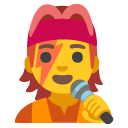


Appearance varies by platform and device. Google Noto, Twemoji, and OpenMoji are open-source.