🦸
The Emoji
Superhero
U+1F9B8 · :superhero:
Trend 68
Meaning layers
- interpretation
- Used to hype someone up for doing something admirable, brave, or unexpectedly helpful. Also deployed ironically for mundane 'heroic' acts like finishing homework or waking up on time.
- tiktok usage
- Appears in comment sections to praise creators who share vulnerable, brave, or inspiring content. Often used alongside other hype emojis in stan culture.
- irony level
- 5 / 10
Platform meanings
- meaning
- Praise emoji for creators doing something brave, vulnerable, or inspiring. Also used ironically in comment sections.
- trend usage
- Floods comment sections on motivational videos, mental health content, and self-improvement TikToks. Ironic use on 'I did the bare minimum' videos.
- hashtags
- #superhero#herovibes#capeless#everydayhero#hyped
- virality score
- 72 / 100
Cultural meanings
🇺🇸
Western / Gen-Z
Primarily used ironically for mundane everyday wins alongside genuine hype for people doing impressive things. Heavy in stan culture and motivational content.
🇵🇰
Pakistan & India
Used sincerely to praise family members, friends, or public figures who do something admirable or selfless. Also popular among Bollywood and cricket fans celebrating players.
🌍
Middle East
Associated with themes of bravery, honor, and protection. Used to praise individuals who stand up for family or community values.
🌐
Global Neutral
Universally understood as praise or admiration for someone doing something exceptional or helpful. Safe and widely recognized across cultures.
🇧🇩
Bangladesh
Used to celebrate achievers and community helpers. Common in group chats when someone solves a problem or helps others through difficulty.
🇱🇰
Sri Lanka
Appears in contexts celebrating local heroes and community leaders. Used among youth on social media to hype peers.
🇨🇳
China
Popular in gaming communities to praise skilled players. Also used in WeChat-equivalent platforms to celebrate academic or professional achievements.
🇯🇵
Japan
Tied to manga and anime hero culture. Used frequently in fan communities for shows like My Hero Academia. Carries strong connotations of self-sacrifice and duty.
🇰🇷
South Korea
Heavily used in K-pop fandoms to celebrate idols who show resilience or dedication. Also popular in gaming to praise clutch performances.
🇹🇼
Taiwan
Used in both fan culture and everyday conversation to praise someone who handled a situation exceptionally well.
🇭🇰
Hong Kong
Used to express admiration for individuals who stand up courageously under pressure, including in political and social contexts.
🇵🇭
Philippines
Frequently used to celebrate OFWs (Overseas Filipino Workers) as everyday heroes. Also appears in fan culture and gaming communities.
🇮🇩
Indonesia
Used to hype friends and celebrities. Popular in gaming communities and among fans of superhero films, with sincere and ironic usage both common.
🇹🇭
Thailand
Used to praise people who do kind or brave things. Also appears in K-pop fan spaces and gaming communities among Thai youth.
🇻🇳
Vietnam
Associated with bravery and helpful acts. Commonly used in gaming chats and among youth on TikTok-equivalent platforms.
🇲🇾
Malaysia
Used sincerely to appreciate helpers and community members. Also found in gaming and pop culture contexts among Malaysian youth.
🇸🇦
Saudi Arabia
Used to honor people who demonstrate courage, generosity, or leadership. Closely tied to values of protection and bravery in social contexts.
🇦🇪
UAE
Multicultural usage — both sincere praise and pop culture reference. Common in expat communities celebrating team achievements or kind acts.
🇪🇬
Egypt
Used to celebrate public figures, athletes, and everyday people who do something extraordinary. Associated with admiration and pride.
🇹🇷
Turkey
Found in gaming communities and among fans of superhero films. Also used sincerely to praise someone who helped in a difficult situation.
🇮🇷
Iran
Used among youth to praise peers online. Also tied to gaming culture and international pop culture fandoms despite content restrictions.
🇳🇬
Nigeria
Used to celebrate people who overcome adversity or lift others up. Strong association with community heroes and inspirational figures.
🇿🇦
South Africa
Used to honor community helpers, especially in contexts of social inequality and activism. Also popular in gaming and sports fan communities.
🇬🇧
UK & Ireland
Used with frequent irony and dry humor — calling yourself a hero for doing basic household tasks. Also sincere in praising NHS workers and community helpers.
🇫🇷
France
Used to celebrate acts of civic bravery or to mock someone overdramatizing their efforts. Carries both sincere and ironic tones.
🇩🇪
Germany
Often used more literally to recognize genuine achievement or helpfulness. Less ironic usage than English-speaking cultures.
🇪🇸
Spain & Italy
Used expressively to celebrate friends and family. High-energy and sincere in most contexts, especially around sports and personal achievements.
🇧🇷
Brazil
Used enthusiastically to hype up friends, athletes, and public figures. Common in football fan communities and among youth on TikTok-equivalent platforms.
🇲🇽
Mexico
Celebrates community helpers, family members, and athletes. Used in both sincere and playful contexts across social media.
🌎
Latin America
Broadly used to express admiration and celebrate those who go out of their way for others. Vibrant usage across gaming and pop culture communities.
🇦🇺
Australia & NZ
Used with characteristic Antipodean irony — often for self-deprecating 'heroic' acts. Also sincere in contexts celebrating community service and first responders.
How its meaning shifted
- 2010
The emoji did not exist yet. Hero concepts were expressed with star emojis, fist emojis, or described in text.
- 2015
Still not yet part of the Unicode standard. Superhero themes online relied on text references, GIFs, and other proxy emojis like ⚡ or 💪.
- 2020
Newly introduced and quickly adopted in the context of the COVID-19 pandemic to honor frontline workers. Marvel/DC film hype also drove adoption.
- 2026
Established dual identity — sincere praise emoji and ironic self-congratulation tool. Deeply embedded in hype culture, gaming, and fan communities globally.
See it on every platform
Emoji combinations
Adjacent emojis
- Opposite
- supervillainskullbroken heart
- Often confused with
- person in tuxedomagefairy
- Can replace
- flexed bicepsglowing starcrown
Share & embed
Frequently asked
01What does the 🦸 Superhero emoji mean?
A person wearing a superhero costume, often depicted with a cape, mask, and heroic pose. Represents extraordinary ability, bravery, and selfless action.
02What does 🦸 mean on TikTok?
Praise emoji for creators doing something brave, vulnerable, or inspiring. Also used ironically in comment sections.
03What does 🦸 mean on WhatsApp?
Sent to compliment someone who helped out or did something impressive in a group or personal chat.
04What does 🦸 mean in Gen-Z slang?
Used to hype someone up for doing something admirable, brave, or unexpectedly helpful. Also deployed ironically for mundane 'heroic' acts like finishing homework or waking up on time.
05Is the 🦸 emoji safe to use?
Praise, admiration, empowerment, celebration of bravery or helpfulness.
06What does 🦸 mean in texting?
Triggers feelings of idealization and inspiration. Psychologically linked to the human archetype of the hero, tapping into collective desires for protection, justice, and extraordinary capability.
07What is the shortcode for 🦸?
The shortcode for Superhero is :superhero:
08What does 🦸 mean in dating?
Sent to a crush to say 'you saved me' or 'you came to my rescue' — often after someone does something sweet or helpful. Playful and complimentary.
Safety & usage
- Safe meaning
- Praise, admiration, empowerment, celebration of bravery or helpfulness.
- Caution
- Occasionally used sarcastically to mock someone for taking undeserved credit or doing the bare minimum while expecting praise.
No significant safety concerns. Sarcastic usage is mild and generally understood in context. Not associated with harmful communities or coded toxic language.
How it looks across platforms
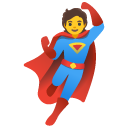


Appearance varies by platform and device. Google Noto, Twemoji, and OpenMoji are open-source.