🦹
The Emoji
Supervillain
U+1F9B9 · :supervillain:
Trend 74
Meaning layers
- interpretation
- Used to self-describe when doing something mischievous, petty, or delightfully evil — often with zero guilt. Also used to hype up someone being a chaotic legend or messy icon.
- tiktok usage
- Appears in POV videos where creators act as the villain of the story, or when calling themselves out for petty/chaotic behavior with pride.
- irony level
- 7 / 10
Platform meanings
- meaning
- Self-identifying as the chaotic or morally grey main character, often with dramatic music and slow-motion edits.
- trend usage
- Used in 'villain era' POV content, 'I'm not the main character I'm the villain' trends, and dark academia aesthetic videos.
- hashtags
- #VillainEra#Supervillain#VillainArc#ChaoticEnergy#NotTheHero
- virality score
- 78 / 100
Cultural meanings
🇺🇸
Western / Gen-Z
Deeply embedded in the 'villain era' self-empowerment meme — using it to celebrate setting boundaries, being petty, or prioritizing oneself without guilt.
🇵🇰
Pakistan & India
Used in social media to describe someone being dramatically clever or scheming; popular among younger users in Bollywood fandom contexts referencing iconic villains.
🌍
Middle East
Used mostly by younger, digitally active users to describe someone cunning or scheming; also tied to anime and superhero fandom communities.
🌐
Global Neutral
Universally understood as representing a villain or evil character, used for playful self-description of mischievous behavior.
🇧🇩
Bangladesh
Primarily used in youth digital culture to describe someone who is slyly clever or mischievous; also popular in DC/Marvel fan communities.
🇱🇰
Sri Lanka
Used among younger social media users to describe cunning or dramatic behavior, often in the context of local drama or cricket rivalries.
🇨🇳
China
Popular on platforms like Weibo and Bilibili in the context of anime villains and game antagonists; also used for 'I did something chaotic' admissions.
🇯🇵
Japan
Closely tied to anime villain aesthetics — used to describe the 'edgy anti-hero' or 'final boss' energy, often with dramatic flair.
🇰🇷
South Korea
Used in K-drama and webtoon fan communities to describe scheming antagonists; also popular in idol fandom when stans defend controversial behavior.
🇹🇼
Taiwan
Common in gaming and comics communities to signal villain character preferences; also used casually to describe someone being cleverly devious.
🇭🇰
Hong Kong
Used among younger netizens to describe someone being calculating or dramatically petty, often in entertainment gossip contexts.
🇵🇭
Philippines
Popular in hugot (emotional) posts and teleserye drama contexts — used when someone is doing something boldly messy or taking revenge.
🇮🇩
Indonesia
Used in K-drama and anime fan communities; also appears in meme culture when someone admits to being the 'antagonist' in a social situation.
🇹🇭
Thailand
Common in lakorn (Thai soap opera) fan communities and gaming circles to describe villain behavior; also used in playful self-deprecation online.
🇻🇳
Vietnam
Used in gaming communities and among manga/anime fans to represent antagonist energy; also used when joking about doing something strategically selfish.
🇲🇾
Malaysia
Popular in both Malay and Chinese-Malaysian youth communities to describe someone scheming or causing delightful chaos in group chats.
🇸🇦
Saudi Arabia
Used mostly by younger, English-literate social media users in gaming and comic contexts; less common in mainstream daily digital communication.
🇦🇪
UAE
Common among multicultural youth in Dubai and Abu Dhabi who consume Western pop culture; used in the 'villain era' self-empowerment sense.
🇪🇬
Egypt
Used among youth to describe a scheming or dramatically clever person; often appears in football (soccer) rivalry trash talk.
🇹🇷
Turkey
Popular in gaming, dizi (Turkish drama) fan communities, and meme pages to describe someone acting as the antagonist with flair.
🇮🇷
Iran
Used primarily in gaming and anime fan communities on platforms like Instagram; associated with powerful antagonist characters.
🇳🇬
Nigeria
Used in Afrobeats and Nollywood fan communities to describe someone acting like a dramatic, calculating antagonist — often with comedic respect.
🇿🇦
South Africa
Used in youth digital culture to describe someone being unapologetically bold or messy; also common in gaming communities.
🇬🇧
UK & Ireland
Used with heavy irony and dry humor — typically self-applied after doing something mildly shady or dramatically correct, very aligned with British sarcasm culture.
🇫🇷
France
Used mostly by younger, digitally active users familiar with English meme culture; sometimes used in gaming and comic contexts.
🇩🇪
Germany
Primarily used in gaming and superhero fan communities; the 'villain era' meme is understood but less organically created in German digital spaces.
🇪🇸
Spain & Italy
Common in gaming and comic book fandom circles; also used to describe someone being delightfully scheming in telenovela or soap drama contexts.
🇧🇷
Brazil
Heavily used in the 'era do vilão' meme trend — Brazilians enthusiastically embrace the villain era concept, especially in drama and relationship contexts.
🇲🇽
Mexico
Used in telenovela fan discourse and general social media drama — calling someone out as the villain of a story or self-declaring chaotic behavior.
🌎
Latin America
Broadly used across Latin America in the context of melodrama, gossip, and gaming — the villain energy resonates strongly with local telenovela culture.
🇦🇺
Australia & NZ
Used with casual irreverence and humor, often self-applied after doing something bluntly honest or unapologetically self-serving — fits the 'no nonsense' cultural tone.
How its meaning shifted
- 2010
Emoji did not exist yet; villain themes in digital communication were expressed through devil horns, skull, or text-based emoticons like >:)
- 2015
Pre-release era; villain emojis were not standardized — users relied on 😈 or 💀 for similar energy in digital villain discourse.
- 2020
Newly established and rapidly gaining traction alongside the 'villain era' meme trend on TikTok and Twitter; often used in COVID-era 'doing what I want' content.
- 2026
Firmly embedded in internet culture as the definitive symbol of 'villain era' self-empowerment, anti-hero aesthetics, and playful pettiness across all major platforms.
See it on every platform
Compare with
Adjacent emojis
- Opposite
- superheroface with halored heart
- Often confused with
- ninjaperson in tuxedomage
Share & embed
Frequently asked
01What does the 🦹 Supervillain emoji mean?
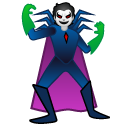
A masked villain character wearing a cape and dark costume, representing a supervillain or evil antagonist from comic books and pop culture.
02What does 🦹 mean on TikTok?
Self-identifying as the chaotic or morally grey main character, often with dramatic music and slow-motion edits.
03What does 🦹 mean on WhatsApp?
Signals mischief or that the sender is about to do something chaotic or dramatic.
04What does 🦹 mean in Gen-Z slang?
Used to self-describe when doing something mischievous, petty, or delightfully evil — often with zero guilt. Also used to hype up someone being a chaotic legend or messy icon.
05Is the 🦹 emoji safe to use?
Playful self-expression of mischief, chaotic energy, or villain aesthetic; used in fandom, gaming, and pop culture contexts.
06What does 🦹 mean in texting?
Taps into the shadow archetype — the part of the psyche that enjoys transgression, power, and chaos without social consequence. Used as an identity performance of controlled deviance.
07What is the shortcode for 🦹?
The shortcode for Supervillain is :supervillain:
08What does 🦹 mean in dating?
Used flirtatiously to signal someone is bad news but in a fun, seductive way — 'I'm the villain in this story and you know you want me 🦹'
Safety & usage
- Safe meaning
- Playful self-expression of mischief, chaotic energy, or villain aesthetic; used in fandom, gaming, and pop culture contexts.
- Caution
- Can be used to glorify genuinely harmful behavior, normalize manipulation or cruelty by framing it as 'villain energy,' or taunt victims in cyberbullying contexts.
Generally safe, but when paired with threatening language or used to mock victims of real-world harm, it can contribute to toxic dynamics. Context is critical.
How it looks across platforms


Appearance varies by platform and device. Google Noto, Twemoji, and OpenMoji are open-source.