🦹🏾
The Emoji
Supervillain: Medium-dark Skin Tone
U+1F9B9 U+1F3FE · :supervillain_mediumdark_skin_tone:
Trend 72
Meaning layers
- interpretation
- Used to describe someone who is unapologetically doing something shady, self-serving, or morally questionable — often worn as a badge of pride. Also used for 'villain era' content where someone embraces their ruthless or unbothered side.
- tiktok usage
- Appears in 'villain era' TikToks where creators showcase bold, selfish, or unbothered behavior they're proud of. Often paired with dramatic music and dark aesthetics.
- irony level
- 6 / 10
Platform meanings
- meaning
- Symbol of the villain era trend — owning bad behavior, dark aesthetics, or embracing a ruthless mindset without apology.
- trend usage
- Used in villain era transformation videos, dark academia content, and 'plot twist' storytimes where the creator reveals they did something morally ambiguous.
- hashtags
- #VillainEra#DarkEra#UnbotheredVibes#SupervillainSzn#NoMoreNiceGuy
- virality score
- 74 / 100
Cultural meanings
🇺🇸
Western / Gen-Z
Iconic symbol of the 'villain era' trend where individuals publicly embrace selfish, unbothered, or ruthless behavior as a form of empowerment. Widely used across all Gen Z social platforms as a badge of dark confidence.
🇵🇰
Pakistan & India
Used humorously among urban youth to describe someone being clever or manipulative in social situations, often referencing Bollywood villain archetypes. The medium-dark skin tone adds cultural relatability for South Asian users.
🌍
Middle East
Used among younger, digitally connected users to reference dramatic villainous behavior, often in the context of social media feuds or rivalry. The dark skin tone representation is noted positively in more diverse communities.
🌐
Global Neutral
Universally understood as representing a villain character, used to signal mischief, scheming, or a dark aesthetic across cultures with minimal misinterpretation.
🇧🇩
Bangladesh
Primarily used by younger social media users familiar with Western meme culture to signal cunning or mischievous behavior, sometimes referencing local drama. Less common among older demographics who may interpret it more literally.
🇱🇰
Sri Lanka
Used in social media circles among youth to humorously label someone as the 'villain' of a situation or story, often tied to local drama or gossip contexts.
🇨🇳
China
Less commonly used due to different emoji ecosystems and cultural references; when used, it maps loosely to cunning or scheming characters from wuxia and drama tropes. Skin tone diversity in emoji is less culturally emphasized.
🇯🇵
Japan
Associated with anime villain archetypes — the masked, cloaked antagonist figure resonates strongly with manga and anime culture. Often used by fans in cosplay and fictional character discussions.
🇰🇷
South Korea
Used in K-drama and webtoon fan communities to describe villain characters or 'second lead syndrome' antagonists. Also popular in idol fan communities when a celebrity does something unexpected or bold.
🇹🇼
Taiwan
Frequently used in online gaming and drama communities to label someone as the antagonist of a situation, drawing from local drama series and gaming culture.
🇭🇰
Hong Kong
Used in social contexts to describe someone acting ruthlessly or cleverly in competitive situations, often with humor. Has some resonance with Hong Kong action film villain aesthetics.
🇵🇭
Philippines
Very popular among Filipino youth on TikTok and Facebook to represent someone in their 'villain era' — a locally trending concept tied to self-empowerment and setting boundaries without apology.
🇮🇩
Indonesia
Used among Gen Z social media users to express being in a dark, unbothered mood, often paired with Indonesian slang. Resonates with local drama and sinetron villain character tropes.
🇹🇭
Thailand
Associated with lakorn (Thai soap opera) villain characters — the scheming antagonist is a beloved trope. Used playfully on social media when someone describes doing something calculated.
🇻🇳
Vietnam
Used among younger Vietnamese social media users to reference cunning or villain-like behavior, often in the context of online dramas or competitive situations.
🇲🇾
Malaysia
Common among Malaysian youth who follow global meme trends; used to describe someone in their villain era or doing something sneaky. The skin tone representation is appreciated in Malaysia's diverse demographic.
🇸🇦
Saudi Arabia
Used by younger Saudi social media users, particularly in gaming and entertainment contexts, to reference villain characters. Cultural modesty norms mean it's rarely used in flirtatious contexts.
🇦🇪
UAE
Popular in the UAE's cosmopolitan youth culture for expressing boldness and an unapologetic attitude, especially in entrepreneurial and social media contexts.
🇪🇬
Egypt
Used humorously in Egyptian social media to call out someone being cunning or petty, often with a dramatic flair consistent with Egyptian humor styles.
🇹🇷
Turkey
Used in Turkish social media to describe someone acting as the antagonist in a situation, often in the context of dizi (drama series) discussions where villain characters are popular.
🇮🇷
Iran
Among younger Iranian social media users, used to describe bold or unconventional behavior that defies social expectations, sometimes as an act of subtle resistance.
🇳🇬
Nigeria
Widely used in Nigerian social media and Afrobeats culture to describe someone being bold, cunning, or unapologetically self-serving — the 'Nollywood villain' aesthetic resonates strongly.
🇿🇦
South Africa
Used across South African social media platforms to signal someone in their villain era, with particular resonance in local pop culture discussions and meme communities.
🇬🇧
UK & Ireland
Used with typical British dry humor to describe someone doing something petty or slightly underhanded, often self-deprecatingly. Common in football banter and celebrity drama discussions.
🇫🇷
France
Used among French youth to describe someone being dramatically ruthless or theatrical in their behavior, often with a cinematic or artistic framing.
🇩🇪
Germany
Used more literally to reference supervillain characters in media discussions, though younger German users adopt it for villain era content following global trends.
🇪🇸
Spain & Italy
Popular among Spanish and Italian youth to describe dramatic, passionate, or over-the-top scheming behavior — fits well with the theatrical emotional expression common in these cultures.
🇧🇷
Brazil
Extremely popular in Brazilian meme culture and social media to describe someone being cunning, petty, or dramatically unbothered. Often appears in Brazilian TikTok villain era content.
🇲🇽
Mexico
Used in Mexican social media to describe someone acting as the 'malo' (bad one) in a situation, often with humor. Telenovela villain archetypes are a strong cultural reference.
🌎
Latin America
Broadly used across Latin America with connections to telenovela villain archetypes, representing someone who is scheming, dramatic, and unapologetically ruthless in social situations.
🇦🇺
Australia & NZ
Used by Australian and New Zealand youth in the villain era trend, often with laconic humor. Common in gaming communities and social media drama callouts.
How its meaning shifted
- 2010
This emoji did not exist in 2010; the supervillain emoji was not yet part of Unicode. General villain concepts were expressed with 😈 or 👺.
- 2015
Still pre-release; villain sentiments were conveyed through 😈, 💀, or text-based descriptions. The concept of a dedicated supervillain emoji was not yet available.
- 2020
Newly established after Unicode 11.0 (2018) adoption; gaining traction in meme culture alongside the rise of the 'villain era' trend and dark aesthetic aesthetics on TikTok and Instagram.
- 2026
Firmly embedded in villain era culture across all major platforms; the medium-dark skin tone version is celebrated for representation. Widely used in empowerment content, dark aesthetics, and self-aware mischief posts.
See it on every platform
Adjacent emojis
- Often confused with
- ninjaperson in stealthsmiling face with horns
- Can replace
- smiling face with hornsskulldetective
Share & embed
Frequently asked
01What does the 🦹🏾 Supervillain: Medium-dark Skin Tone emoji mean?
A person dressed as a supervillain with a mask and cape, shown with medium-dark skin tone. Represents evil, villainy, mischief, and antagonistic characters from comic books and pop culture.
02What does 🦹🏾 mean on TikTok?
Symbol of the villain era trend — owning bad behavior, dark aesthetics, or embracing a ruthless mindset without apology.
03What does 🦹🏾 mean on WhatsApp?
Signals that someone is up to something sneaky or mischievous, often used humorously between friends.
04What does 🦹🏾 mean in Gen-Z slang?
Used to describe someone who is unapologetically doing something shady, self-serving, or morally questionable — often worn as a badge of pride. Also used for 'villain era' content where someone embraces their ruthless or unbothered side.
05Is the 🦹🏾 emoji safe to use?
Represents fictional villainy, mischief, dark humor, and empowerment through the villain era trend. Widely used in pop culture, cosplay, and self-expression contexts.
06What does 🦹🏾 mean in texting?
Psychologically linked to the appeal of shadow-self expression — the emoji allows people to safely explore darker, more dominant aspects of identity. Often used as a coping mechanism to reclaim power after being wronged.
07What is the shortcode for 🦹🏾?
The shortcode for Supervillain: Medium-dark Skin Tone is :supervillain_mediumdark_skin_tone:
08What does 🦹🏾 mean in dating?
Used flirtatiously to hint at being a 'bad boy/girl' or someone who plays games, often in a playful 'I'm trouble but worth it' framing.
Safety & usage
- Safe meaning
- Represents fictional villainy, mischief, dark humor, and empowerment through the villain era trend. Widely used in pop culture, cosplay, and self-expression contexts.
- Caution
- Can be used to glorify genuinely harmful, manipulative, or abusive behavior by framing it as 'villain coded' and therefore cool or acceptable.
Monitor usage in contexts where 'villain era' framing is used to justify real-world harm, manipulation, or harassment. The emoji itself is benign but the cultural trend it represents can sometimes normalize toxic behavior patterns.
How it looks across platforms
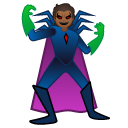


Appearance varies by platform and device. Google Noto, Twemoji, and OpenMoji are open-source.