🤸♀️
The Emoji
Woman Cartwheeling
U+1F938 U+200D U+2640 U+FE0F · :woman_cartwheeling:
Trend 68
Meaning layers
- interpretation
- Used to express unbothered energy, carefree attitude, or doing something despite the chaos — 'cartwheeling through life.' Also signals flexing physical confidence or hype.
- tiktok usage
- Appears in transition videos, gym content, and 'living my best life' montages; used in captions like 'me after surviving Monday 🤸♀️'
- irony level
- 4 / 10
Platform meanings
- meaning
- Energy, hype, carefree chaos, gym motivation, or ironic positivity
- trend usage
- Used in transition videos, cartwheel challenge content, and 'vibes only' captions; frequently pairs with POV and 'day in my life' formats
- hashtags
- #cartwheel#gymgirl#carefreevibes#livingmybestlife#gymnastics
- virality score
- 72 / 100
Cultural meanings
🇺🇸
Western / Gen-Z
A go-to emoji for expressing unbothered, carefree energy or ironic positivity — 'cartwheeling through the apocalypse' is a recognizable cultural shorthand.
🇵🇰
Pakistan & India
Used mostly literally for gymnastics or sports contexts; also sent by younger users to express excitement or 'living freely' which can carry a subtle rebellious undertone for women.
🌍
Middle East
Generally interpreted as a sports or fitness emoji; used in gym and wellness spaces but less common in casual chat due to cultural associations around women's physical expression in public.
🌐
Global Neutral
Universally understood as representing physical activity, joy, and energetic movement — safe and positive across most global contexts.
🇧🇩
Bangladesh
Primarily literal, associated with physical education and gymnastics; younger users may adopt Western Gen Z ironic usage through TikTok influence.
🇱🇰
Sri Lanka
Used in sports and fitness contexts; seen in school and youth community posts about physical activity and positivity.
🇨🇳
China
Associated with gymnastics — a nationally prestigious sport — so this emoji carries pride connotations; also used in lifestyle and fitness content on Douyin and WeChat.
🇯🇵
Japan
Linked to rhythmic gymnastics and energetic idol culture; used in cheerful, high-energy contexts and by fitness enthusiasts on social media.
🇰🇷
South Korea
Popular in K-fitness and wellness communities; signals an active lifestyle and positive energy, often used alongside motivational content on KakaoTalk and Instagram.
🇹🇼
Taiwan
Used in fitness and lifestyle content; Gen Z Taiwanese users adopt the emoji's ironic Western usage through global social media exposure.
🇭🇰
Hong Kong
Used casually for expressing good vibes and energetic happiness; appears in fitness and lifestyle posts with cosmopolitan digital culture influence.
🇵🇭
Philippines
Widely used in upbeat social media content; signals happiness, carefree energy, and positivity — very common in Filipina fitness and lifestyle creator content.
🇮🇩
Indonesia
Used in fitness and motivational contexts; younger users increasingly adopt ironic usage influenced by global TikTok trends.
🇹🇭
Thailand
Associated with cheerful, energetic expression; used in fitness content and by lifestyle influencers signaling a fun, active persona.
🇻🇳
Vietnam
Appears in sports, fitness, and motivational content; younger Vietnamese social media users use it to express carefree joy.
🇲🇾
Malaysia
Used across fitness and lifestyle posts; signals positivity and an active mindset, common among younger multilingual social media users.
🇸🇦
Saudi Arabia
Primarily used in sports and women's empowerment contexts, especially post-2017 social reform era; carries a positive, progressive undertone for women in fitness spaces.
🇦🇪
UAE
Used by the cosmopolitan, fitness-forward population to signal active living and positive energy; common in Dubai-based lifestyle influencer content.
🇪🇬
Egypt
Used mostly in sports and youth fitness contexts; also deployed by younger Egyptians for ironic positivity influenced by global meme culture.
🇹🇷
Turkey
Common in fitness and lifestyle content; younger Turkish users adopt the emoji's playful ironic usage through TikTok and Instagram trends.
🇮🇷
Iran
Used in private or diaspora social media spaces to express freedom and carefree joy — can carry subtle symbolic meaning of liberation for Iranian women.
🇳🇬
Nigeria
Popular in celebratory and motivational contexts; Nigerian Gen Z users use it to signal winning, thriving, and living boldly.
🇿🇦
South Africa
Used in fitness, lifestyle, and feel-good posts; signals positive energy and an active, joyful life — common in Cape Town and Johannesburg lifestyle content.
🇬🇧
UK & Ireland
Used sarcastically and ironically almost as often as sincerely; common British usage includes pairing with self-deprecating humor about surviving difficult situations.
🇫🇷
France
Used in sports and wellness contexts; French users also deploy it with characteristic ironic detachment in response to absurd everyday situations.
🇩🇪
Germany
Mostly literal — associated with sports and physical fitness; German social media culture tends toward sincere rather than ironic emoji usage.
🇪🇸
Spain & Italy
Used expressively to convey excitement, joy, and celebratory energy; fits well within the emotionally expressive Mediterranean digital communication style.
🇧🇷
Brazil
High-energy usage — Brazilians use this emoji enthusiastically in celebration, fitness, and carnival-adjacent content; very fitting for the culturally movement-positive Brazilian context.
🇲🇽
Mexico
Used in celebratory, joyful, and fitness contexts; Mexican youth culture embraces the carefree energy this emoji projects.
🌎
Latin America
Broadly used across Latin America to signal joy, physical confidence, and celebratory moments — fits the region's expressive digital communication culture.
🇦🇺
Australia & NZ
Used casually and often ironically; Australians deploy it in beach, sports, and outdoor content as well as in the classic 'absolutely thriving in chaos' usage.
How its meaning shifted
- 2010
Emoji did not exist yet; gymnastics and physical activity were represented through text emoticons or generic sport emojis.
- 2015
Emoji introduced in 2016, so not yet available; anticipation building as Unicode expanded sports emoji representation.
- 2020
Established as a fitness and positive energy emoji; increasingly used in TikTok and Instagram fitness content during the pandemic home workout era.
- 2026
Widely adopted as both a sincere fitness/lifestyle emoji and an ironic 'unbothered while everything is on fire' symbol; deeply embedded in Gen Z and Millennial meme vocabulary.
See it on every platform
Compare with
Adjacent emojis
- Often confused with
- man cartwheelingperson doing cartwheelwoman gymnastics
- Can replace
- woman dancingwoman runningsparkles
Share & embed
Frequently asked
01What does the 🤸♀️ Woman Cartwheeling emoji mean?
A woman performing a cartwheel, depicted as a gymnast or acrobat in motion with arms and legs extended.
02What does 🤸♀️ mean on TikTok?
Energy, hype, carefree chaos, gym motivation, or ironic positivity
03What does 🤸♀️ mean on WhatsApp?
Expressing excitement, happiness, or that someone is in a great mood
04What does 🤸♀️ mean in Gen-Z slang?
Used to express unbothered energy, carefree attitude, or doing something despite the chaos — 'cartwheeling through life.' Also signals flexing physical confidence or hype.
05Is the 🤸♀️ emoji safe to use?
Represents physical activity, joy, gymnastics, carefree energy, and positive celebration.
06What does 🤸♀️ mean in texting?
Cartwheeling is associated with childlike freedom and uninhibited movement; psychologically it evokes nostalgia for carefree youth and a sense of exuberant self-expression.
07What is the shortcode for 🤸♀️?
The shortcode for Woman Cartwheeling is :woman_cartwheeling:
08What does 🤸♀️ mean in dating?
Playfully used to show off physical confidence or hint at flexibility — sometimes flirtatious in a lighthearted way without being overtly sexual.
Safety & usage
- Safe meaning
- Represents physical activity, joy, gymnastics, carefree energy, and positive celebration.
- Caution
- Occasionally used passive-aggressively to mock someone's misfortune — e.g., celebrating an enemy's downfall with performative cheerfulness.
Very low risk emoji; rarely weaponized. The flexibility angle can occasionally appear in mildly flirtatious contexts but is not inherently inappropriate.
How it looks across platforms
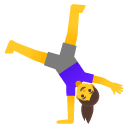
Appearance varies by platform and device. Google Noto, Twemoji, and OpenMoji are open-source.